


Strategies for improving adherence to antiepileptic drug treatment in people with epilepsy
- PMID: 33089492
- PMCID: PMC8092477
- DOI: 10.1002/14651858.CD008312.pub4
Strategies for improving adherence to antiepileptic drug treatment in people with epilepsy
Abstract
Background: Poor adherence to antiepileptic medication is associated with increased mortality, morbidity and healthcare costs. In this review, we focus on interventions designed and tested in randomised controlled trials (RCTs) and quasi-RCTs to assist people with adherence to antiepileptic medication. This is an update of a Cochrane review first published in 2011, and last updated in 2017.
Objectives: To determine the effectiveness of interventions aimed at improving adherence to antiepileptic medication in adults and children with epilepsy.
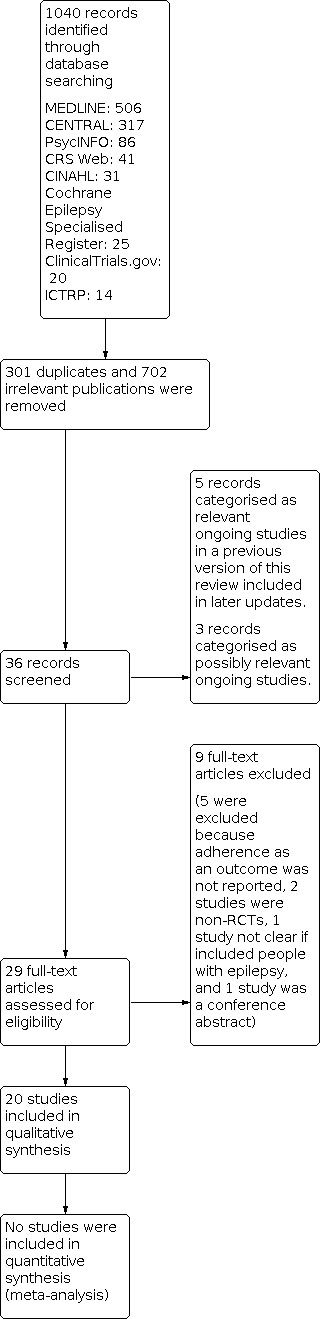
Search methods: For the latest update, we searched the following databases on 18 February 2020: Cochrane Register of Studies (CRS Web), MEDLINE, CINAHL Plus and PsycINFO. CRS Web includes RCTs or quasi-RCTs from PubMed, Embase, ClinicalTrials.gov, the World Health Organization International Clinical Trials Registry Platform (ICTRP), CENTRAL, and the Specialized Registers of Cochrane Review Groups including Epilepsy. We also searched the reference lists of relevant articles.
Selection criteria: RCTs and quasi-RCTs of adherence-enhancing interventions aimed at people with a clinical diagnosis of epilepsy (as defined in individual studies), of any age and treated with antiepileptic drugs in a primary care, outpatient or other community setting.
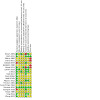
Data collection and analysis: All review authors independently assessed lists of potentially relevant citations and abstracts. At least two review authors independently extracted data and performed a quality assessment of each study according to the Cochrane tool for assessing risk of bias. We graded the level of evidence for each outcome according to GRADE. The studies differed widely according to the type of intervention and measures of adherence; therefore combining data was not appropriate.
Main results: We included 20 studies reporting data on 2832 participants. Thirteen studies targeted adults with epilepsy, one study included participants of all ages, one study included participants older than two years, one recruited pediatric patients aged between 1 month to 15 years, one study targeted caregivers of children with epilepsy, one targeted adolescents and caregivers, and two studies targeted families of children with epilepsy. We identified three ongoing studies. Follow-up time was generally short in most studies, ranging from 1 to 12 months. The studies examined three main types of interventions: educational interventions, behavioural interventions and mixed interventions. All but three studies compared treatment with usual care or 'no intervention'. Due to heterogeneity between studies in terms of interventions, methods used to measure adherence and the way the studies were reported, we did not pool the results and these findings were inappropriate to be included in a meta-analysis. Education and counselling of participants with epilepsy had mixed success (moderate-certainty evidence). Behavioural interventions such as the use of intensive reminders provided more favourable effects on adherence (moderate-certainty evidence). The effect on adherence to antiepileptic drugs described by studies of mixed interventions showed improved adherence in the intervention groups compared to the control groups (high-certainty evidence). Eleven studies described seizure frequency or seizure severity or both, with four of them, reporting improved adherence and decreased seizure frequency in the intervention groups (moderate-certainty evidence). Findings related to self-efficacy and quality of life were mixed, with no clear pattern across types of intervention.
Authors' conclusions: Behavioural interventions such as intensive reminders and the use of mixed interventions demonstrate some positive results, however, we need more reliable evidence on their efficacy, derived from carefully-designed RCTs before we can draw a firm conclusion. None of the newly included studies have provided additional information that would lead to significant changes in our conclusions.
Trial registration: ClinicalTrials.gov NCT01851057 NCT02165306 NCT02015806.
Copyright © 2020 The Cochrane Collaboration. Published by John Wiley & Sons, Ltd.
Conflict of interest statement
Alaqeel S: none known
Olga Gershuni: none known
Jawza Al‐sabhan: none known
Mickael Hiligsmann has received research grants through his institution from Amgen, Bayer and Radius Health.
Figures
Update of
-
Strategies for improving adherence to antiepileptic drug treatment in people with epilepsy.Cochrane Database Syst Rev. 2017 Feb 3;2(2):CD008312. doi: 10.1002/14651858.CD008312.pub3. Cochrane Database Syst Rev. 2017. Update in: Cochrane Database Syst Rev. 2020 Oct 22;10:CD008312. doi: 10.1002/14651858.CD008312.pub4. PMID: 28157274 Free PMC article. Updated.
References
References to studies included in this review
Brown 2009 {published data only}
Dash 2015 {published data only}
DiIorio 2009 {published data only}
Dilorio 2011 {published data only}
Edward 2019 {published data only}
Helgeson 1990 {published data only}
Ibinda 2014 {published data only}
Leenen 2018 {published data only}
-
- Leenen LA, Wijnen BF, Kessels AG, Chan H, Kinderen RJ, Evers SM, et al. Effectiveness of a multicomponent self-management intervention for adults with epilepsy (ZMILE study): a randomized controlled trial. Epilepsy & Behavior 2018;80:259-65. [DOI: 10.1016/j.yebeh.2018.01.019] [PMID: ] - DOI - PubMed
Li 2013 {published data only}
Modi 2013 {published data only}
Modi 2016a {published data only}
Modi 2016b {published data only}
Pakpour 2015 {published data only}
Peterson 1984 {published data only}
Pryse‐Phillips 1982 {published data only}
Ridsdale 2018 {published data only}
-
- Magill N, Ridsdale L, Goldstein LH, McCrone P, Morgan M, Noble AJ, et al. Self-management education for adults with poorly controlled epilepsy (SMILE (UK)): statistical, economic and qualitative analysis plan for a randomised controlled trial. Trials 2015;16:269. [DOI: 10.1186/s13063-015-0788-9] [PMID: ] - DOI - PMC - PubMed
-
- Ridsdale L, Wojewodka G, Robinson EJ, Noble AJ, Morgan M, Taylor SJ, et al. The effectiveness of a group self-management education course for adults with poorly controlled epilepsy, SMILE (UK): a randomized controlled trial. Epilepsia 2018;59(5):1048–61. [DOI: 10.1111/epi.14073] [PMID: ] - DOI - PMC - PubMed
Saengow 2018 {published data only}
-
- Saengow VE, Chancharoenchai P, Saartying W, Pimpa W, Chotichanon N, Lewsirirat T, et al. Epilepsy video animation: impact on knowledge and drug adherence in pediatric epilepsy patients and caregivers. Clinical Neurology and Neurosurgery 2018;172:59-61. [DOI: 10.1016/j.clineuro.2018.06.031] [PMID: ] - DOI - PubMed
Shope 1980 {published data only}
Tang 2014 {published data only}
Zheng 2019 {published data only}
-
- Zheng Y, Ding X, Guo Y, Chen Q, Wang W, Zheng Y, et al. Multidisciplinary management improves anxiety, depression, medication adherence, and quality of life among patients with epilepsy in eastern China: a prospective study. Epilepsy & Behavior 2019;100(Pt A):106400. [DOI: 10.1016/j.yebeh.2019.07.001 ] [PMID: ] - PubMed
References to studies excluded from this review
Adamolekun 1999 {published data only}
Boggs 2007 {unpublished data only}
-
- Boggs J, DeToledo J. Compliance with once-daily divalproex extended-release tablets (Depakote-ER) versus multiple-daily dose valproic acid capsules (Depakene) in epilepsy. Epilepsia 2007;48 Suppl 6:340-1, Abstract no: 3.251.
Choudhry 2017 {published data only}
Cramer 1995 {published data only}
Lewis 1990 {published data only}
May 2002 {published data only}
McLaughlin 2011 {published data only}
-
- McLaughlin DP, McFarland K. A randomized trial of a group based cognitive behavior therapy program for older adults with epilepsy: the impact on seizure frequency, depression and psychosocial well-being. Journal of Behavioral Medicine 2011;34(3):201-7. [DOI: 10.1007/s10865-010-9299-z] [PMID: ] - DOI - PubMed
Ridsdale 1997 {published data only}
References to ongoing studies
NCT02646631 {published data only}
-
- NCT02646631. Behavioral and educational tools to improve epilepsy care. clinicaltrials.gov/ct2/show/study/NCT02646631 (first received 24 December 2018).
NCT03484039 {published data only}
-
- NCT03484039. Incorporating multidimensional psychosocial interventions improves the well-being of individuals with epilepsy [The Epilepsy Wellness Center: incorporating multidimensional self-management psychosocial interventions in epilepsy care improves the well-being of individuals with epilepsy: a feasibility and proof-of-concept study]. clinicaltrials.gov/ct2/show/study/NCT03484039 (first received 30 March 2018).
Additional references
Baker 1997
-
- Baker GA, Jacoby A, Buck D, Stalgis C, Monnet D. Quality of life of people with epilepsy: a European study. Epilepsia 1997;38(3):353-62. [PMID: ] - PubMed
Briesacher 2008
Cramer 2008
da Mota Gomes 2017
Davis 2008
-
- Davis KL, Candrilli SD, Edin HM. Prevalence and cost of non adherence with antiepileptic drugs in an adult managed care population. Epilepsia 2008;49(3):446-54. [PMID: ] - PubMed
Deeks 2019
-
- Deeks JJ, Higgins JP, Altman DG (editors). Chapter 10: Analysing data and undertaking meta-analyses. In: Higgins JP, Thomas J, Chandler J, Cumpston M, Li T, Page MJ, et al (editors). Cochrane Handbook for Systematic Reviews of Interventions version 6.0 (updated July 2019). Cochrane, 2019. Available from www.training.cochrane.org/handbook.
DiMatteo 2004
Eatock 2007
Ettinger 2009a
-
- Ettinger AB, Baker GA. Best clinical and research practice in epilepsy of older people: focus on antiepileptic drug adherence. Epilepsy & Behavior 2009;15 Suppl 1:S60-3. [PMID: ] - PubMed
Ettinger 2009b
-
- Ettinger AB, Manjunath R, Candrilli SD, Davis KL. Prevalence and cost of non adherence to antiepileptic drugs in elderly patients with epilepsy. Epilepsy & Behavior 2009;14(2):324-9. [PMID: ] - PubMed
Faught 2008
-
- Faught E, Duh MS, Weiner JR, Guerin A, Cunnington MC. Nonadherence to antiepileptic drugs and increased mortality: findings from the RANSOM Study. Neurology 2008;71(20):1572-8. [PMID: ] - PubMed
Fisher 2005
-
- Fisher RS, Van Emde Boas W, Blume W, Elger C, Genton P, Lee P, et al. Epileptic seizures and epilepsy: definitions proposed by the International League Against Epilepsy (ILAE) and the International Bureau for Epilepsy (IBE). Epilepsia 2005;46(4):470-2. [PMID: ] - PubMed
Glanville 2019
GRADEpro GDT [Computer program]
-
- McMaster University (developed by Evidence Prime) GRADEpro GDT. Version accessed 1 June 2020. Hamilton (ON): McMaster University (developed by Evidence Prime). Available at gradepro.org.
Higgins 2003
Higgins 2004
Higgins 2017
-
- Higgins JP, Altman DG, Sterne JA (editors). Chapter 8: Assessing risk of bias in included studies. In: Higgins JP, Churchill R, Chandler J, Cumpston MS (editors). Cochrane Handbook for Systematic Reviews of Interventions version 5.2.0 (updated June 2017), Cochrane, 2017. Available from www.training.cochrane.org/handbook.
Hovinga 2008
-
- Hovinga CA, Asato MR, Manjunath R, Wheless JW, Phelps SJ, Sheth RD, et al. Association of non-adherence to antiepileptic drugs and seizures, quality of life, and productivity: survey of patients with epilepsy and physicians. Epilepsy & Behavior 2008;13(2):316-22. [DOI: 10.1016/j.yebeh.2008.03.009] [PMID: ] - DOI - PubMed
Kirkham 2010
Lefebvre 2019
-
- Lefebvre C, Glanville J, Briscoe S, Littlewood A, Marshall C, Metzendorf M-I, et al. Technical supplement to chapter 4: Searching for and selecting studies. In: Higgins JP, Thomas J, Chandler J, Cumpston MS, Li T, Page MJ, et al (Eds). Cochrane Handbook for Systematic Reviews of Interventions Version 6. Cochrane, 2019. Available from www.training.cochrane.org/handbook.
Lehane 2006
Malek 2017
Manjunath 2009
-
- Manjunath R, Davis KL, Candrilli SD, Ettinger AB. Association of antiepileptic drug non adherence with risk of seizures in adults with epilepsy. Epilepsy & Behavior 2009;14(2):372-8. [PMID: ] - PubMed
Moher 1999
-
- Moher D, Cook DJ, Eastwood S, Olkin I, Rennie D, Stroup DF. Improving the quality of reports of meta-analyses of randomised controlled trials: the QUOROM statement. Quality of Reporting of Meta-analyses. Lancet 1999;354(9193):1896-900. [PMID: ] - PubMed
Ngugi 2011
Nichol 1999
Nieuwlaat 2014
Paschal 2008
Peterson 2003
Rand 2000
Review Manager 2014 [Computer program]
-
- Nordic Cochrane Centre, The Cochrane Collaboration Review Manager 5 (RevMan 5). Version 5.3. Copenhagen: Nordic Cochrane Centre, The Cochrane Collaboration, 2014.
Roter 1998
Sander 2003
-
- Sander JW. The epidemiology of epilepsy revisited. Current Opinion in Neurology 2003;16(2):165-70. [PMID: ] - PubMed
Schedlbauer 2010
Schroeder 2004
Schünemann 2013
-
- Schünemann H, Brożek J, Guyatt G, Oxman A, editor(s). Handbook for grading the quality of evidence and the strength of recommendations using the GRADE approach (updated October 2013). GRADE Working Group, 2013. Available from gdt.guidelinedevelopment.org/app/handbook/handbook.html.
Sieber 2000
Vermeire 2001
Vermeire 2005
-
- Vermeire EI, Wens J, Van Royen P, Biot Y, Hearnshaw H, Lindenmeyer A. Interventions for improving adherence to treatment recommendations in people with type 2 diabetes mellitus. Cochrane Database of Systematic Reviews 2005, Issue 2. Art. No: CD003638. [DOI: 10.1002/14651858.CD003638.pub2] - DOI - PMC - PubMed
