


Individual and contextual factors associated with mistimed and unwanted pregnancies among adolescent girls and young women in selected high fertility countries in sub-Saharan Africa: A multilevel mixed effects analysis
- PMID: 33091050
- PMCID: PMC7580885
- DOI: 10.1371/journal.pone.0241050
Individual and contextual factors associated with mistimed and unwanted pregnancies among adolescent girls and young women in selected high fertility countries in sub-Saharan Africa: A multilevel mixed effects analysis
Abstract
Introduction: Unintended pregnancies are associated with a number of risk factors such as malnutrition, mental illness, unsafe abortion, maternal mortality and horizontal transmission of HIV to children. These risks are predominant among adolescent girls and young women compared to older women. This study examined the individual and contextual factors associated with unintended pregnancy among adolescent girls and young women in selected high fertility countries in sub-Saharan Africa.
Materials and methods: Data for this study was obtained from recent Demographic and Health Surveys carried out between 2010 and 2018 in 10 countries in sub-Sahara Africa. The sample size for this study was made up of 6,791 adolescent girls and young women (aged 15-24), who were pregnant during the surveys and had complete responses on all the variables considered in the study. Unintended pregnancy was the outcome variable in this study. Descriptive and multilevel logistic regression analyses were performed and the fixed effect results of the multilevel logistic regression analysis were reported as adjusted odds ratios at 95% confidence interval.
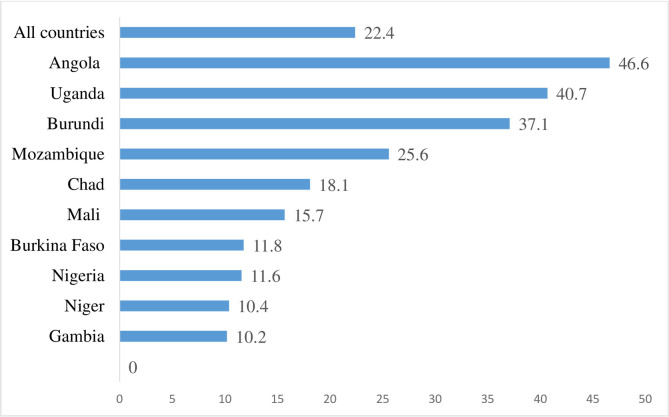
Results: Unintended pregnancy in the selected countries was 22.4%, with Angola, recording the highest prevalence of 46.6% while Gambia had the lowest prevalence of 10.2%. The likelihood of unintended pregnancy was high among adolescent girls and young women aged 15-19 [aOR = 1.48; 95% CI = 1.26-1.73], those with primary [aOR = 1.99; 95% CI = 1.69-2.33] and secondary/higher [aOR = 2.30; 95% CI = 1.90-2.78] levels of education, single (never married/separated/divorced/widowed) adolescent girls and young women [aOR = 9.23; 95% CI = 7.55-11.28] and those who were cohabiting [aOR = 2.53; 95% CI = 2.16-2.96]. The odds of unintended pregnancy also increased with increasing birth order, with adolescent girls and young women having three or more births more likely to have unintended pregnancies compared to those with one birth [aOR = 1.99; 95% CI = 1.59-2.48]. Adolescent girls and young women who had ever used contraceptives (modern or traditional), had higher odds of unintended pregnancies compared to those who had never used contraceptives [aOR = 1.32; 95% CI = 1.12-1.54]. Finally, adolescent girls and young women who belonged to the rich wealth quintile were more likely to have unintended pregnancy compared to those in the poor wealth quintile [1.28; 95% CI = 1.08-1.51].
Conclusion: The study found that age, marital status, level of education, parity, use of contraceptives and wealth quintile are associated with unintended pregnancy among adolescent girls and young women in high fertility sub-Saharan African countries. These findings call for the need for government and non-governmental organisations in high fertility sub-Saharan African countries to restructure sexual and reproductive health services, taking into consideration these individual and contextual level characteristics of adolescent girls and young women.
Conflict of interest statement
The author has declared that no competing interests exist.
Figures
References
-
- Geda YF. Determinants of teenage pregnancy in Ethiopia: A Case–control study, 2019. Current Medical Issues. 2019;17(4):112.
-
- Tsui AO, Wasserheit JN, Haaga JG, National Research C. Reproductive health in developing countries: expanding dimensions, building solutions: National Academies Press; (US: ); 1997. - PubMed
-
- Bongaarts J. Trends in unwanted childbearing in the developing world. Studies in Family planning. 1997:267–77. - PubMed
MeSH terms
LinkOut - more resources
Full Text Sources
Miscellaneous
