


[Epidemiological specificities of COVID-19 in Africa: Current or future public health concern?]
- PMID: 33091399
- PMCID: PMC7571419
- DOI: 10.1016/j.pharma.2020.10.011
[Epidemiological specificities of COVID-19 in Africa: Current or future public health concern?]
Abstract
Objectives: Africa is the continent which is the least equipped to fight the COVID-19 epidemic. However, Africa, which represents 17 % of the world's population, is estimated to have only 5 % of global cases (source: WHO on 2020/08/04). In this work, the authors try to identify and understand the reasons for these epidemiological data.
Method: Some follow-up indicators have been carried out, mainly through WHO reports. These data were compared with the literature and the field expertise of the association "Biologie sans frontières" in Africa.
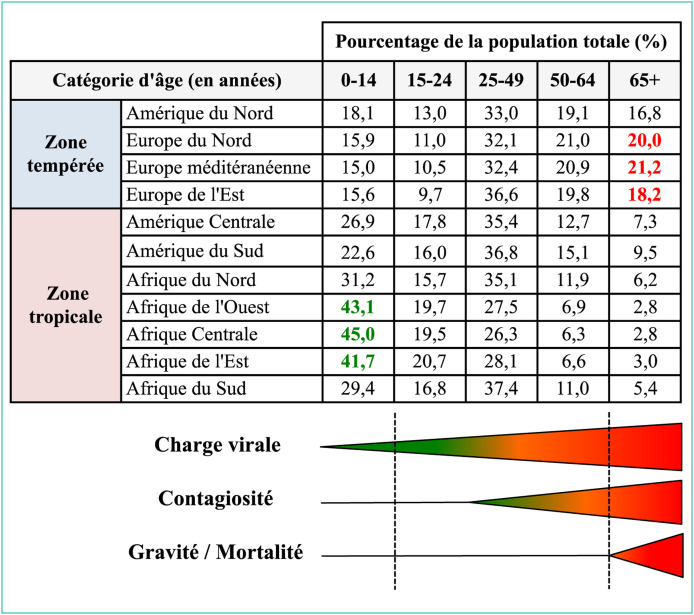
Results: The following points mark the particularity of COVID-19 in Africa: (1) insufficient diagnostic capacity (linked to gross national product), (2) a younger population limiting the population at risk and the number of deaths, (3) a favourable climate (hot and humid) which is decreasing viral transmission, (4) some socio-cultural factors that can reduce cases reporting.
Conclusion: Today, this health crisis is omnipresent while the number of deaths remains limited in Africa. Simultaneously, actions concerning African public health priorities (malaria, diarrhoea, AIDS…) are interrupted or slowed down.
Objectifs: L’Afrique est le continent le moins armé pour lutter contre l’épidémie de COVID-19. Cependant, l’Afrique qui regroupe 17 % de la population mondiale, ne pèserait que 5 % des cas mondiaux (source : OMS à la date du 04/08/2020). Dans ce travail, les auteurs essaient d’identifier et de comprendre les raisons de ces données épidémiologiques.
Méthode: De nombreux suivis d’indicateurs ont été réalisés grâce principalement aux rapports de l’OMS. Ces données ont été confrontées à la littérature, ainsi qu’à l’expertise de terrain de l’association « biologie sans frontières » en Afrique.
Résultats: Les points suivants marquent la singularité de la COVID-19 en Afrique : (1) une capacité diagnostique insuffisante liée au produit intérieur brut, (2) une population jeune réduisant la population à risque et le nombre de décès, (3) un climat favorable (chaud et humide) limitant la transmission virale, (4) de nombreux facteurs socioculturels pouvant limiter la déclaration des cas.
Conclusion: Aujourd’hui, cette crise sanitaire est médiatiquement omniprésente alors que le nombre de décès reste limité en Afrique. En parallèle, des actions concernant les réelles priorités de santé publique africaines (paludisme, diarrhées, SIDA…) sont ralenties ou interrompues.
Keywords: Africa; Afrique; COVID-19; Capacité diagnostique; Climat; Climate; Demography; Diagnostic capacity; Démographie; GDP; PIB.
Copyright © 2020 Académie Nationale de Pharmacie. Published by Elsevier Masson SAS. All rights reserved.
Figures


References
-
- Organisation Mondiale de la Santé . 2020. COVID-19 – Chronologie de l’action de l’OMS. [Internet], [cited 2020 Jun 16]. Available from: https://www.who.int/fr/news-room/detail/27-04-2020-who-timeline---covid-19.
-
- Organisation Mondiale de la Santé . 2020. WHO Statement regarding cluster of pneumonia cases in Wuhan, China. [Internet], [cited 2020 Jun 16]. Available from: https://www.who.int/china/news/detail/09-01-2020-who-statement-regarding....
-
- Organisation Mondiale de la Santé . 2020. Novel Coronavirus – China. [Internet], [cited 2020 Jun 16]. Available from: https://www.who.int/csr/don/12-january-2020-novel-coronavirus-china/en/
-
- Organisation des Nations Unies . 2020. L’épidémie de coronavirus est désormais une pandémie, estime l’OMS. [cited 2020 Jun 16]. Available from: https://news.un.org/fr/story/2020/03/1063761.
-
- Organisation Mondiale de la Santé . 2020. Coronavirus disease 2019 (COVID-19) Situation Report - 197. [Internet], [cited 2020 Oct 7]. Available from https://www.who.int/docs/default-source/coronaviruse/situation-reports/2....
MeSH terms
LinkOut - more resources
Full Text Sources
Other Literature Sources
Medical
