Meta-Analysis
. 2020 Oct 20;12(10):3201.
doi: 10.3390/nu12103201.

Breakfast Characteristics and Its Association with Daily Micronutrients Intake in Children and Adolescents-A Systematic Review and Meta-Analysis

Affiliations
Meta-Analysis

Breakfast Characteristics and Its Association with Daily Micronutrients Intake in Children and Adolescents-A Systematic Review and Meta-Analysis

Natalia Giménez-Legarre et al. Nutrients. .

Abstract

Breakfast is an important source of key nutrients in the diet. For this reason, the aim of this review was to investigate the associations between breakfast consumption and daily micronutrients intake in both children and adolescents (aged 2-18 years). A peer-reviewed systematic search was conducted in three datasets (PubMed, Scopus and Cochrane Library) in February 2020 in English and Spanish. Two independent reviewers evaluated 3188 studies considering the AXIS critical appraisal and PRISMA methodologies. Meta-analysis was carried out comparing results according to type of breakfast consumed (Ready to eat cereals (RTEC) breakfast or other types of breakfast) and breakfast skipping. Thirty-three articles were included in the systematic review (SR) and 7 in the meta-analysis. In the SR, we observed that those children and adolescents who usually consume RTEC at breakfast had a higher consumption of B-vitamins than those not consuming RTEC at breakfast. Breakfast consumers had a higher mineral intake (iron, calcium, magnesium, potassium, zinc, and iodine) than breakfast skippers. In the Meta-Analysis, RTEC consumers had significantly higher vitamin C intake than breakfast skippers (SMD, -4.12; 95% confidence intervals (CI): -5.09, -3.16). Furthermore, those children who usually consume breakfast had significantly higher daily intake of calcium than breakfast skippers (SMD, -7.03; 95%CI: -9.02, -5.04). Our review proposes that breakfast consumption seems to be associated with higher daily micronutrients intake than breakfast skippers.

Keywords: adolescents; breakfast; children; micronutrient intake; nutrient.


Conflict of interest statement

Authors declare no conflicts of interest.

Figures
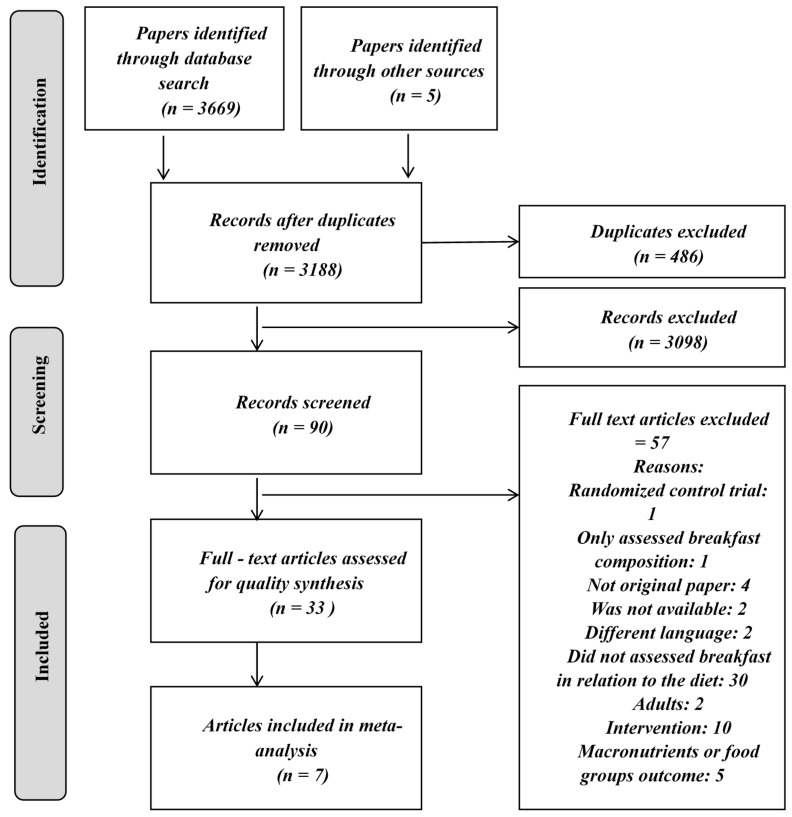
Figure 1
Figure 1
Flowchart diagram of study selection and search.
Figure 2
Figure 2
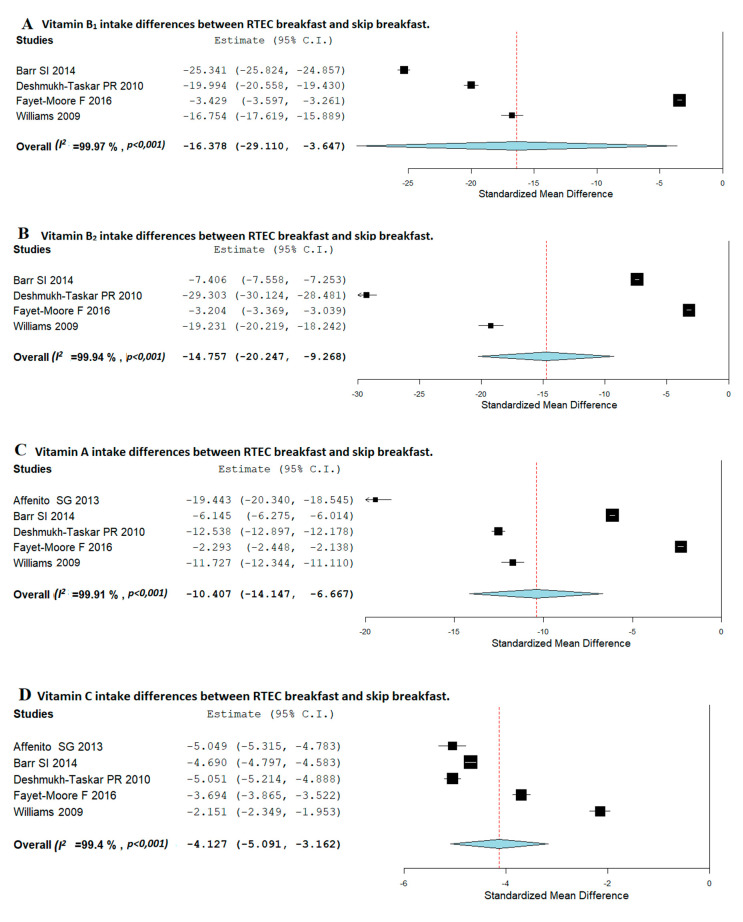
Random-effects meta-analysis of the effects of relationships between Ready to Eat Cereal (RTEC) breakfast and breakfast-skipping concerning vitamin B1 (A), vitamin B2 (B), vitamin A (C), and vitamin C (D) intake. CI: confidence intervals.
Figure 3
Figure 3
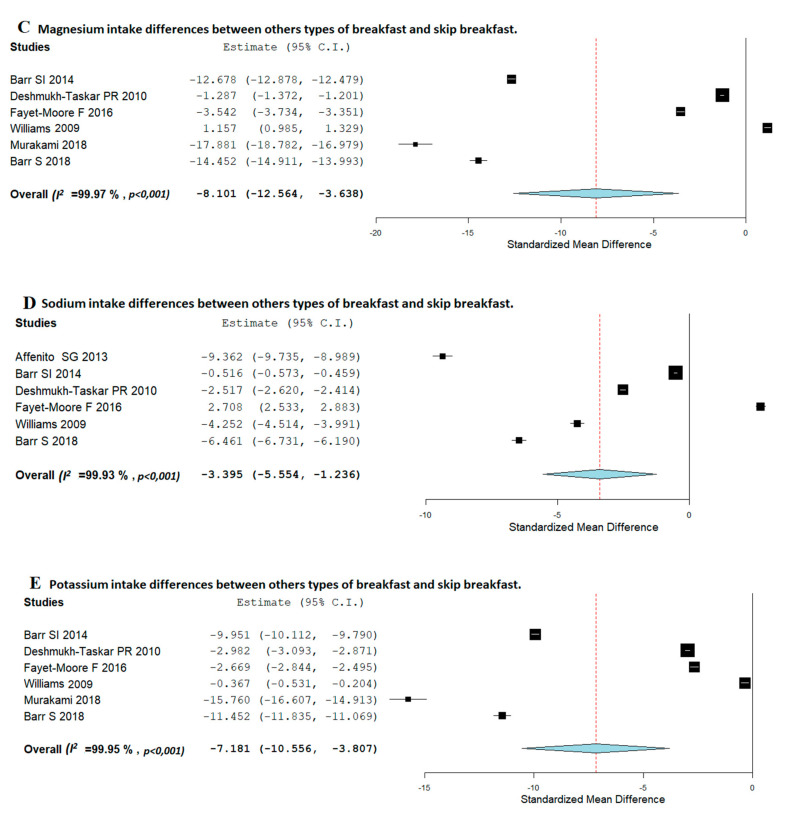
Random-effects meta-analysis of the effects of relationships between RTEC breakfast and breakfast-skipping concerning calcium (A), iron (B), magnesium (C), sodium (D), and potassium (E) intake.
Figure 4
Figure 4
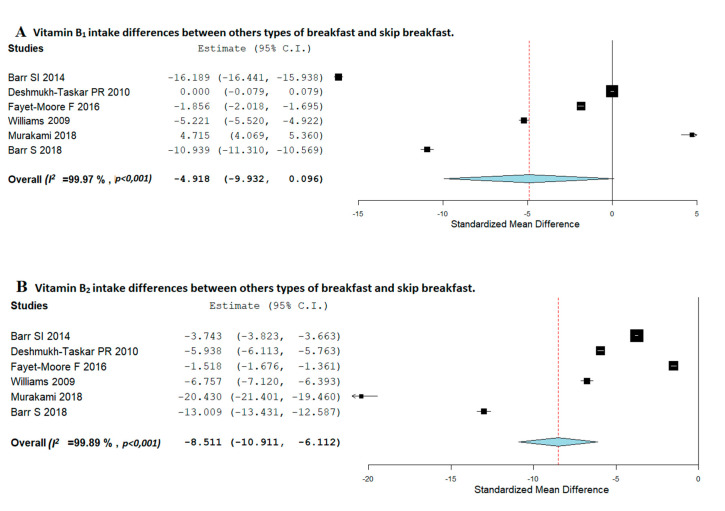
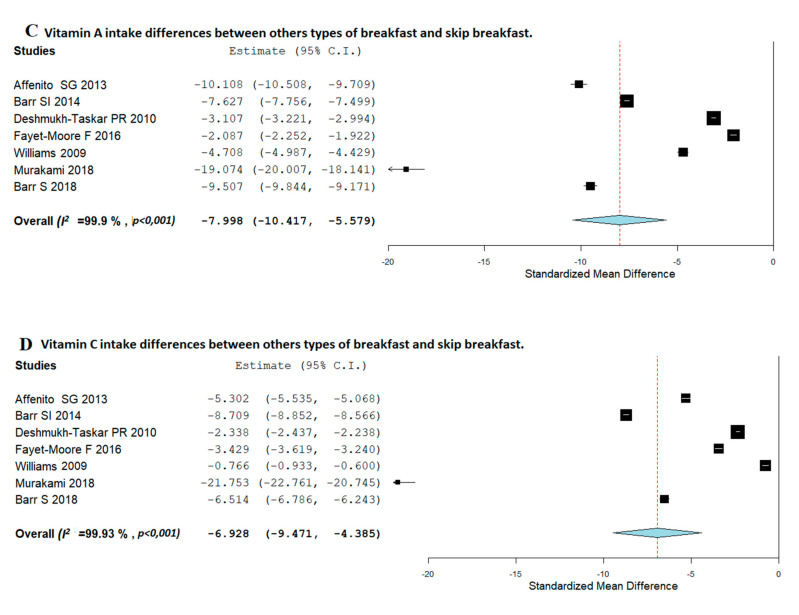
Random-effects meta-analysis of the effects of relationships between consumption of other types of breakfast and breakfast-skipping concerning vitamin B1 (A), vitamin B2 (B), vitamin A (C), and vitamin C (D) intake.
Figure 4
Figure 4
Random-effects meta-analysis of the effects of relationships between consumption of other types of breakfast and breakfast-skipping concerning vitamin B1 (A), vitamin B2 (B), vitamin A (C), and vitamin C (D) intake.
Figure 5
Figure 5
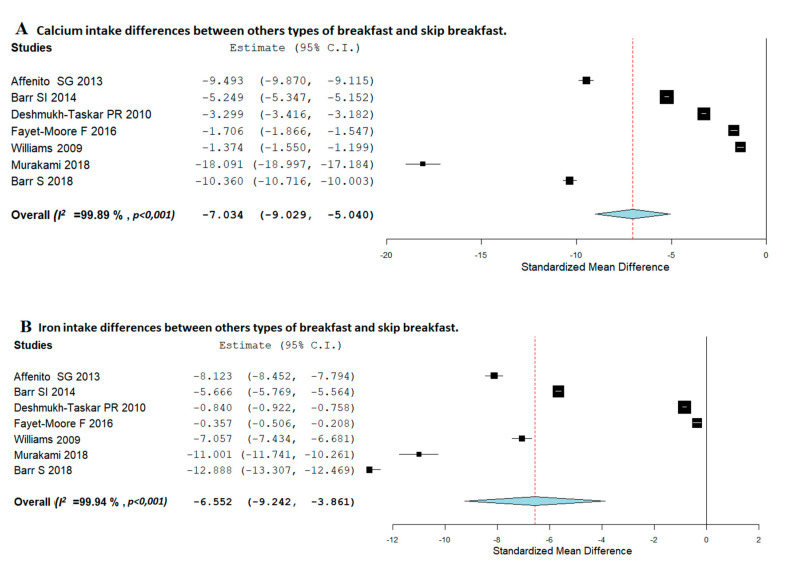
Random-effects meta-analysis of the effects of relationships between consumption of other types of breakfast and breakfast-skipping concerning calcium (A), iron (B), magnesium (C), sodium (D), and potassium (E) intake.
Figure 5
Figure 5
Random-effects meta-analysis of the effects of relationships between consumption of other types of breakfast and breakfast-skipping concerning calcium (A), iron (B), magnesium (C), sodium (D), and potassium (E) intake.

References

    1. O’neil C.E., Nicklas T.A., Fulgoni V.L. Nutrient Intake, Diet Quality, And Weight/Adiposity Parameters In Breakfast Patterns Compared With No Breakfast In Adults: National Health And Nutrition Examination Survey 2001–2008. J. Acad. Nutr. Diet. 2014;114:S27–S43. doi: 10.1016/j.jand.2014.08.021. - DOI - PubMed
    1. Rehm C.D., Drewnowski A. Replacing American Breakfast Foods With Ready-To-Eat (Rte) Cereals Increases Consumption Of Key Food Groups And Nutrients Among Us Children And Adults: Results Of An Nhanes Modeling Study. Nutrients. 2017;9:1010. doi: 10.3390/nu9091010. - DOI - PMC - PubMed
    1. Coulthard J.D., Palla L., Pot G.K. Breakfast Consumption And Nutrient Intakes In 4-18-Year-Olds: Uk National Diet And Nutrition Survey Rolling Programme (2008–2012) Br. J. Nutr. 2017;118:280–290. doi: 10.1017/S0007114517001714. - DOI - PubMed
    1. O’neil C.E., Byrd-Bredbenner C., Hayes D., Jana L., Klinger S.E., Stephenson-Martin S. The Role Of Breakfast In Health: Definition And Criteria For A Quality Breakfast. J. Acad. Nutr. Diet. 2014;114:S8–S26. doi: 10.1016/j.jand.2014.08.022. - DOI - PubMed
    1. Szajewska H., Ruszczynski M. Systematic Review Demonstrating That Breakfast Consumption Influences Body Weight Outcomes In Children And Adolescents In Europe (Structured Abstract) Crit. Rev. Food Sci. Nutr. 2010;50:113–119. doi: 10.1080/10408390903467514. - DOI - PubMed