. 2020 Oct 20;10(10):1926.
doi: 10.3390/ani10101926.

A Novel Corn-Expressed Phytase Improves Daily Weight Gain, Protein Efficiency Ratio and Nutrients Digestibility and Alters Fecal Microbiota in Pigs Fed with Very Low Protein Diets

Affiliations

A Novel Corn-Expressed Phytase Improves Daily Weight Gain, Protein Efficiency Ratio and Nutrients Digestibility and Alters Fecal Microbiota in Pigs Fed with Very Low Protein Diets

Cedrick N Shili et al. Animals (Basel). .

Abstract

The objective of this study was to assess the effect of a novel corn-expressed phytase (CEP) on growth, nutrients digestibility, bone characteristics and fecal microbiota of pigs fed with very low-protein, -calcium (Ca) and -phosphorous (P) diets. Forty-eight barrows were subjected to 6 groups for 4 weeks: positive control-adequate protein (PC), negative control-reduced protein (NC), NC + low-dose CEP, i.e., 2000 FTU/kg (LD), NC + high-dose CEP, i.e., 4000 FTU/kg (HD), LD with 0.12% unit reduced Ca and 0.15% unit reduced available P (LDR), and HD with 0.12% unit reduced Ca and 0.15% unit reduced available P (HDR). Compared to NC, LD and HDR had a higher average daily gain (ADG) and gain:protein ratio (G:P), HD and HDR had greater apparent fecal digestibility of Ca and P and bone mineral density and LDR and HDR had lower serum osteocalcin. The feces of LD was enriched in Lachnospiraceae, while the HD had a higher abundance of Succinvibrio and LDR had a higher abundance of Bifidobacterium and Actinobacteria. In conclusion, supplementation of protein-restricted diets with a CEP decreased their negative effects on ADG and G:P ratio, increased the digestibility of Ca and P regardless of the levels of these minerals in the diet, improved bone characteristics and produced differential effects on fecal bacterial population.

Keywords: bone characteristics; corn-expressed phytase; fecal microbiota; growth; low calcium/phosphorous diets; low-protein diets; nutrients digestibility; pigs.


Conflict of interest statement

J.N.B. and M.B.L. are affiliated with Agrivida; however, Agrivida had no role in designing of the study, data collection, analysis or interpretation of collected data, writing the manuscript or decision to publish the results. All authors including J.N.B. and M.B.L. declare no potential conflict of interests.

Figures
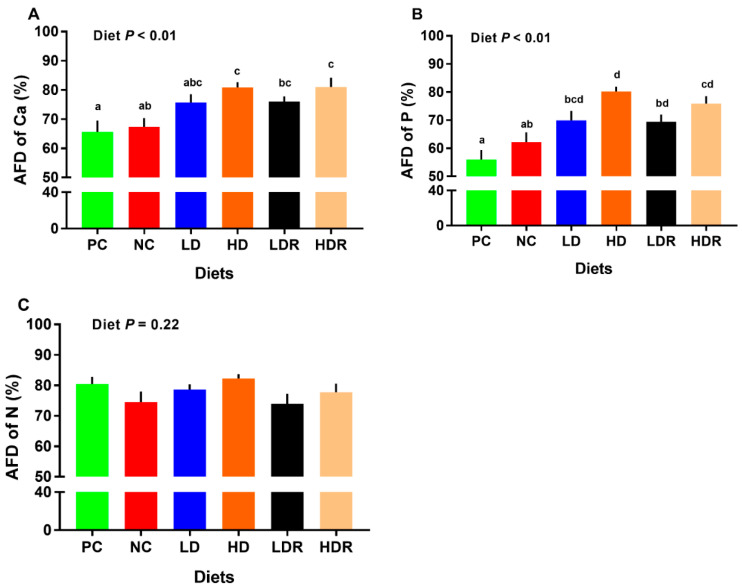
Figure 1
Figure 1
Nutrients’ digestibility in pigs fed with low-protein diets supplemented with a corn-expressed phytase. (A) apparent fecal digestibility (AFD) of calcium (Ca), (B) AFD of phosphorus (P), (C) AFD of nitrogen (N). Pigs are grouped based on their dietary treatments: PC (positive control): normal protein, adequate Ca and available phosphorous (aP), no corn-expressed phytase (CEP) added; NC (negative control): low protein, adequate Ca and aP, no CEP added; LD: NC + CEP added at low dose, i.e., 2000 FTU/kg of diet; HD: NC + CEP added at high dose, i.e., 4000 FTU/kg of diet; LDR: LD with reduced calcium (Ca) and phosphorus (P); HDR: HD with reduced Ca and P. The values are means ± standard errors of means. Different letters in the bar plots indicate significant differences (p ≤ 0.05, Tukey’s test). n = 8 for each dietary group.
Figure 2
Figure 2
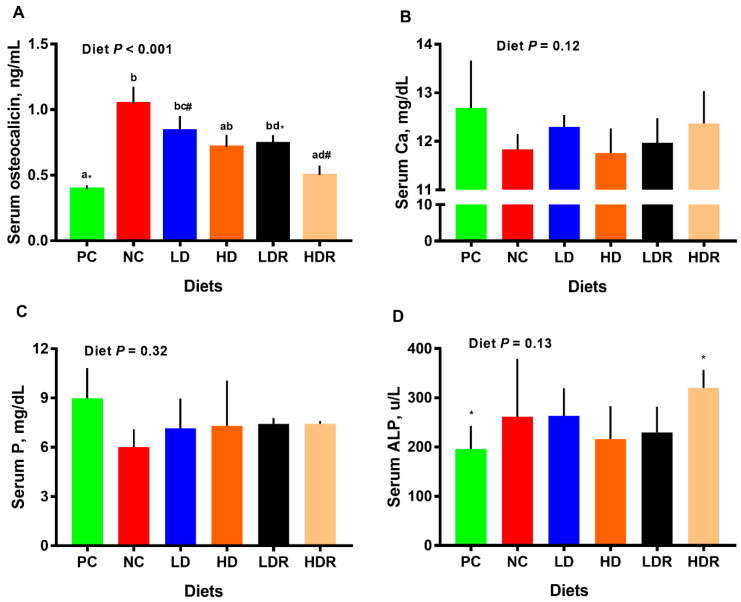
Serum metabolites and hormones in pigs fed with low-protein diets supplemented with a corn-expressed phytase. (A) serum osteocalcin, (B) serum calcium (Ca), (C) serum phosphorus (P), (D) serum alkaline phosphatase (ALP). Pigs are grouped based on their dietary treatments: PC (positive control): normal protein, adequate Ca and available phosphorous (aP), no corn-expressed phytase (CEP) added; NC (negative control): low protein, adequate Ca and aP, no CEP added; LD: NC + CEP added at low dose, i.e., 2000 FTU/kg of diet; HD: NC + CEP added at high dose, i.e., 4000 FTU/kg of diet; LDR: LD with reduced calcium (Ca) and phosphorus (P); HDR: HD with reduced Ca and P. The values are means ± standard errors of means. Different letters in the bar plots indicate significant differences (p ≤ 0.05, Tukey’s test) and common superscript symbols indicate a trend (0.05 < p ≤ 0.1). n = 7–8 for each dietary group.
Figure 3
Figure 3
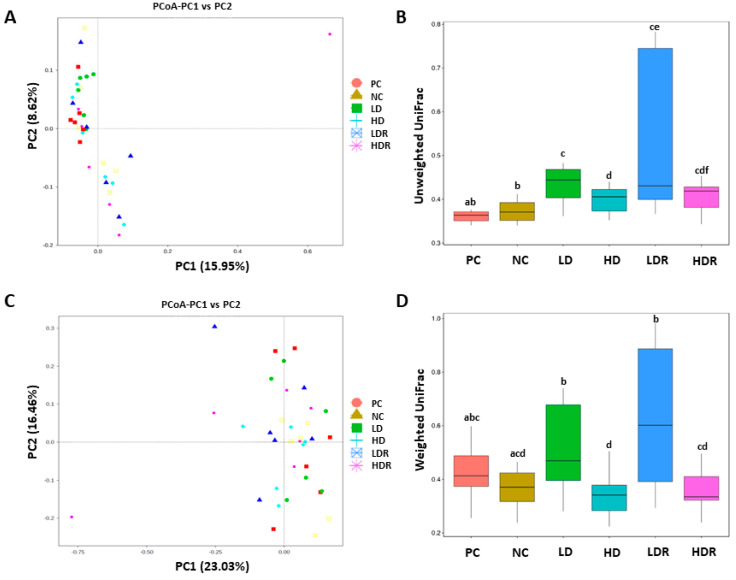
Beta diversity of the fecal bacterial community in pigs fed with low-protein diets supplemented with a corn-expressed phytase. (A) Principal Coordinates Analysis (PCoA) of unweighted UniFrac distances showing the diversity of fecal microbiota across individual animals assigned to 6 dietary groups. Each node represents an individual pig, (B) Unweighted UniFrac distances shown for each dietary group, (C) PCoA of weighted UniFrac distances showing the diversity of fecal microbiota across animals assigned to 6 dietary groups. Each node represents an individual pig, (D) Weighted UniFrac distances shown for each dietary group. Pigs are grouped based on their dietary treatments: PC (positive control): normal protein, adequate Ca and available phosphorous (aP), no corn-expressed phytase (CEP) added; NC (negative control): low protein, adequate Ca and aP, no CEP added; LD: NC + CEP added at low dose, i.e., 2000 FTU/kg of diet; HD: NC + CEP added at high dose, i.e., 4000 FTU/kg of diet; LDR: LD with reduced calcium (Ca) and phosphorus (P); HDR: HD with reduced Ca and P. The values are means ± standard errors. Different letters in the box plots indicate significant differences (p ≤ 0.05, Wilcoxon test). n = 6 for each dietary group.
Figure 4
Figure 4
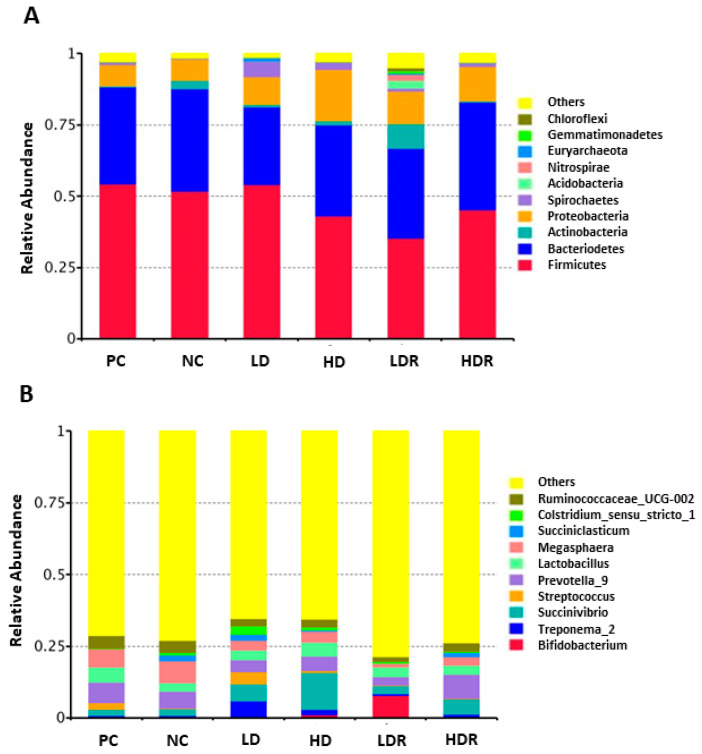
The fecal bacterial composition in pigs fed with low-protein diets supplemented with a corn-expressed phytase. (A) the relative abundance of bacterial community composition at phylum level, (B) the relative abundance of bacterial community composition at genus level. Pigs are grouped based on their dietary treatments: PC (positive control): normal protein, adequate Ca and available phosphorous (aP), no corn-expressed phytase (CEP) added; NC (negative control): low protein, adequate Ca and aP, no CEP added; LD: NC + CEP added at low dose, i.e., 2000 FTU/kg of diet; HD: NC + CEP added at high dose, i.e., 4000 FTU/kg of diet; LDR: LD with reduced calcium (Ca) and phosphorus (P); HDR: HD with reduced Ca and P. Only the top 10 phyla and genera are shown for clarity. n = 6 for each dietary group.
Figure 5
Figure 5
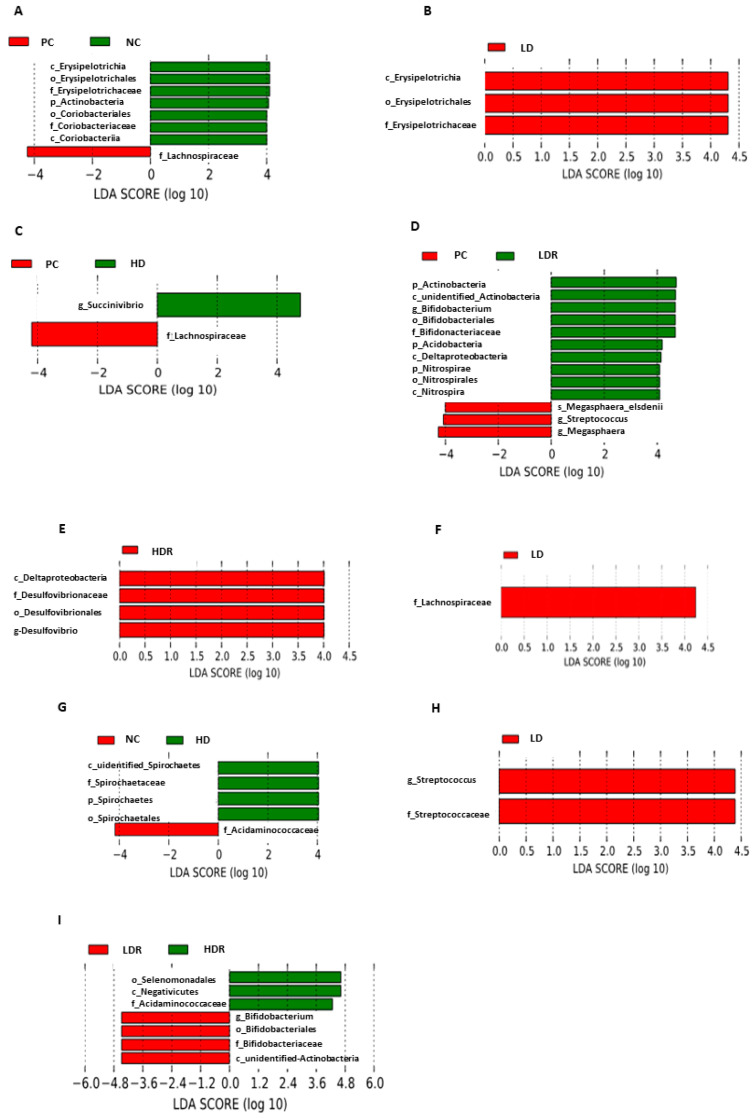
Fecal microbiota composition histograms in pigs fed with low-protein diets supplemented with a corn-expressed phytase. Histograms of linear discriminant analysis (LDA) with effect size (LEfSe) on fecal microbiota composition (A) PC vs. NC, (B) PC vs. LD, (C) PC vs. HD, (D) PC vs. LDR, (E) PC vs. HDR, (F) NC vs. LD, (G) NC vs. HD, (H) LD vs. LDR, (I) LDR vs. HDR. Pigs are grouped based on their dietary treatments: PC (positive control): normal protein, adequate Ca and available phosphorous (aP), no corn-expressed phytase (CEP) added; NC (negative control): low protein, adequate Ca and aP, no CEP added; LD: NC + CEP added at low dose, i.e., 2000 FTU/kg of diet; HD: NC + CEP added at high dose, i.e., 4000 FTU/kg of diet; LDR: LD with reduced calcium (Ca) and phosphorus (P); HDR: HD with reduced Ca and P. There was no significant difference on species identified for LD vs. HD and HD vs. HDR. n = 6 for each dietary group.

References

    1. Jongbloed A.W., Lenis N.P. Environmental Concerns about Animal Manure. J. Anim. Sci. 1998;76:2641. doi: 10.2527/1998.76102641x. - DOI - PubMed
    1. Selle P.H., Cowieson A.J., Ravindran V. Consequences of Calcium Interactions with Phytate and Phytase for Poultry and Pigs. Livest. Sci. 2009;124:126–141. doi: 10.1016/j.livsci.2009.01.006. - DOI
    1. Nyachoti C.M., Omogbenigun F.O., Rademacher M., Blank G. Performance Responses and Indicators of Gastrointestinal Health in Early-Weaned Pigs Fed Low-Protein Amino Acid-Supplemented Diets. J. Anim. Sci. 2006;84:125–134. - PubMed
    1. Oster M., Gerlinger C., Heide K., Just F., Borgelt L., Wolf P., Polley C., Vollmar B., Muráni E., Ponsuksili S., et al. Lower Dietary Phosphorus Supply in Pigs Match Both Animal Welfare Aspects and Resource Efficiency. Ambio. 2018;47:20–29. doi: 10.1007/s13280-017-0969-8. - DOI - PMC - PubMed
    1. Heo J.-M., Kim J.-C., Hansen C.F., Mullan B.P., Hampson D.J., Pluske J.R. Effects of Feeding Low Protein Diets to Piglets on Plasma Urea Nitrogen, Faecal Ammonia Nitrogen, the Incidence of Diarrhoea and Performance after Weaning. Arch. Anim. Nutr. 2008;62:343–358. doi: 10.1080/17450390802327811. - DOI - PubMed