Review
. 2020 Oct 27;76(17):2011-2023.
doi: 10.1016/j.jacc.2020.08.059.

Coronavirus and Cardiovascular Disease, Myocardial Injury, and Arrhythmia: JACC Focus Seminar

Affiliations
Review

Coronavirus and Cardiovascular Disease, Myocardial Injury, and Arrhythmia: JACC Focus Seminar

Gennaro Giustino et al. J Am Coll Cardiol. .

Abstract

The cardiovascular system is affected broadly by severe acute respiratory syndrome coronavirus 2 infection. Both direct viral infection and indirect injury resulting from inflammation, endothelial activation, and microvascular thrombosis occur in the context of coronavirus disease 2019. What determines the extent of cardiovascular injury is the amount of viral inoculum, the magnitude of the host immune response, and the presence of co-morbidities. Myocardial injury occurs in approximately one-quarter of hospitalized patients and is associated with a greater need for mechanical ventilator support and higher hospital mortality. The central pathophysiology underlying cardiovascular injury is the interplay between virus binding to the angiotensin-converting enzyme 2 receptor and the impact this action has on the renin-angiotensin system, the body's innate immune response, and the vascular response to cytokine production. The purpose of this review was to describe the mechanisms underlying cardiovascular injury, including that of thromboembolic disease and arrhythmia, and to discuss their clinical sequelae.

Keywords: COVID-19; SARS-CoV-2; arrhythmia; myocardial injury; thrombosis.


Figures

None
Graphical abstract
Central Illustration
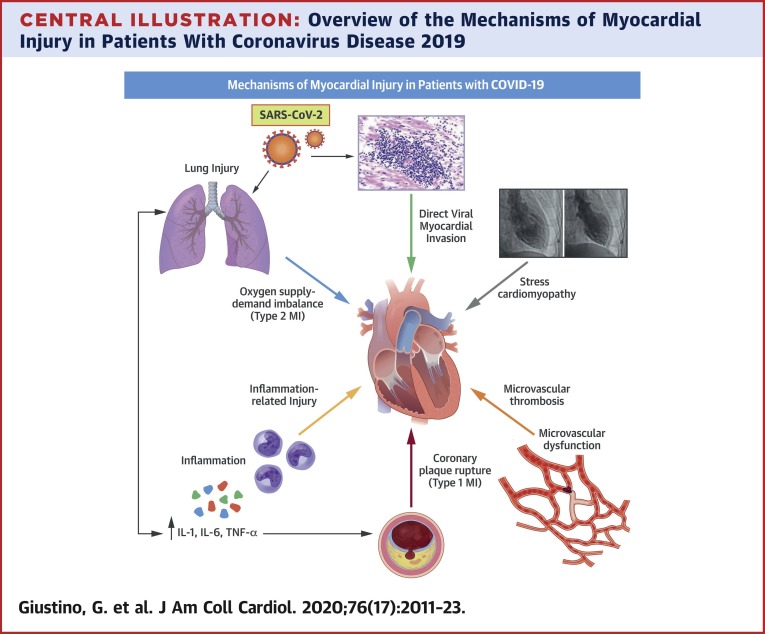
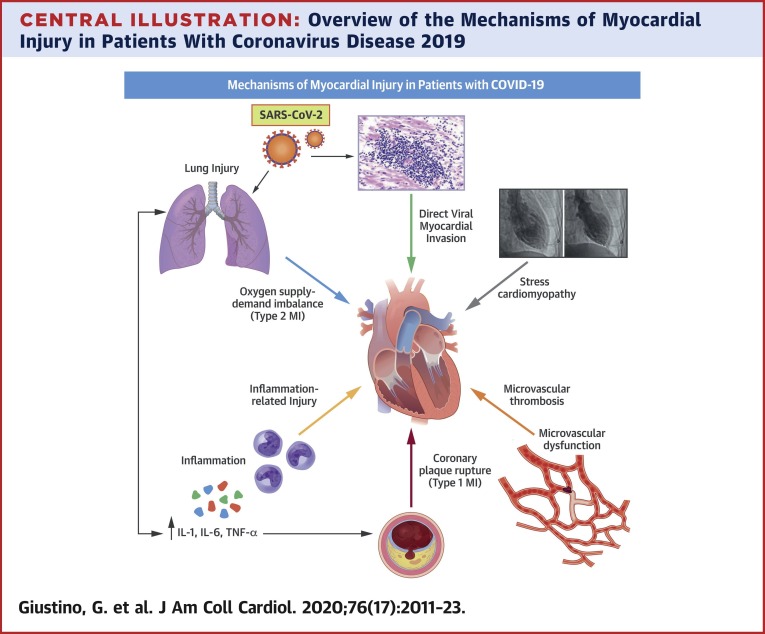
Overview of the Mechanisms of Myocardial Injury in Patients With Coronavirus Disease 2019 Myocardial injury in the setting of COVID-19 is frequent and associated with poor prognosis. The mechanisms through which COVID-19 can cause myocardial injury are heterogeneous and include oxygen supply–demand imbalance, microvascular and macrovascular thrombosis, inflammation-related injury, stress-induced cardiomyopathy, and direct viral invasion of the myocardium. COVID-19 = coronavirus disease 2019; IL = interleukin; MI = myocardial infarction; SARS-CoV-2 = severe acute respiratory syndrome coronavirus 2; TNF = tumor necrosis factor.
Figure 1
Figure 1
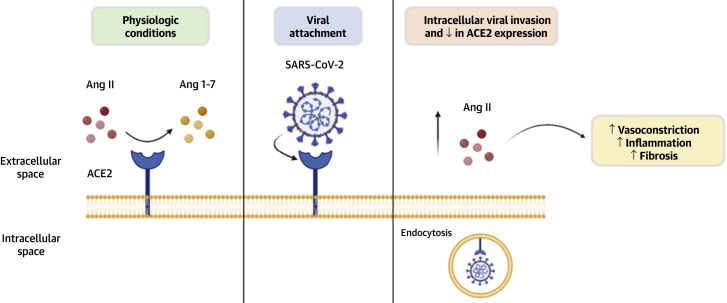
Interaction Between SARS-CoV-2, ACE2 Transmembrane Protein, and Ang II Levels in Patients With COVID-19 In severe acute respiratory syndrome coronavirus 2 (SARS-CoV-2) infection, the angiotensin-converting enzyme 2 (ACE2) transmembrane protein is internalized, leading to decreased receptor density. The loss of ACE2 receptor density and down-regulation of ACE2 activity leads to an accumulation of angiotensin II (Ang II), which exerts vasoconstrictor, profibrotic, and proinflammatory effects. Image created with BioRender. Ang 1-7 = angiotensin 1-7; COVID-19 = coronavirus disease 2019.
Figure 2
Figure 2
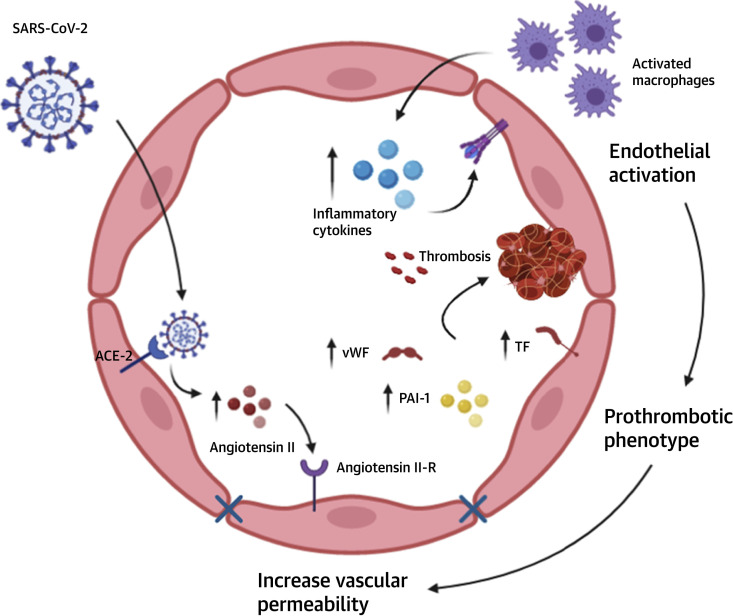
Endothelial Activation, Inflammation, and Thrombosis in COVID-19 Inflammatory cytokines and excessive Ang II activity lead to endothelial activation, which is associated with a prothrombotic phenotype and increased endothelial permeability. In addition, SARS-CoV-2 has been shown to directly invade endothelial cells and cause endotheliitis. Image created with BioRender.com. PAI = plasminogen activator inhibitor; TF = tissue factor; vWF = von Willebrand factor; other abbreviations as in Figure 1.

References

    1. GBD 2017 Causes of Death Collaborators Global, regional, and national age-sex-specific mortality for 282 causes of death in 195 countries and territories, 1980-2017: a systematic analysis for the Global Burden of Disease Study 2017. Lancet. 2018;392:1736–1788. - PMC - PubMed
    1. Fauci A.S., Lane H.C., Redfield R.R. Covid-19—navigating the uncharted. N Engl J Med. 2020;382:1268–1269. - PMC - PubMed
    1. Guo T., Fan Y., Chen M. Cardiovascular implications of fatal outcomes of patients with coronavirus disease 2019 (COVID-19) JAMA Cardiol. 2020;27:1–8. - PMC - PubMed
    1. Shi S., Qin M., Shen B. Association of cardiac injury with mortality in hospitalized patients with COVID-19 in Wuhan, China. JAMA Cardiol. 2020;25:802–810. - PMC - PubMed
    1. Zhou F., Yu T., Du R. Clinical course and risk factors for mortality of adult inpatients with COVID-19 in Wuhan, China: a retrospective cohort study. Lancet. 2020;395:1054–1062. - PMC - PubMed