. 2020 Jun 13;42(4):211-220.
doi: 10.1016/j.pld.2020.06.002. eCollection 2020 Aug.

Maintaining biodiversity will define our long-term success

Affiliations

Maintaining biodiversity will define our long-term success

Peter Raven et al. Plant Divers. .

Abstract

Human beings are not only a part of our planet's ecosystems, but also, they are massively overusing them. This makes ecosystem protection, including biodiversity preservation, vital for humanity's future. The speed and scale of the threat are unprecedented in human history. The long arch of evolution has been confronted with such a high level of human impact, that we are now facing the sixth mass extinction event, 66 million years after the last one. This threat heightens the imperative for bold human intervention. Our paper identifies three strategies for such an intervention. First, and possibly most challenging, human demand needs to be curbed so it fits within the bounds of what Earth's ecosystems can renew. Without meeting this quantitative goal, biodiversity preservation efforts will not be able to get scaled. Second, in the transition time, we must focus on those locations and areas where most biodiversity is concentrated. Such a focus on 'hotspots' will help safeguard the largest portion of biodiversity with least effort. Third, to direct biodiversity preservation strategies, we need to much better document the existence and distribution of biodiversity around the globe. New information technologies could help with this critical effort. In conclusion, biodiversity preservation is no longer just a concern for specialized biologist but is becoming a societal necessity if humanity wants to have a stable future.

Keywords: Biocapacity; Biodiversity; Conservation strategy; Hotspots.


Conflict of interest statement

The authors have no conflicts of interest to declare.

Figures
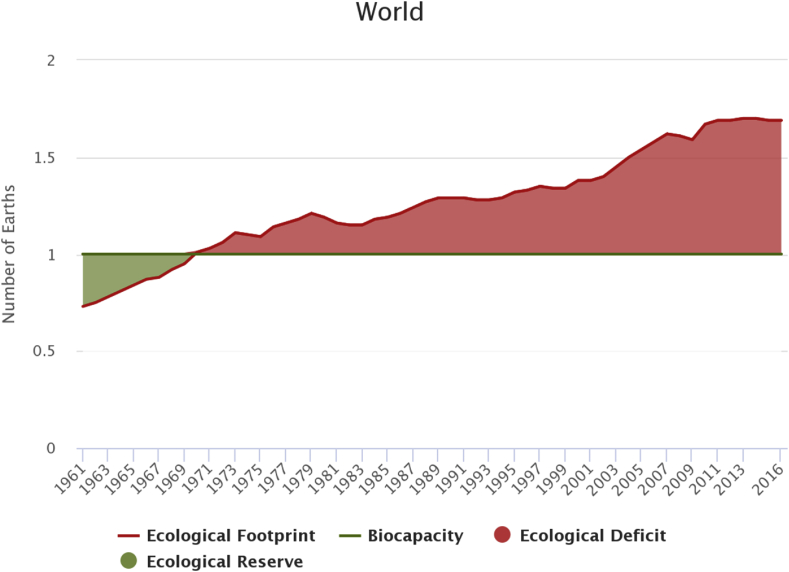
Fig. 1
Fig. 1
The change in human demand against our planet's regeneration (shown as the green, horizontal “one-Earth” line). Note that to preserve biodiversity, human demand needs eventually to reach less than one Earth to secure some of the regenerative capacity for other species (data source: data.footprintnetwork.org).
Fig. 2
Fig. 2
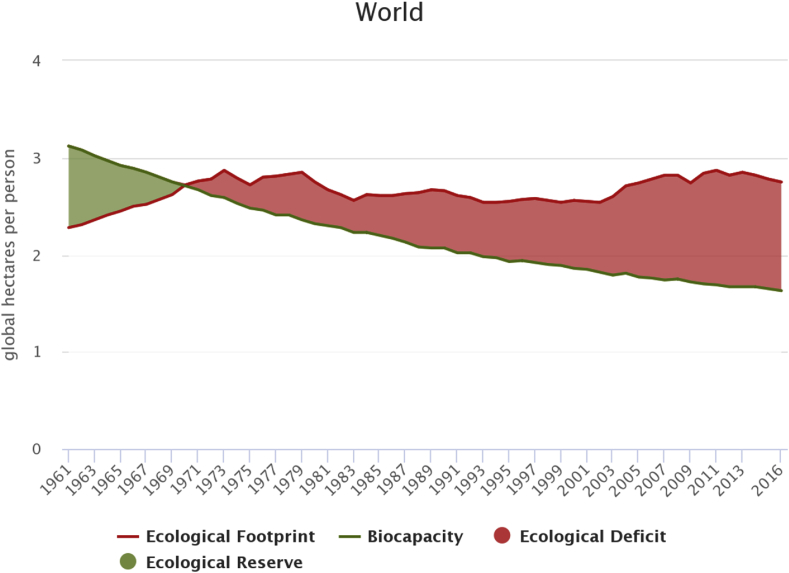
It is the same graph as Fig. 1, but expressed per person. It shows human demand on nature (humanity's Ecological Footprint per resident) compared to how much Earth's ecosystems can renew (the planet's biocapacity per person) for the last six decades. The results here are expressed not in “number of Earths” as in Fig. 1, but in global hectares, or biologically productive hectares with world average productivity. Explanations on the unit of measurement and the underlying logic is summarized in section 2 of Wackernagel et al.‘s open access paper (2019). The graph indicates that the growing human population has led to less biocapacity per person, while demand per Earth resident has stayed relatively similar. Consumption of products may have gone up, but with increases in efficiency the resulting demand on nature per person has not (data source: data.footprintnetwork.org).
Fig. 3
Fig. 3
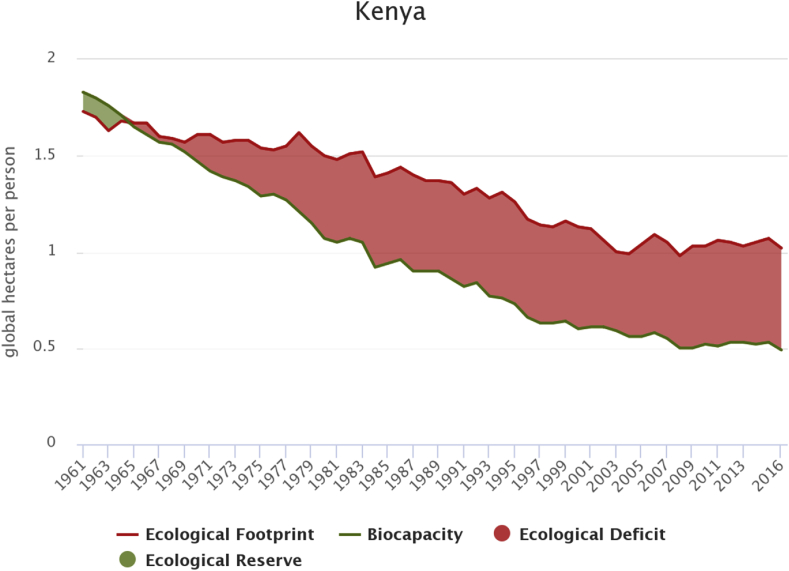
The trends of human demand on nature of Kenyan consumption (Kenya's Ecological Footprint per resident) compared to how much ecosystems in Kenya can renew (Kenya's biocapacity per person). Both are expressed in global hectares per person. The graphs reveal that growing populations have led to less biocapacity per person, even though biocapacity as a whole increased in Kenya due to agricultural intensification. Just that population increased more rapidly, from about 8 million people in 1961 to over 53 million today, reflecting an excessively slow “demographic transition.” Persistently low income has not allowed Kenyans, on average, to fully compensate the resource demand with supplies from the outside. The growing ecological deficit makes it increasingly difficult to implement lasting biodiversity strategies in countries like Kenya (data source: data.footprintnetwork.org).
Fig. 4
Fig. 4
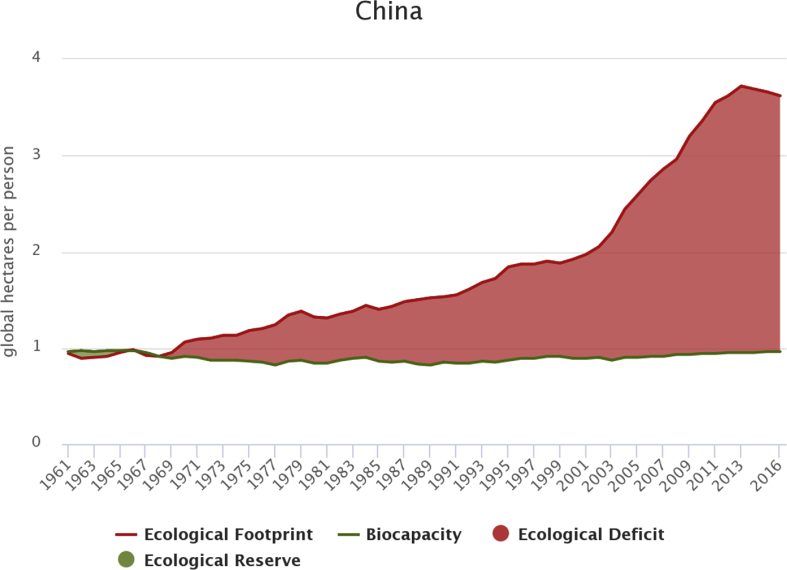
The trends of human demand on nature of Chinese consumption (China's Ecological Footprint per resident) compared to how much ecosystems in China can renew (China's biocapacity per person). Both are expressed in global hectares per person. The graphs depict rapid expansion of demand in this century, and an apparent flattening off in recent years. Currently China's Ecological Footprint is 3.7-fold larger than its own biocapacity. Much of its Footprint is attributable to carbon emissions (data source: data.footprintnetwork.org).
Fig. 5
Fig. 5
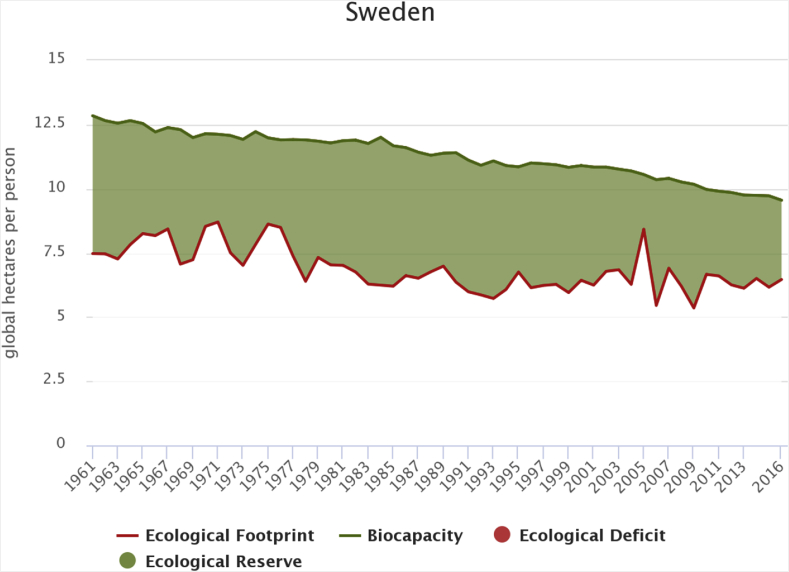
The trends of human demand on nature of Swedish consumption (Sweden's Ecological Footprint per resident) compared to how much ecosystems in Sweden can renew (Sweden's biocapacity per person). Both are expressed in global hectares per person. Sweden's per person demand is 80% higher than China's and 130% than the world average Footprint per person. The high per person Footprint in Sweden is still exceeded by an even higher per person biocapacity of that country, leaving Sweden with an ecological reserve (data source: data.footprintnetwork.org).

References

    1. Anzilotti Eillie. 2018. 2019. Food Waste Is Going to Take over the Fashion Industry, Fast Company.www.fastcompany.com/40584274/food-waste-is-going-to-take-over-the-fashio... June 15.
    1. Bar-On Y.M., Phillips R., Milo R. The biomass distribution on Earth. Proc. U.S. Natl. Acad. Sci. 2018;115:6506–6511. - PMC - PubMed
    1. Butler J.H., Montzka S.A. The NOAA annual greenhouse gas Index (AGGI) (NOAA Earth system research laboratory, Boulder, CO) 2019. https://www.esrl.noaa.gov/gmd/aggi/aggi.html Available at:
    1. Ceballos G., Ehrlich P.R.E., Baranosky A.D., García A., Pringle M., Palmer T.M. Accelerated human-induced species loss: entering the sixth mass extinction. Sci. Adv. 2015;1 - PMC - PubMed
    1. Ceballos G., Ehrlich P.R., Dirzo R. Biological annihilation via the ongoing sixth mass extinction signaled by vertebrate population losses and declines. Proc. Natl. Acad. Sci. U. S. A. 2017;114:6089–6096. - PMC - PubMed

LinkOut - more resources