Review
. 2021 Dec;53(1):117-134.
doi: 10.1080/07853890.2020.1839959.

Hydroxychloroquine: a comprehensive review and its controversial role in coronavirus disease 2019

Affiliations
Review

Hydroxychloroquine: a comprehensive review and its controversial role in coronavirus disease 2019

Pankaj Bansal et al. Ann Med. 2021 Dec.

Abstract

Hydroxychloroquine, initially used as an antimalarial, is used as an immunomodulatory and anti-inflammatory agent for the management of autoimmune and rheumatic diseases such as systemic lupus erythematosus. Lately, there has been interest in its potential efficacy against severe acute respiratory syndrome coronavirus 2, with several speculated mechanisms. The purpose of this review is to elaborate on the mechanisms surrounding hydroxychloroquine. The review is an in-depth analysis of the antimalarial, immunomodulatory, and antiviral mechanisms of hydroxychloroquine, with detailed and novel pictorial explanations. The mechanisms of hydroxychloroquine are related to potential cardiotoxic manifestations and demonstrate potential adverse effects when used for coronavirus disease 2019 (COVID-19). Finally, current literature associated with hydroxychloroquine and COVID-19 has been analyzed to interrelate the mechanisms, adverse effects, and use of hydroxychloroquine in the current pandemic. Currently, there is insufficient evidence about the efficacy and safety of hydroxychloroquine in COVID-19. KEY MESSAGES HCQ, initially an antimalarial agent, is used as an immunomodulatory agent for managing several autoimmune diseases, for which its efficacy is linked to inhibiting lysosomal antigen processing, MHC-II antigen presentation, and TLR functions. HCQ is generally well-tolerated although severe life-threatening adverse effects including cardiomyopathy and conduction defects have been reported. HCQ use in COVID-19 should be discouraged outside clinical trials under strict medical supervision.

Keywords: COVID-19; Hydroxychloroquine; cardiotoxicity; mechanism of action.


Conflict of interest statement

JMD has research grants from Pfizer and has served on advisory boards sponsored by Abbvie and Sanofi-Genzyme, outside of the submitted work. The other authors declare no competing interests.

Figures
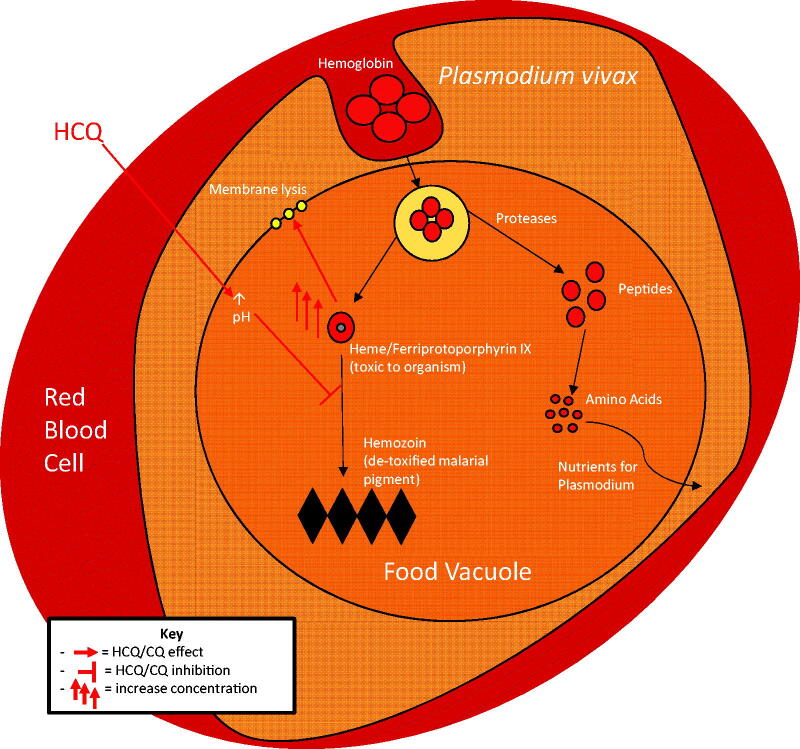
Figure 1.
Figure 1.
Antimalarial actions of hydroxychloroquine (HCQ). Being lipophilic, HCQ easily permeates the red blood cell that contains the malaria parasite and enters the food vacuole of the parasite. Being weakly alkaline, HCQ increases the pH of the food vacuole, which inhibits the conversion of toxic haem to non-toxic hemozoin. Accumulation of toxic haem leads to membrane lysis and parasite death.
Figure 2.
Figure 2.
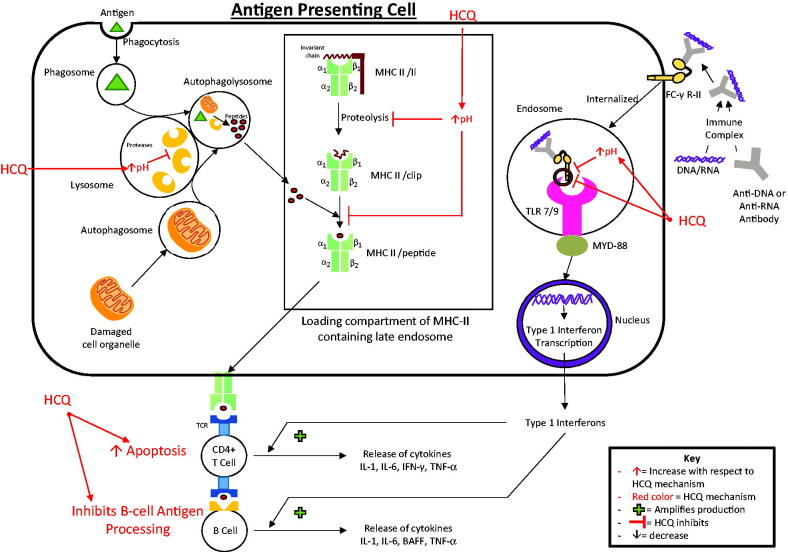
Immunomodulatory actions of hydroxychloroquine (HCQ). In antigen-presenting cells, HCQ increases the pH of lysosomes and inhibits lysosomal proteases, thereby inhibiting antigen processing and presentation to major histocompatibility complex class-II proteins (MHC-II). HCQ increases the pH of the late endosome loading compartment that contains MHC-II, which inhibits the clipping and replacement of the invariant chain (Ii) by antigenic peptides and prevents the formation of the MHC-II/peptide complex, thereby inhibiting MHC-II-mediated antigen presentation to CD4+ T-cells. In plasmacytoid dendritic cells, HCQ inhibits immune complex-mediated Toll-like receptor (TLR) 7 and 9 in the endosome by increasing the pH of the endosome and directly inhibiting the binding of the immune complex to the TLR 7 and 9, thereby preventing downstream type-1 interferon transcription. HCQ promotes T-cell apoptosis and inhibits B-cell antigen processing, thereby decreasing T-cell- and B-cell-mediated cytokine release.
Figure 3.
Figure 3.
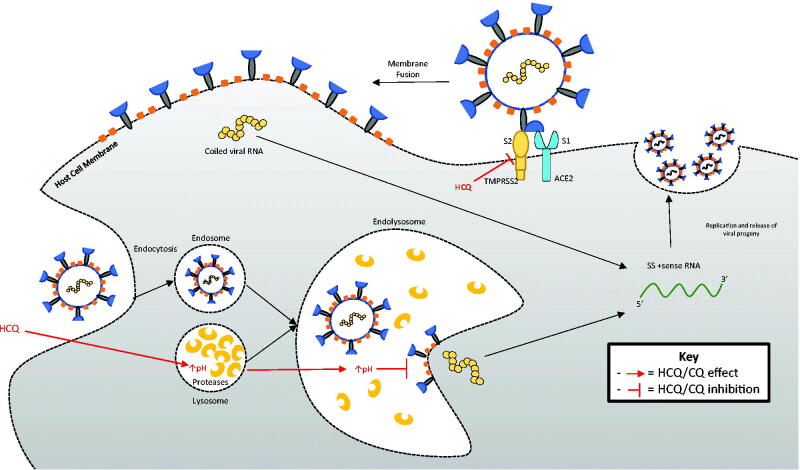
Proposed theoretical antiviral actions of hydroxychloroquine (HCQ). By increasing the pH of the lysosome, HCQ may inhibit endosomal acidification to prevent viral RNA shedding into the cytoplasm, thereby interfering with downstream viral replication. HCQ may bind the gangliosides and inhibit the communication between the spike protein and the cell membrane, thus inhibiting viral entry into the cell.
Figure 4.
Figure 4.
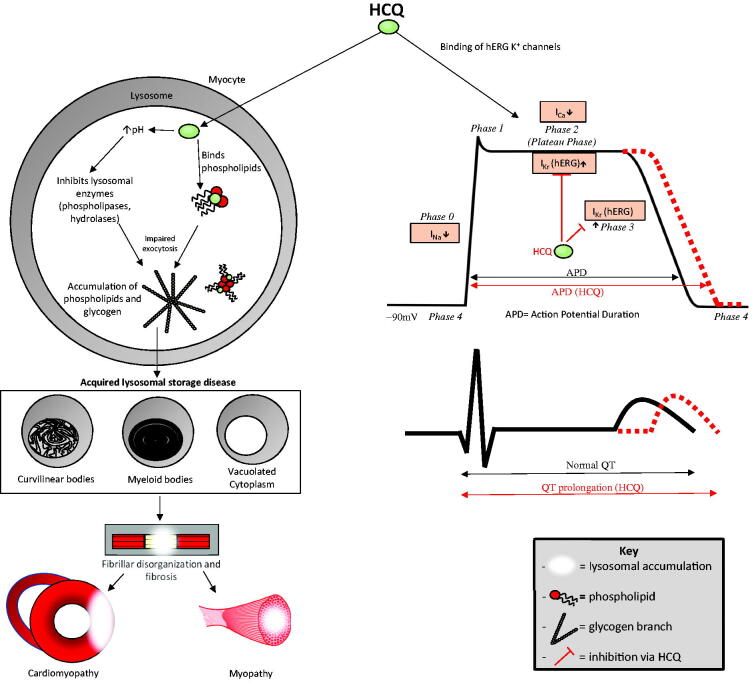
Hydroxychloroquine (HCQ)-induced cardiomyopathy and myopathy. HCQ permeates the lysosomes of myocytes and causes glycogen and phospholipid accumulation by binding phospholipids and increasing the pH, thereby inhibiting phospholipases and hydrolases. This leads to the formation of curvilinear and myeloid bodies and cytoplasmic vacuoles causing an acquired lysosomal storage disease, which causes fibrillar disorganization, atrophy, and fibrosis. These changes lead to cardiomyopathy and proximal myopathy in skeletal muscles. HCQ-induced conduction abnormalities. HCQ binds Ikr (hERG) potassium channels, slowing potassium efflux in phase 2 and especially phase 3, thereby prolonging the action potential duration that leads to QTc prolongation (depicted in red). The action potential begins with sodium influx, phase 0; rapid potassium efflux, phase 1; calcium influx balanced by potassium efflux, phase 2; potassium efflux, phase 3; and subsequent restoration of resting membrane potential, phase 4.

Comment in

References

    1. Schrezenmeier E, Dörner T.. Mechanisms of action of hydroxychloroquine and chloroquine: implications for rheumatology. Nat Rev Rheumatol. 2020;16(3):155–166. - PubMed
    1. White NJ. Cardiotoxicity of antimalarial drugs. Lancet Infect Dis. 2007;7(8):549–558. - PubMed
    1. Keyaerts E, Vijgen L, Maes P, et al. In vitro inhibition of severe acute respiratory syndrome coronavirus by chloroquine. Biochem Biophys Res Commun. 2004;323(1):264–268. - PMC - PubMed
    1. Vincent MJ, Bergeron E, Benjannet S, et al. Chloroquine is a potent inhibitor of SARS coronavirus infection and spread. Virol J. 2005;2:69. [16115318] - PMC - PubMed
    1. Wang M, Cao R, Zhang L, et al. Remdesivir and chloroquine effectively inhibit the recently emerged novel coronavirus (2019-nCoV) in vitro. Cell Res. 2020;30(3):269–271. - PMC - PubMed