


Validation of the COVID-19 Fears Questionnaires for Chronic Medical Conditions: A Scleroderma Patient-centered Intervention Network COVID-19 Cohort study
- PMID: 33096402
- PMCID: PMC7543945
- DOI: 10.1016/j.jpsychores.2020.110271
Validation of the COVID-19 Fears Questionnaires for Chronic Medical Conditions: A Scleroderma Patient-centered Intervention Network COVID-19 Cohort study
Abstract
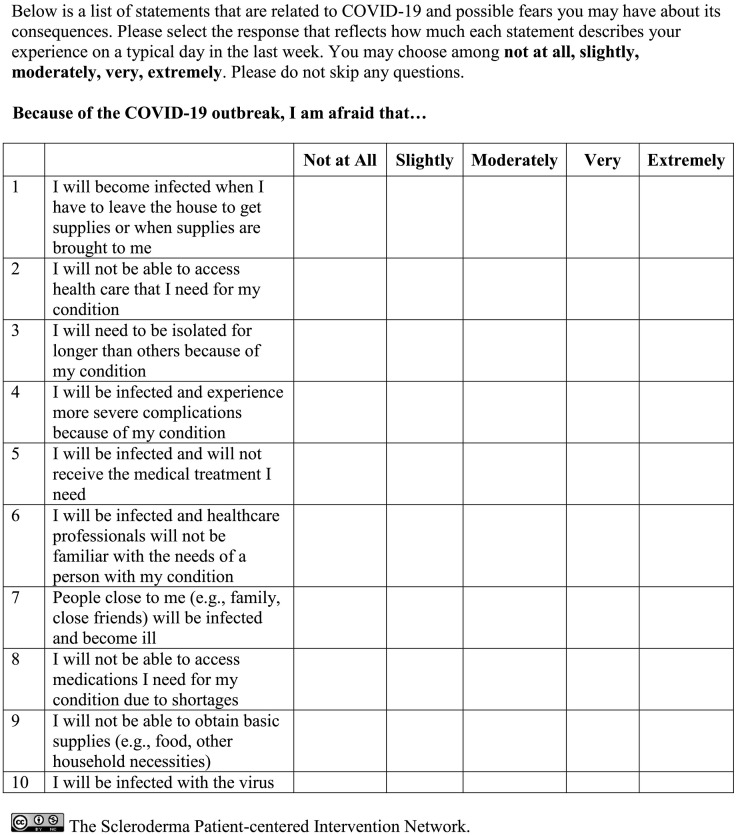
Objective: Fear associated with medical vulnerability should be considered when assessing mental health among individuals with chronic medical conditions during the COVID-19 pandemic. The objective was to develop and validate the COVID-19 Fears Questionnaire for Chronic Medical Conditions.
Methods: Fifteen initial items were generated based on suggestions from 121 people with the chronic autoimmune disease systemic sclerosis (SSc; scleroderma). Patients in a COVID-19 SSc cohort completed items between April 9 and 27, 2020. Exploratory factor analysis (EFA) and item analysis were used to select items for inclusion. Cronbach's alpha and Pearson correlations were used to evaluate internal consistency reliability and convergent validity. Factor structure was confirmed with confirmatory factor analysis (CFA) in follow-up data collection two weeks later.
Results: 787 participants completed baseline measures; 563 of them completed the follow-up assessment. Ten of 15 initial items were included in the final questionnaire. EFA suggested that a single dimension explained the data reasonably well. There were no indications of floor or ceiling effects. Cronbach's alpha was 0.91. Correlations between the COVID-19 Fears Questionnaire and measures of anxiety (r = 0.53), depressive symptoms (r = 0.44), and perceived stress (r = 0.50) supported construct validity. CFA supported the single-factor structure (χ2(35) = 311.2, p < 0.001, Tucker-Lewis Index = 0.97, Comparative Fit Index = 0.96, Root Mean Square Error of Approximation = 0.12).
Conclusion: The COVID-19 Fears Questionnaire for Chronic Medical Conditions can be used to assess fear among people at risk due to pre-existing medical conditions during the COVID-19 pandemic.
Keywords: COVID-19; Chronic medical condition; Coronavirus; Fear; Mental health; Scleroderma; Systemic sclerosis; Validation.
Copyright © 2020 Elsevier Inc. All rights reserved.
Conflict of interest statement
None.
Figures
References
-
- Callaway E., Cyranoski D., Mallapaty S., Stoye E., Tollefson J. The coronavirus pandemic in five powerful charts. Nature. 2020;579:482–483. - PubMed
-
- Salisbury H. Helen Salisbury: fear in the time of covid. BMJ. 2020;368:m1286. doi: 10.1136/bmj.m1286. https://doi - DOI - PubMed
-
- Thombs D.B., Tao L., Wu Y. Preliminary COVID-19 fears questionnaire: systemic sclerosis and chronic medical conditions versions. OSF Preprints. 2020, April 7 doi: 10.31219/osf.io/m2ybt. - DOI
Publication types
MeSH terms
LinkOut - more resources
Full Text Sources
Medical
Miscellaneous
