


Micro-Fibrillated Cellulose in Adhesive Systems for the Production of Wood-Based Panels
- PMID: 33096654
- PMCID: PMC7587974
- DOI: 10.3390/molecules25204846
Micro-Fibrillated Cellulose in Adhesive Systems for the Production of Wood-Based Panels
Abstract
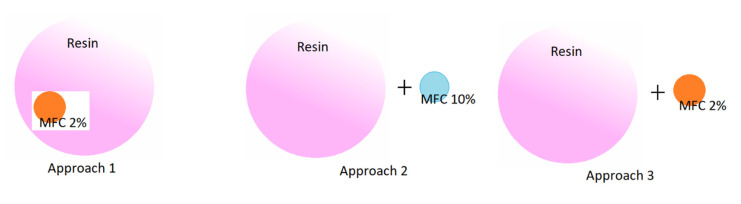
Micro-Fibrillated Cellulose (MFC) is a new type of bio-based additive, coming from wood cellulose. It can compete and substitute oil derived chemicals in several application fields. In the present work, the use of micro-fibrillated cellulose, in waterborne adhesive systems applied in the manufacture of composite wood-based panels was evaluated. Research was conducted to test the potential of improving the performance of wood-based panel types such as particleboard, waferboard or randomly-oriented strand board and plywood, by the application of MFC and the substitution of conventional and non-renewable chemical compounds. The approaches followed to introduce MFC into the adhesive systems were three, i.e., MFC 2% suspension added during the adhesive resin synthesis, MFC 10% paste admixed with the already prepared adhesive resin and MFC 2% suspension admixed with the already prepared resin. It was found that MFC improves not only the performance of the final wood panel products but also the behaviour of the applied adhesive polymer colloids (e.g., rheology improvement), especially when admixed with the already prepared resins. Moreover, it was proven that when MFC is introduced into the adhesive resin system, there is a possibility of decreasing the resin consumption, by maintaining the board performance. MFC's robustness to pH, shear and temperature makes it a highly interesting new additive for adhesive producers. In addition, its natural origin can give adhesive producers the opportunity to move over to more environmentally friendly product solutions.
Keywords: formaldehyde adhesives; micro-fibrillated cellulose; wood-based panels.
Conflict of interest statement
The authors declare no conflict of interest. The funders had no role in the design of the study; in the collection, analyses, or interpretation of data; in the writing of the manuscript, or in the decision to publish the results.
Figures
References
-
- Sundarraj A.A., Ranganathan T.V. A review on cellulose and its utilization from agro-industrial waste. Drug Invent. Today. 2018;10:89–94.
-
- Andresen M., Johansson L.-S., Tanem B.S., Stenius P. Properties and characterization of hydrophobized microfibrillated cellulose. Cellulose. 2006;13:665–677. doi: 10.1007/s10570-006-9072-1. - DOI
-
- Veigel S., Rathke J., Weigl M., Gindl-Altmutter W. Particle Board and Oriented Strand Board Prepared with Nanocellulose-Reinforced Adhesive. J. Nanomater. 2012;2012:158503. doi: 10.1155/2012/158503. - DOI
-
- Amini E., Tajvidi M., Gardner D.J., Bousfiled D.W. Utilization of Cellulose Nanofibrils as a binder for Particleboard Manufacture. BioResources. 2007;12:4093–4110. doi: 10.15376/biores.12.2.4093-4110. - DOI
MeSH terms
Substances
LinkOut - more resources
Full Text Sources
