


Learnings from Regional Market Dynamics of Originator and Biosimilar Infliximab and Etanercept in Germany
- PMID: 33096709
- PMCID: PMC7590006
- DOI: 10.3390/ph13100324
Learnings from Regional Market Dynamics of Originator and Biosimilar Infliximab and Etanercept in Germany
Abstract
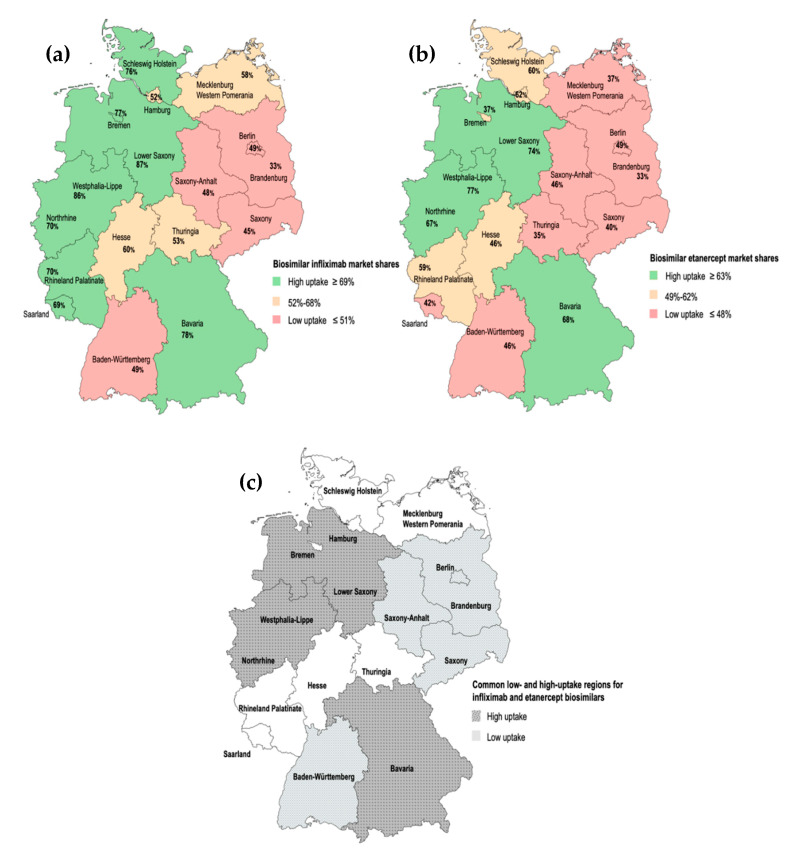
Drug budget and prescription control measures are implemented regionally in Germany, meaning that the uptake of pharmaceuticals, including biosimilars, can vary by region. We examine regional market dynamics of tumor necrosis factor alpha (TNFα) inhibitor originators and biosimilars in Germany and studied the influence of biosimilar policies on these dynamics. This study is based on: (1) a literature review in which German biosimilar policies are identified, (2) the analysis of dispensing data (2010-2018) for the class of TNFα inhibitors, and (3) ten semi-structured interviews investigating prescribers' and insurers' views on factors potentially influencing biosimilar uptake. The analysis of biosimilar market shares of infliximab and etanercept revealed wide variations across the 17 German Regional Associations of Statutory Health Insurance Accredited Physicians (PA regions). Quantitative analyses indicated that biosimilar market shares for infliximab and etanercept were significantly lower in former East Germany when compared to former West Germany regions. Through qualitative interview analyses, this study showed that the use of infliximab and etanercept biosimilars across Germany is primarily influenced by (1) the regional-level implementation of biosimilar quotas and the presence of monitoring/sanctioning mechanisms to ensure adherence to these quotas, (2) the different insurer-manufacturer discount contracts, and (3) gainsharing arrangements established at the insurer-prescriber level.
Keywords: Germany; TNFα inhibitors; biologics; biosimilars; etanercept; incentives; infliximab; market dynamics; policies; uptake.
Conflict of interest statement
S.S., I.H. and A.G.V. have founded the KU Leuven Fund on Market Analysis of Biologics and Biosimilars following Loss of Exclusivity (MABEL). S.S. was involved in a stakeholder roundtable on biologics and biosimilars sponsored by Amgen, Pfizer and MSD; he has participated in advisory board meetings for Pfizer and Amgen; he has contributed to studies on biologics and biosimilars for Hospira (together with A.G.V. and I.H.), Celltrion, Mundipharma and Pfizer, and he has had speaking engagements for Amgen and Sandoz. A.G.V. is involved in consulting, advisory work and speaking engagements for a number of companies, a.o. AbbVie, Accord, Amgen, Biogen, EGA, Pfizer/Hospira, Mundipharma, Roche, Sandoz. E.M., T.B.L., G.G., S.E., M.S. and G.S. declare no conflict of interest.
Figures
References
-
- Smolen J.S., Braun J., Dougados M., Emery P., FitzGerald O., Helliwell P., Kavanaugh A., Kvien T.K., Landewé R., Luger T., et al. Treating spondyloarthritis, including ankylosing spondylitis and psoriatic arthritis, to target: Recommendations of an international task force. Ann. Rheum. Dis. 2014;73:6–16. doi: 10.1136/annrheumdis-2013-203419. - DOI - PMC - PubMed
-
- IQVIA . Fokus Biosimilars, Ausgabe 5. IQVIA Commercial GmbH & Co. OHG; Frankfurt am Main, Germany: 2019.
-
- Organisation for Economic Co-Operation and Development (OECD) Improving Forecasting of Pharmaceutical Spending—Insights from 23 OECD and EU Countries. OECD; Paris, France: 2019.
LinkOut - more resources
Full Text Sources
