. 2020 Oct 21;10(10):2080.
doi: 10.3390/nano10102080.

Liposome-Mediated Inhibition of Inflammation by Hydroxycitrate

Affiliations

Liposome-Mediated Inhibition of Inflammation by Hydroxycitrate

Antonio Vassallo et al. Nanomaterials (Basel). .

Abstract

Hydroxycitrate (HCA), a main organic acid component of the fruit rind of Garcinia cambogia, is a natural citrate analog that can inhibit the ATP citrate lyase (ACLY) enzyme with a consequent reduction of inflammatory mediators (i.e., nitric oxide (NO), reactive oxygen species (ROS), and prostaglandin E2 (PGE2)) levels. Therefore, HCA has been proposed as a novel means to prevent, treat, and ameliorate conditions involving inflammation. However, HCA presents a low membrane permeability, and a large quantity is required to have a biological effect. To overcome this problem, HCA was formulated in liposomes in this work, and the enhancement of HCA cell availability along with the reduction in the amount required to downregulate NO, ROS, and PGE2 in macrophages were assessed. The liposomes were small in size (~60 nm), monodispersed, negatively charged (-50 mV), and stable on storage. The in vitro results showed that the liposomal encapsulation increased by approximately 4 times the intracellular accumulation of HCA in macrophages, and reduced by 10 times the amount of HCA required to abolish LPS-induced NO, ROS, and PGE2 increase. This suggests that liposomal HCA can be exploited to target the citrate pathway involved in inflammatory processes.

Keywords: antioxidant; hydroxycitrate; inflammation; liposomes; macrophages.


Conflict of interest statement

The authors declare no conflict of interest.

Figures
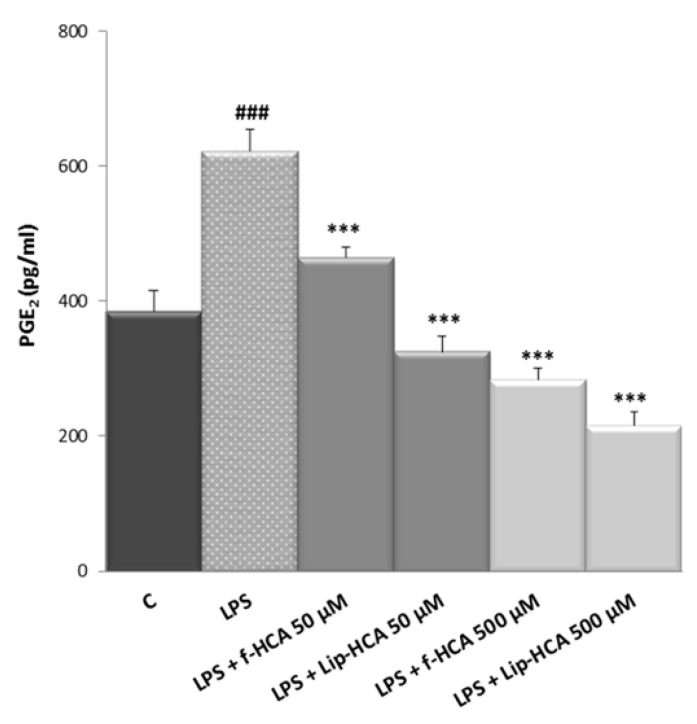
Figure 1
Figure 1
Effect of free HCA (f-HCA) and HCA-loaded liposomes (Lip-HCA) on prostaglandin E2 (PGE2) production. U937/PMA cells were triggered by LPS in the presence or absence of Lip-HCA and f-HCA (50 or 500 µM). After 48 h, PGE2 levels were quantified. Results are presented as means ± SD from three independent experiments. ###, *** p < 0.001, # vs. control (C, untreated cells), * vs. LPS.
Figure 2
Figure 2
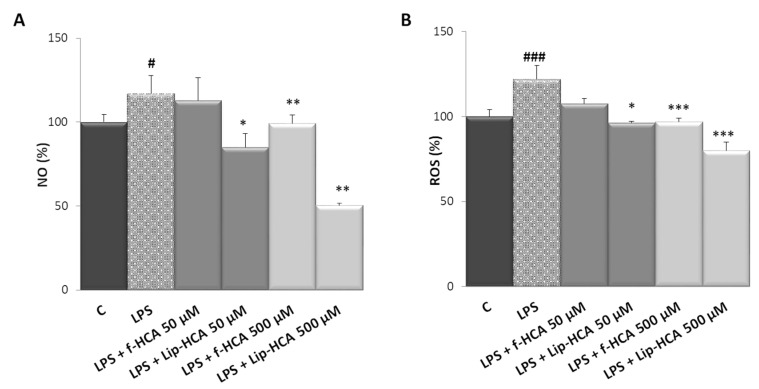
Effect of free HCA (f-HCA) and HCA-loaded liposomes (Lip-HCA) on nitric oxide (NO) (A) and reactive oxygen species (ROS) (B) production. U937/PMA cells were triggered by 100 ng/mL of LPS in the presence or absence of Lip-HCA and f-HCA (50 or 500 µM). After 24 h, NO and ROS levels were quantified. Results are presented as means ± SD from three independent experiments. #, * p < 0.05, ** p < 0.01, ###, *** p < 0.001, # vs. control (C, untreated cells), * vs. LPS.
Figure 3
Figure 3
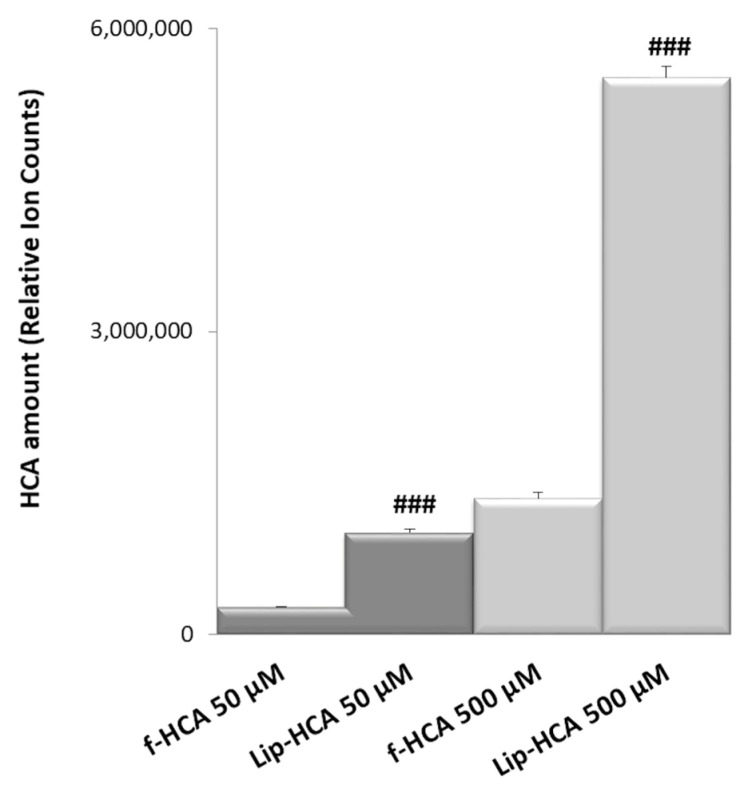
Relative amounts of HCA accumulated in U937/PMA cells after 24 h of exposure to free HCA (f-HCA) and HCA-loaded liposomes (Lip-HCA) (50 and 500 μM). Results are presented as means ± SD (n = 3). ### p < 0.001 (50 μM f-HCA vs. 50 μM Lip-HCA, and 500 μM f-HCA vs. 500 μM Lip-HCA).

References

    1. O’Neill L.A., Hardie D.G. Metabolism of inflammation limited by AMPK and pseudo-starvation. Nature. 2013;493:346–355. doi: 10.1038/nature11862. - DOI - PubMed
    1. Todisco S., Convertini P., Iacobazzi V., Infantino V. TCA Cycle Rewiring as Emerging Metabolic Signature of Hepatocellular Carcinoma. Cancers. 2019;12:68. doi: 10.3390/cancers12010068. - DOI - PMC - PubMed
    1. Ryan D.G., O’Neill L.A.J. Krebs cycle rewired for macrophage and dendritic cell effector functions. FEBS Lett. 2017;591:2992–3006. doi: 10.1002/1873-3468.12744. - DOI - PubMed
    1. Iacobazzi V., Infantino V. Citrate—New functions for an old metabolite. Biol. Chem. 2014;395:387–399. doi: 10.1515/hsz-2013-0271. - DOI - PubMed
    1. Lee I.T., Yang C.M. Role of NADPH oxidase/ROS in pro-inflammatory mediators-induced airway and pulmonary diseases. Biochem. Pharmacol. 2012;84:581–590. doi: 10.1016/j.bcp.2012.05.005. - DOI - PubMed

LinkOut - more resources