. 2020 Oct 23;19(1):185.
doi: 10.1186/s12933-020-01154-w.

Worldwide inertia to the use of cardiorenal protective glucose-lowering drugs (SGLT2i and GLP-1 RA) in high-risk patients with type 2 diabetes

Affiliations

Worldwide inertia to the use of cardiorenal protective glucose-lowering drugs (SGLT2i and GLP-1 RA) in high-risk patients with type 2 diabetes

Guntram Schernthaner et al. Cardiovasc Diabetol. .

Abstract

The disclosure of proven cardiorenal benefits with certain antidiabetic agents was supposed to herald a new era in the management of type 2 diabetes (T2D), especially for the many patients with T2D who are at high risk for cardiovascular and renal events. However, as the evidence in favour of various sodium-glucose transporter-2 inhibitor (SGLT2i) and glucagon-like peptide-1 receptor agonists (GLP-1 RA) accumulates, prescriptions of these agents continue to stagnate, even among eligible, at-risk patients. By contrast, dipeptidyl peptidase-4 inhibitors (DPP-4i) DPP-4i remain more widely used than SGLT2i and GLP-1 RA in these patients, despite a similar cost to SGLT2i and a large body of evidence showing no clear benefit on cardiorenal outcomes. We are a group of diabetologists united by a shared concern that clinical inertia is preventing these patients from receiving life-saving treatments, as well as placing them at greater risk of hospitalisation for heart failure and progression of renal disease. We propose a manifesto for change, in order to increase uptake of SGLT2i and GLP-1 RA in appropriate patients as a matter of urgency, especially those who could be readily switched from an agent without proven cardiorenal benefit. Central to our manifesto is a shift from linear treatment algorithms based on HbA1c target setting to parallel, independent considerations of atherosclerotic cardiovascular disease, heart failure and renal risks, in accordance with newly updated guidelines. Finally, we call upon all colleagues to play their part in implementing our manifesto at a local level, ensuring that patients do not pay a heavy price for continued clinical inertia in T2D.

Keywords: Cardiorenal protection; Clinical inertia; Glucose lowering drugs; Type 2 diabetes.


Conflict of interest statement

GS has received honoraria from AstraZeneca, Boehringer Ingelheim, Eli Lilly, Mundipharma, Servier and Takeda for speaking at sponsored meetings or attending advisory boards. NS has participated in scientific advisory boards and/or received honoraria from Astra Zeneca, Novo Nordisk, MSD, Boehringer-Ingelheim, Eli Lilly, Sanofi Aventis. ASA has participated in scientific advisory boards and/or received honoraria from Novo Nordisk, Sanofi-aventis, Boehringer- Ingelheim, Servier, Takeda, Eli Lilly, Astra Zeneca, MSD. AVB has participated in scientific advisory boards and/or received honoraria from Boehringer-Ingelheim, Astra-Zeneca, Novo-Nordisk, Sanofi-Aventis, Eli-Lilly, Novartis, Servier, Janssen, Medtronic. FE has participated in scientific advisory boards and/or received honoraria from Astra Zeneca, Boehringer-Ingelheim, Novo Nordisk. PF has received honoraria as a speaker and participated in scientific advisory-board in the last 3 years for Astra-Zeneca, Janssen, Boehringer Ingelheim, Eli Lilly, Sanofi, Novo Nordisk; has been an investigator of the Empa-Reg Outcome study, the ELIXA trial, the EXSCEL trial and the ongoing SOUL-Study. AJ has served as a consultant and is on speakers bureaus for AstraZeneca, Boehringer Ingelheim, Eli Lilly, Merck Sharp & Dohme (MSD), Novo Nordisk, and Sanofi. PK has been a board member and/or received honoraria from Novo Nordisk, Sanofi-Aventis, Eli-Lilly, Boehringer-Ingelheim, Astra-Zeneca, Egis, MSD, DiCare, Wörwag-Pharma, Richter-Gedeon, Novartis, 77 Elektronika Kft. IK has been a member of advisory boards and/or received honoraria/speaker fee from AstraZeneca, Boehringer Ingelheim, Eli Lilly, Ipsen, Novo Nordisk, Merck Sharp & Dohme, Sanofi Aventis, Berlin-Chemie. NML has been a member of advisory boards and/or received honoraria /speaker fee from Astra Zeneca, Boehringer-Ingelheim, Eli Lilly, Merck, Novo Nordisk, Sanofi Aventis. BM has been a member of advisory boards and/or received honoraria from Novo Nordisk, Astra Zeneca, Boehringer-Ingelheim, Takeda. EM has been a member of advisory boards and/or received speaker fee from Boehringer-Ingelheim, Eli Lilly, NovoNordisk, Sanofi, MSD, Worwag -Pharma, Mundipharma. DR has been a member of advisory boards and/or received honoraria/speaker fee from Abbott, Amgen, AstraZeneca, Bayer, Belupo, Boehringer Ingelheim, Eli Lilly, Lifescan – Johnson & Johnson, International Sweeteners Association, Krka, Medtronic, Mediligo, Novartis, Novo Nordisk, MSD, Merck Sharp & Dohme, Pfizer, Pliva, Roche, Salvus, Sandoz, Solvay, Sanofi Aventis and Takeda. CS has been a member of advisory boards, received honoraria/fees from Sanofi, Novo Nordisk, Astra Zeneca, Boehringer-Ingellheim, Servier Pharma. JS has been a member of boards and/or received honoraria from Novo Nordisk, Astra Zeneca, Eli Lilly, Sanofi-Aventis, Boehringer-Ingelheim. TT has been a member of advisory board and/or received speaker fee from Boehringer-Ingelheim, Astra Zeneca, Novo Nordisk, Eli Lilly, Sanofi, Servier, MSD. ZV has been a member of advisory boards and/or received honoraria from Astra Zeneca, Novo Nordisk, Boehringer-Ingelheim, Eli Lilly, Sanofi Aventis.

Figures
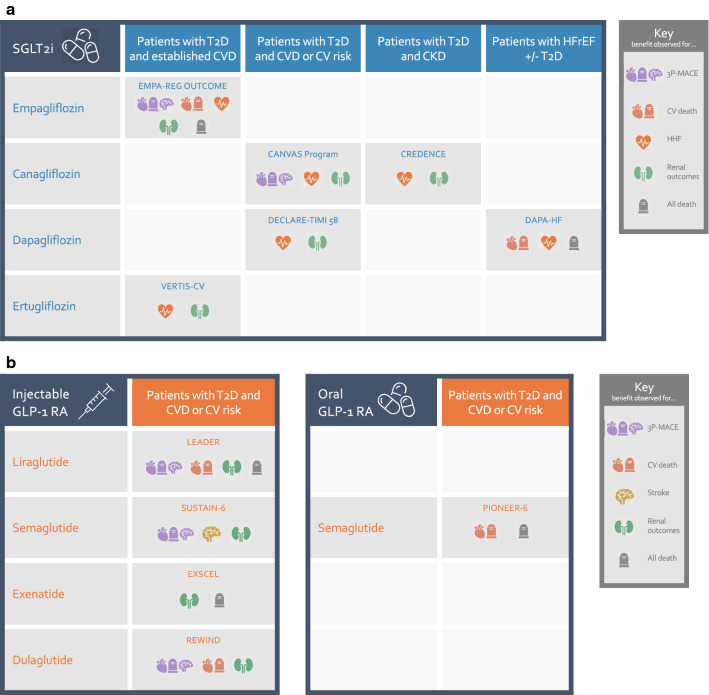
Fig. 1
Fig. 1
Cardiorenal and mortality benefits reported for SGLT2i and GLP-1 RA. a SGLT2i. CVOTs for empagliflozin, canagliflozin, dapagliflozin and ertugliflozin have all pointed to beneficial effects on HHF and renal function outcomes [–5, 7, 11, 13], either in a population with T2D and established CVD, or in a broader population also including patients with T2D and high CV risk. Renal benefits included slower progression of renal function decline and, where reported, improved albuminuria outcomes. In addition, empagliflozin and canagliflozin CVOTs demonstrated a reduction in 3P-MACE, while empagliflozin alone showed reductions in CV death and death by any cause [1, 7]. Note that in some cases benefits were shown in exploratory analyses. Dedicated renal and heart HF studies are also shedding light on cardiorenal benefits with SGLT2i. In CREDENCE, canagliflozin reduced HHF and renal events in patients with T2D and CKD (and showed a trend towards reduced CV deaths that did reach significance) [6], while in DAPA-HF, CV death, HHF and death by any cause were all reduced with dapagliflozin in patients with HFrEF, with or without T2D [9]. While this manuscript was under review, new publications have also shown that dapagliflozin improved a composite of renal and CV outcomes in patients with CKD, with or without T2D, in DAPA-CKD [20], and that empagliflozin reduced the risk of a composite of CV death or HHF in patients with HFrEF, with or without T2D, in EMPEROR-Reduced [21] (not shown). b GLP-1 RA. Some, but not all, GLP-1 RA CVOTs have shown cardiorenal benefits in patients with T2D and established CVD or high CV risk. Among injectable GLP-1 RA, liraglutide, semaglutide and dulaglutide CVOTs have all shown benefits in 3P-MACE and albuminuria outcomes [14, 15, 17, 18, 122, 123]. In addition, liraglutide reduced the risks of CV death and death by any cause, while semaglutide and dulaglutide reduced the risk of stroke. Once-weekly exenatide showed a trend towards a 3P-MACE benefit that did not reach significance in its CVOT, and also suggested reduced risks of death by any cause and albuminuria [19, 124]. Finally, a CVOT on the oral formulation of semaglutide suggested reduced risks of CV death and death by any cause [16]. For all CVOTs, patients in both placebo and treatment arms also received standard of care. Outcome definitions and inclusion criteria varied between CVOTs. Not all outcomes were primary outcomes, and findings may in some cases be of nominal significance only due to multiple testing, e.g. position in a prespecified hierarchy of statistical tests. Only marketed medications are shown
Fig. 2
Fig. 2
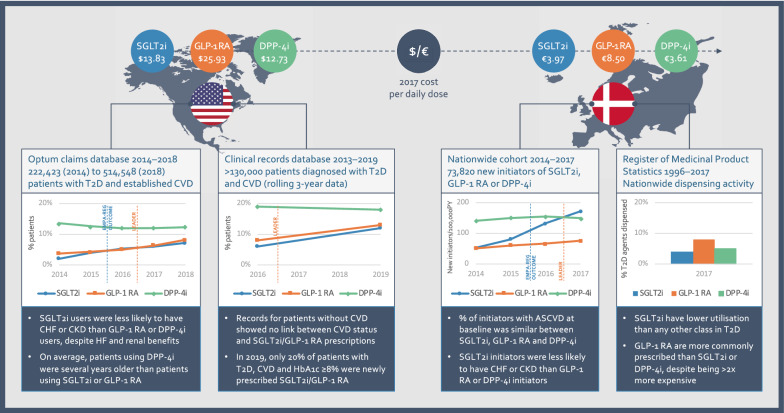
Most patients with T2D and CVD are not prescribed SGLT2i or GLP-1 RA. Data from the US and Denmark show clinical inertia in prescribing SGLT2i or GLP-1 RA, with only modest increases following the disclosures of the first CVOTs to show cardiorenal benefits, in September 2015 (EMPA-REG OUTCOME) and June 2016 (LEADER), respectively. Summaries are shown of data from the US Optum claims database between 2014 and 2018 [26, 31]; a rolling 3-year window study of clinical records from 20 US healthcare organisations, with the oldest cohort from Q1 2013 to Q1 2016 and the most recent cohort from Q1 2016 to 2019 [29, 30]; a nationwide cohort of new initiators of T2D therapies in Denmark from 2014 and 2017 [28]; and a nationwide registry of medicine utilisation in Denmark from 1996 to 2017, which did not include patient-level data [27]. Contemporary costs of SGLT2i, GLP-1 RA and DPP-4i in 2017, the most recent year captured by all the studies, show that pricing does not seem to explain therapy preferences. US prices are median National Average Drug Acquisition Cost reference data per day for empagliflozin, liraglutide and sitagliptin [73]. Other agents in each class were similarly priced. For Denmark, mean prices for a defined daily dose are shown across each class [27]
Fig. 3
Fig. 3
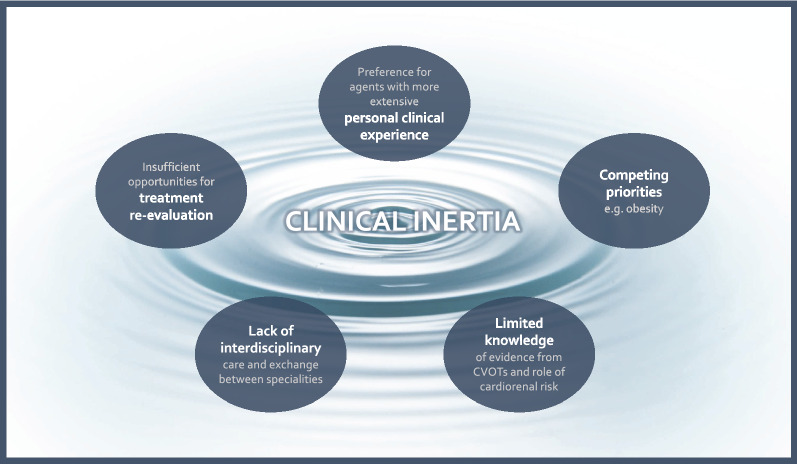
Drivers of clinical inertia in the management of cardiorenal risk in T2D. We argue that the slow uptake of SGLT2i and GLP-1 RA following CVOT disclosures can be attributed to clinical inertia. We suggest several factors that may be responsible for driving this inertia; each will need to be addressed if we are to ensure that eligible, at-risk patients are to benefit from the risk reductions proven in CVOTs, and now emerging from dedicated HF and renal studies
Fig. 4
Fig. 4
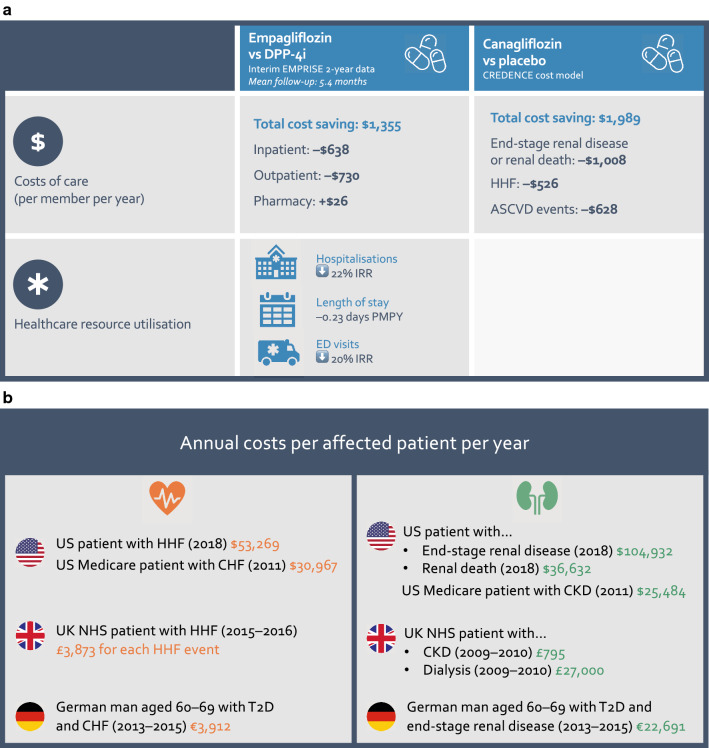
Savings to healthcare costs and resource utilisation with SGLT2i. a Savings across US insured populations with T2D. Two-year interim data from the EMPRISE real-world evidence study has measured the cost of care and healthcare resource utilisation for new initiators of empagliflozin vs DPP-4i in two commercial claims databases plus Medicare patients between August 2014 and September 2016, with an average of 5.4 months follow-up. Healthcare resource utilisation data were available for 17,549 patients in each arm matched 1:1 by propensity scoring, and showed ≥ 20% reductions in the numbers of hospitalisations and ER visits with empagliflozin per member per year (PMPY) [125]. Cost data were available for 2928 patients in each arm matched 1:1 by propensity scoring, and showed substantial savings with empagliflozin across the full cohort [126]. A model based on data from the CREDENCE renal outcomes study estimated that the total cost saving for a US insured population with T2D and CKD would be nearly $2000 PMPY when adding canagliflozin to standard of care [100]. b Savings per affected patient in the US, UK and Germany. Cost data from the US [100, 103], UK [101, 127] and Germany [102] showing the healthcare expenditure associated with HF and CKD. As expected, costs for the US are notably higher than in Europe; however, even in the UK and Germany expenditure is substantial
Fig. 5
Fig. 5
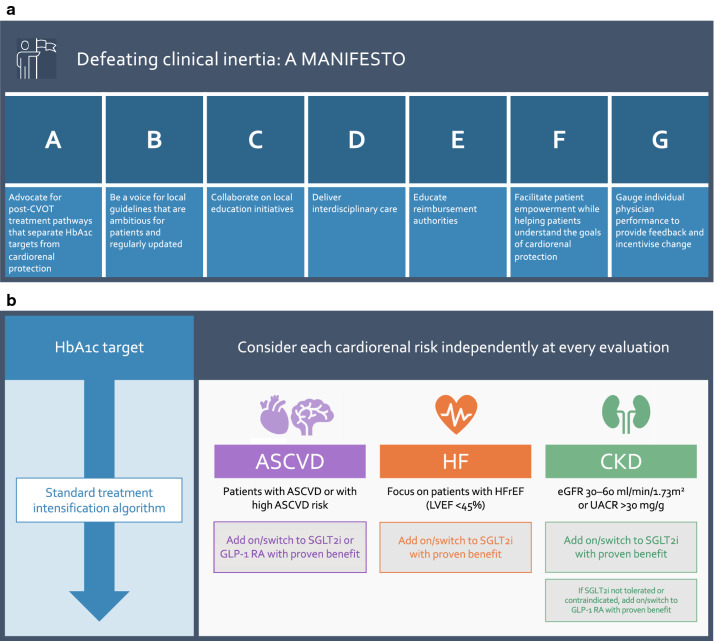
The clinical inertia crisis: a manifesto. a Our manifesto for change. We have set out needed actions to tackle clinical inertia in T2D in a ‘manifesto’ to change practice, including seven steps that colleagues can adopt to change local prescribing habits, so that more lives are saved and cardiorenal events avoided with appropriate use of SGLT2i and GLP-1 RA. b Rethinking treatment algorithms to separate the management of cardiorenal risk from HbA1c targets. Central to our manifesto is a wider adoption of the new approach taken by ADA, EASD and ESC guidelines [36, 50, 51] to treatment algorithms of antidiabetic agents. Rather than only add on treatments when HbA1c targets are exceeded, updated guidelines recommend that ASCVD, HF and renal risks should be considered independently of HbA1c. For patients with established ASCVD or presenting indicators of high ASCVD risk, the treatment regimen should be adapted by add-on or switch to incorporate a SGLT2i or GLP-1 RA with proven CV benefits. For patients with HF, notably HFrEF with LVEF < 45%, or CKD, an SGLT2i with proven benefit should be incorporated by add-on or switch, so long as not contraindicated e.g. due to renal function lower than indicated in prescribing information. CKD can be defined as estimated glomerular filtration rate (eGFR) < 60 ml/min/1.73 m2 and/or urinary albumin–creatinine ratio (UACR) > 30 mg/g (and especially if > 300 mg/g). Among SGLT2i, according to current European Union prescribing information, dapagliflozin, empagliflozin and ertugliflozin should not be initiated below 60 ml/min/1.73 m2 (and stopped if persistently below 45 ml/min/1.73 m2), while canagliflozin should only be used below 45 ml/min/1.73 m2 for patients with UACR ˃ 300 mg/g, and should not be initiated below 30 ml/min/1.73 m2. Prescribing information in the United States has some differences; ertugliflozin is not recommended in patients with an eGFR below 60 ml/min/1.73 m2, while canagliflozin, dapagliflozin and empagliflozin may be initiated below 60 ml/min/1.73 m2, but should be discontinued if persistently below 45 ml/min/1.73 m2 (with the exception of dapagliflozin in patients with HFrEF, with or without T2D, where use is supported for eGFR ≥ 30 ml/min/1.73 m2). If SGLT2i cannot be used, a GLP-1 RA with proven benefit should be considered to improve renal outcomes for patients with CKD

References

    1. Zinman B, Wanner C, Lachin JM, Fitchett D, Bluhmki E, Hantel S, et al. Empagliflozin, cardiovascular outcomes, and mortality in type 2 diabetes. N Engl J Med. 2015;373:2117–2128. doi: 10.1056/NEJMoa1504720. - DOI - PubMed
    1. Wanner C, Inzucchi SE, Lachin JM, Fitchett D, von Eynatten M, Mattheus M, et al. Empagliflozin and progression of kidney disease in type 2 diabetes. N Engl J Med. 2016;375:323–334. doi: 10.1056/NEJMoa1515920. - DOI - PubMed
    1. Fitchett D, Zinman B, Wanner C, Lachin JM, Hantel S, Salsali A, et al. Heart failure outcomes with empagliflozin in patients with type 2 diabetes at high cardiovascular risk: results of the EMPA-REG OUTCOME® trial. Eur Heart J. 2016;37:1526–1534. doi: 10.1093/eurheartj/ehv728. - DOI - PMC - PubMed
    1. Wiviott SD, Raz I, Bonaca MP, Mosenzon O, Kato ET, Cahn A, et al. Dapagliflozin and cardiovascular outcomes in type 2 diabetes. N Engl J Med. 2019;380:347–357. doi: 10.1056/NEJMoa1812389. - DOI - PubMed
    1. Mosenzon O, Wiviott SD, Cahn A, Rozenberg A, Yanuv I, Goodrich EL, et al. Effects of dapagliflozin on development and progression of kidney disease in patients with type 2 diabetes: an analysis from the DECLARE-TIMI 58 randomised trial. Lancet Diabetes Endocrinol. 2019;7:606–617. doi: 10.1016/S2213-8587(19)30180-9. - DOI - PubMed

MeSH terms