. 2020 Nov 25;40(48):9272-9282.
doi: 10.1523/JNEUROSCI.2072-20.2020. Epub 2020 Oct 23.

Dissociation of Medial Frontal β-Bursts and Executive Control

Affiliations

Dissociation of Medial Frontal β-Bursts and Executive Control

Steven P Errington et al. J Neurosci. .

Abstract

The neural mechanisms of executive and motor control concern both basic researchers and clinicians. In human studies, preparation and cancellation of movements are accompanied by changes in the β-frequency band (15-29 Hz) of electroencephalogram (EEG). Previous studies with human participants performing stop signal (countermanding) tasks have described reduced frequency of transient β-bursts over sensorimotor cortical areas before movement initiation and increased β-bursting over medial frontal areas with movement cancellation. This modulation has been interpreted as contributing to the trial-by-trial control of behavior. We performed identical analyses of EEG recorded over the frontal lobe of macaque monkeys (one male, one female) performing a saccade countermanding task. While we replicate the occurrence and modulation of β-bursts associated with initiation and cancellation of saccades, we found that β-bursts occur too infrequently to account for the observed stopping behavior. We also found β-bursts were more common after errors, but their incidence was unrelated to response time (RT) adaptation. These results demonstrate the homology of this EEG signature between humans and macaques but raise questions about the current interpretation of β band functional significance.SIGNIFICANCE STATEMENT The finding of increased β-bursting over medial frontal cortex with movement cancellation in humans is difficult to reconcile with the finding of modulation too late to contribute to movement cancellation in medial frontal cortex of macaque monkeys. To obtain comparable measurement scales, we recorded electroencephalogram (EEG) over medial frontal cortex of macaques performing a stop signal (countermanding) task. We replicated the occurrence and modulation of β-bursts associated with the cancellation of movements, but we found that β-bursts occur too infrequently to account for observed stopping behavior. Unfortunately, this finding raises doubts whether β-bursts can be a causal mechanism of response inhibition, which impacts future applications in devices such as brain-machine interfaces.

Keywords: EEG; countermanding; error monitoring; response inhibition; stop signal; stopping.


Figures

Figure 1.
Figure 1.
Experimental procedures. A, Saccade-countermanding task. Monkeys initiated trials by fixating on a central point. After a variable time, the center of the fixation point was extinguished. A peripheral target was presented simultaneously at one of two possible locations. On no-stop-signal trials monkeys were required to shift gaze to the target, whereupon after 600 ± 0 ms a high-pitched auditory feedback tone was delivered, and 600-ms later fluid reward was provided. On stop-signal trials (∼40% of trials), after the target appeared the center of the fixation point was re-illuminated after a variable SSD, which instructed the monkey to cancel the saccade in which case the same high-pitched tone was presented after a 1500 ± 0 ms hold time followed, after 600 ± 0 ms by fluid reward. SSD was adjusted such that monkeys successfully canceled the saccade in ∼50% of trials. In the remaining trials, monkeys made non-canceled errors which were followed after 600 ± 0 ms by a low-pitched tone, and no reward was delivered. Monkeys could not initiate trials earlier after errors. B, Countermanding behavior. Top left, Cumulative distribution function of response latencies on no-stop (green) and non-canceled (yellow) trials. Response latencies on non-canceled trials were faster than those on no-stop trials. Top right, Inhibition function plotting the probability of responding across SSDs. Weibull functions were fitted to data from each session. The mean of these Weibull functions across sessions and the corresponding 95% CI is plotted for each monkey (monkey Eu: purple; X: blue). Bottom left, Distribution of mean SSRTs across sessions. Bottom right, Distribution of the proportion of trigger failures across sessions. C, LFP processing. EEG was recorded with leads placed on the cranial surface over the medial frontal cortex at the location analogous to FCz in humans. The EEG lead was located over the supplementary eye field (SEF) and pre-supplementary motor area (pre-SMA). For each session, raw data were extracted. After bandpass filtering between 15 and 29 Hz, this signal was epoched from −1000 to 2500 ms relative to target presentation, saccade initiation, and stop-signal presentation. D, β-Burst processing. The epoched signal for each trial was convolved with a complex Morlet wavelet. Time-frequency power estimates were extracted by calculating the squared magnitude of the complex wavelet-convolved data. Individual β-bursts were defined as local maxima in the trial-by-trial band time-frequency power matrix, for which the power exceeded a threshold of six times the median power of the entire time-frequency power matrix for the electrode. An example burst is shown in the time-frequency plot at the bottom. E, Examples of β band time frequency in 12 randomly selected trials, aligned on SSD (solid red), with the corresponding SSRT (dashed red). These plots are indistinguishable from counterparts derived from human data.
Figure 2.
Figure 2.
β-Bursts during stopping. A, Boxplots showing the incidence of β-bursts observed during the STOP process interval (from scheduled SSD to SSRT) during no-stop (green), non-canceled (orange), canceled (red), and during an equivalent period of time before target presentation (gray). β-Bursts are observed in ∼10–15% of trials and are slightly but significantly more commonly observed when saccades are inhibited. B, Raster plot of β-bursts aligned on a pretarget baseline interval (left), stop signal (middle), and saccade initiation (right) across all sessions. Each tick-mark shows the time of peak β-amplitudes satisfying inclusion criteria on each trial. Rasters are shown for non-canceled, no-stop, and canceled trials. The rough equivalence of β-burst frequency across types of trials is evident, as is the elevation of β-burst rate at the end of non-canceled error trials. C, β-Burst density function derived from raster plots. β-Burst peak times were convolved with a Gaussian function. During the stopping period, β-bursts were slightly but significantly more common on canceled trials (red line) than on no-stop (green) or non-canceled trials (yellow). D, Comparing time course of β-burst (top) and single neuron discharges (bottom) on canceled and latency-matched no stop signal trials for a single session. At no time did the incidence of β-bursts on single session differentiate between movement initiation and inhibition. In contrast, as demonstrated previously, the discharge rate of an example FEF movement neuron sampled in one session shows a clear separation between trial types occurring before the STOP process concludes. The neuron was recorded from another monkey in a separate study performing a choice countermanding task (Middlebrooks et al., 2020) and is provided as an example to demonstrate the mechanistic differences between the signals.
Figure 3.
Figure 3.
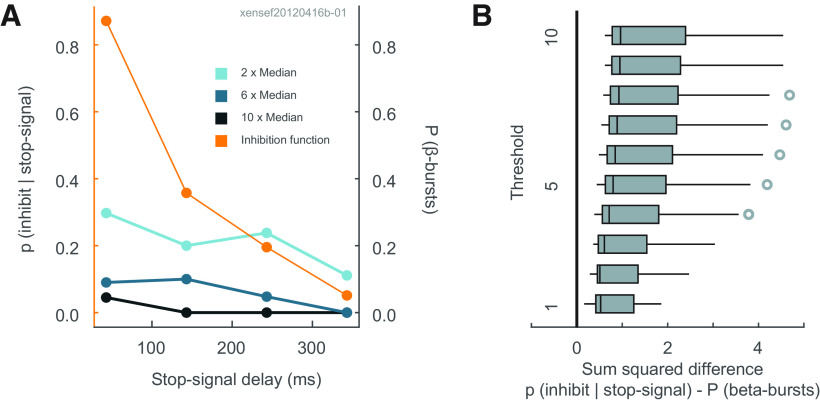
No relationship between β-bursts and response inhibition. A, Primary ordinate, average probability for a representative session of inhibiting on stop signal trials as a function of stop signal delay (orange line). Secondary ordinate, average probability of β-bursts determined with amplitudes exceeding the median threshold by 2 (light blue), 6 (blue), and 10 (dark blue) times in that session. The neurometric function derived from the probability of β-bursts does not correspond to the probability of inhibiting as a function of stop signal delay. B, Boxplots of the sum of squared differences between probabilities of canceling and of β-bursts across sessions determined with amplitudes exceeding from one to 10 times the median threshold. Open circles indicate outlier values. From generous to severe measurement thresholds, the incidence of β-bursts did not account for the probability of cancellation with stop signal delay.
Figure 4.
Figure 4.
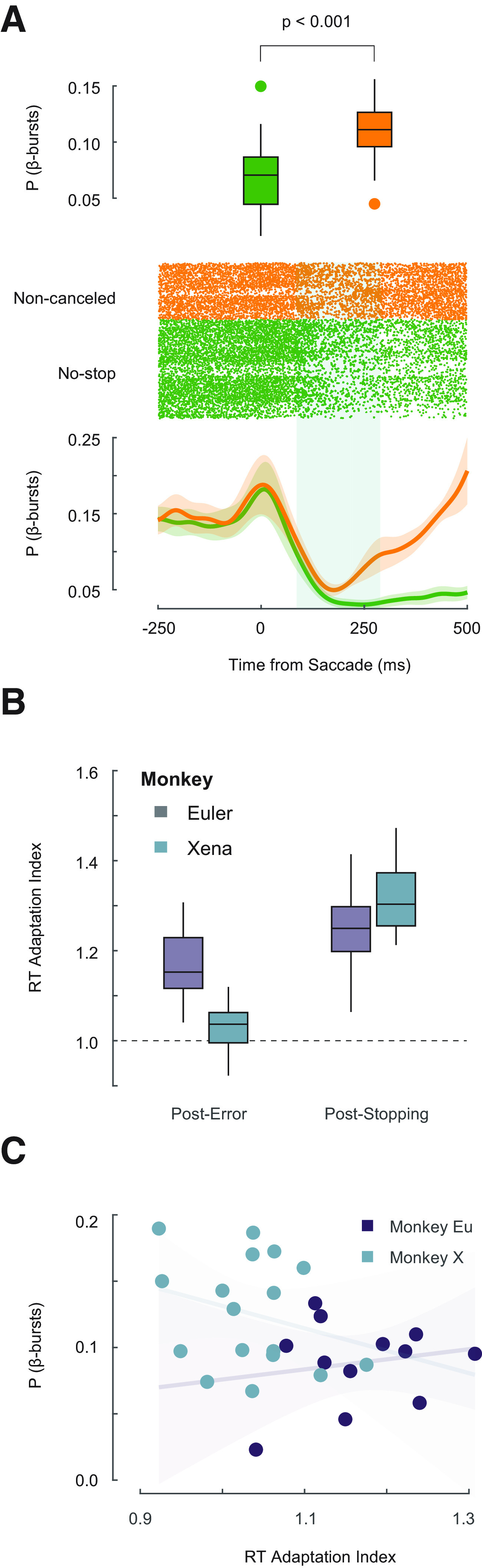
Relationship between β-bursts and performance monitoring. A, β-Bursts during error and correct responses. Top, Boxplot showing significantly greater incidence of β-bursts observed 100–300 ms following non-canceled (orange) compared with correct saccades (green). Middle, Raster plot aligned on saccade. Each tick-mark shows the time of one β-burst on a non-canceled (yellow) and no-stop (green) trials. Bottom, β-Burst density function. Following a saccade, the incidence of bursts on both error and correct trials decreases. This is followed by a pronounced increase in β-burst frequency ∼150 ms after noncancelled error saccades. B, Boxplots of RT adaptation following non-canceled errors and successful cancellations across sessions for Eu (purple) and X (cyan). Values greater than one represent slowing. As observed previously, both monkeys tend to delay responses somewhat after errors and more after successful stopping. C, β-Bursts are unrelated to RT adaptation. The incidence of β-bursts observed after errors did not vary as a function of the post-error RT adaptation index across sessions for Eu (purple) or X (cyan). Non-significant regression lines (±95% CI) include 0 slope.

References

    1. Amarante LM, Caetano MS, Laubach M (2017) Medial frontal theta is entrained to rewarded actions. J Neurosci 37:10757–10769. 10.1523/JNEUROSCI.1965-17.2017 - DOI - PMC - PubMed
    1. Amiez C, Petrides M (2009) Anatomical organization of the eye fields in the human and non-human primate frontal cortex. Prog Neurobiol 89:220–230. 10.1016/j.pneurobio.2009.07.010 - DOI - PubMed
    1. Aron AR, Poldrack RA (2006) Cortical and subcortical contributions to Stop signal response inhibition: role of the subthalamic nucleus. J Neurosci 26:2424–2433. 10.1523/JNEUROSCI.4682-05.2006 - DOI - PMC - PubMed
    1. Aron AR, Behrens TE, Smith S, Frank MJ, Poldrack RA (2007) Triangulating a cognitive control network using diffusion-weighted magnetic resonance imaging (MRI) and functional MRI. J Neurosci 27:3743–3752. 10.1523/JNEUROSCI.0519-07.2007 - DOI - PMC - PubMed
    1. Beyer F, Münte TF, Fischer J, Krämer UM (2012) Neural aftereffects of errors in a stop-signal task. Neuropsychologia 50:3304–3312. 10.1016/j.neuropsychologia.2012.10.007 - DOI - PubMed

Publication types

LinkOut - more resources