. 2021 Mar;15(3):774-788.
doi: 10.1038/s41396-020-00812-x. Epub 2020 Oct 23.

Host specificity of microbiome assembly and its fitness effects in phytoplankton

Affiliations

Host specificity of microbiome assembly and its fitness effects in phytoplankton

Sara L Jackrel et al. ISME J. 2021 Mar.

Abstract

Insights into symbiosis between eukaryotic hosts and their microbiomes have shifted paradigms on what determines host fitness, ecology, and behavior. Questions remain regarding the roles of host versus environment in shaping microbiomes, and how microbiome composition affects host fitness. Using a model system in ecology, phytoplankton, we tested whether microbiomes are host-specific, confer fitness benefits that are host-specific, and remain conserved in time in their composition and fitness effects. We used an experimental approach in which hosts were cleaned of bacteria and then exposed to bacterial communities from natural environments to permit recruitment of microbiomes. We found that phytoplankton microbiomes consisted of a subset of taxa recruited from these natural environments. Microbiome recruitment was host-specific, with host species explaining more variation in microbiome composition than environment. While microbiome composition shifted and then stabilized over time, host specificity remained for dozens of generations. Microbiomes increased host fitness, but these fitness effects were host-specific for only two of the five species. The shifts in microbiome composition over time amplified fitness benefits to the hosts. Overall, this work solidifies the importance of host factors in shaping microbiomes and elucidates the temporal dynamics of microbiome compositional and fitness effects.


Conflict of interest statement

The authors declare that they have no conflict of interest.

Figures

Fig. 1
Fig. 1. Bacterial communities originating from three ponds in southeastern Michigan differed from the communities that migrated into jars containing initially axenic algae.
These bacterial communities now associated with algae were A lower in taxonomic richness, B lower in Shannon’s diversity, but C similar in Pielou’s evenness. As algal cultures were maintained under laboratory conditions, richness and diversity continued to decline whereas evenness remained similar. D Bacterial community composition described using a Bray–Curtis distance metric differed most between the community inhabiting pond water versus the subset of the community that migrated into the jars containing the initially axenic algal cultures, as well as between culture jars (i.e., Day 3) and culture flasks (i.e., Days 10–31). Bacterial composition differed significantly between all days, except Day 24, which did not differ significantly from Day 17 or Day 31 via pairwise post hoc tests where p < 0.05.
Fig. 2
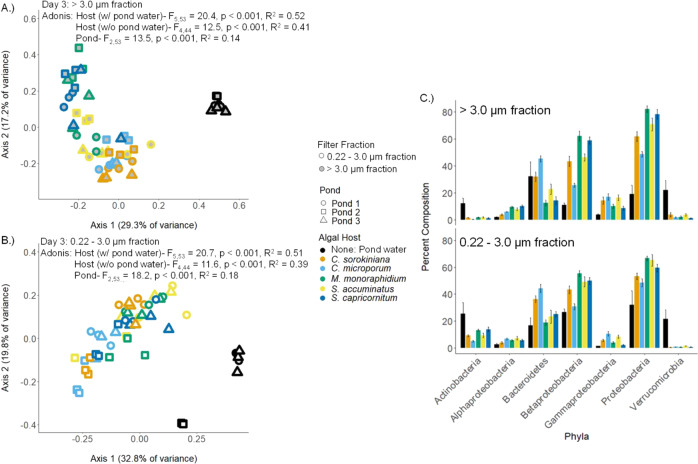
Fig. 2. Bacterial community composition described using a Bray–Curtis distance metric exhibited specificity to the algal-host species immediately following the 72-h incubation period of initially axenic algae in pond water.
Host specificity was evident in A the >3.0-μm fraction and B the 0.22–3.0-μm fraction. Host specificity in the C >3.0-μm fraction and D 0.22–3.0-μm fraction could be explained in part by the prevalence of Bacteriodetes in cultures of C. microporum and C. sorokiniana versus Proteobacteria in cultures of the remaining three species. Bacterial composition associated with each algal host differed significantly for all host pairwise comparisons for both fractions, with the exception of M. minutum versus S. capricornutum, which did not harbor significantly different bacterial communities from each other for either fraction, via pairwise post hoc tests where p < 0.05. See Fig. S4 for analyses using the phylogenetic-dependent UniFrac distance metric.
Fig. 3
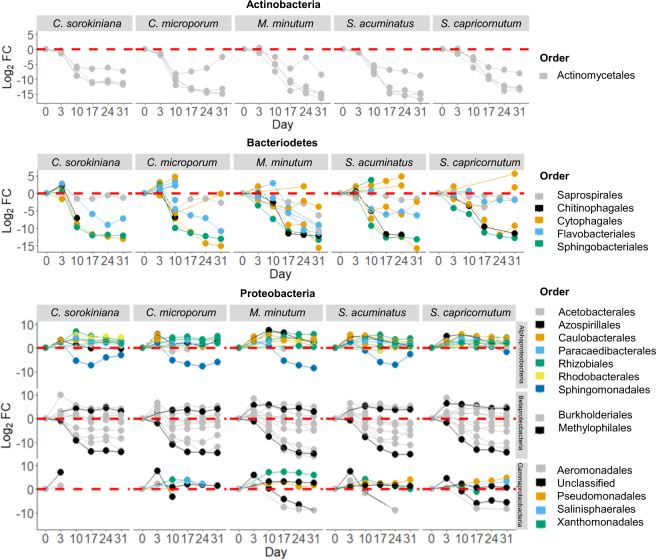
Fig. 3. Relative to initial pond water, algal cultures were significantly under and over represented in numerous taxa (see Fig. S5 for results from all phyla).
Among OTUs comprising at least 0.1% of all algal culture reads, OTUs of Proteobacteria and Bacteroidetes showed variable results depending on taxon, whereas OTUs of Actinobacteria showed consistent patterns of underrepresentation. See Fig. S5 for these three phyla with no relative abundance threshold. Included in analyses were 0.22–3.0-μm samples for pond water and Day 3, and >0.22-μm samples for Days 10–31. OTU lines with fewer than six data points were absent from the normalized datasets at those time points.
Fig. 4
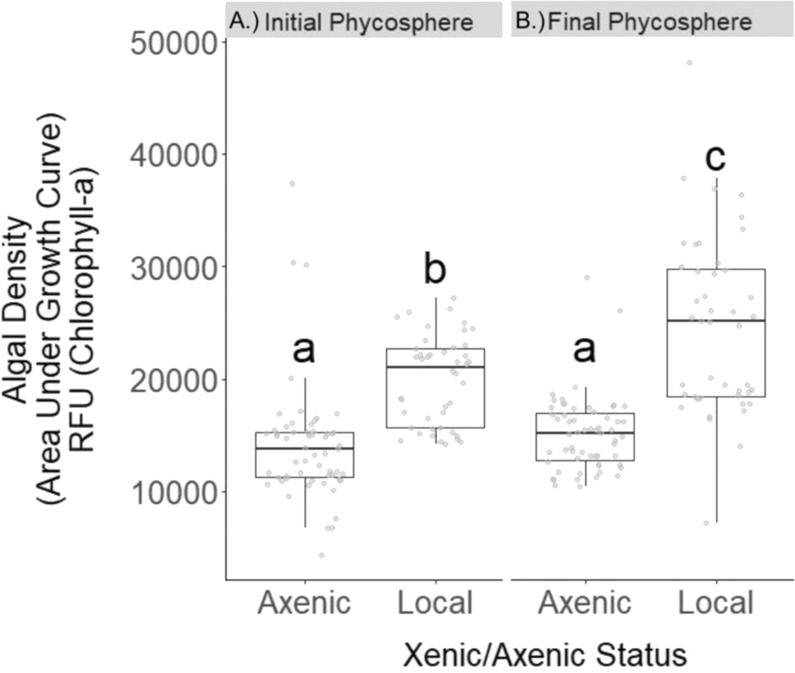
Fig. 4. Five species of initially axenic algae inoculated with final phycospheres grew to significantly higher population densities than axenic algae inoculated with initial phycospheres.
Phycospheres were reintroduced to the algal species of origin to generate “xenic” strains. A Initial phycospheres originated from algal cultures obtained on Day 3, which was 72 h following exposure of axenic algae to pond water, and B final phycospheres originated from Day 31 of this experiment following 4 weeks of maintenance under controlled laboratory conditions. See Figs. 1 and 3 for further description of bacterial community composition changes over this timespan. Total area under the curve of fluorescence-based estimates of algal population density was compared across the first 14 days of growth. Tests of initial and final phycospheres inherently required two rounds of experiments completed at different times. Linear mixed-effects model was significant (p < 0.0001) with shared lettering indicating those treatments that do not differ significantly according to post hoc comparisons (p > 0.05).
Fig. 5
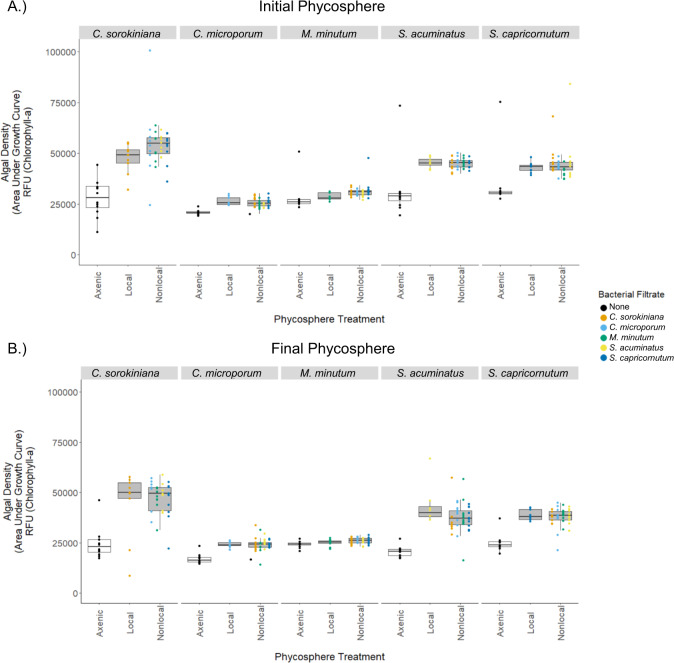
Fig. 5. Phycosphere bacterial communities that assembled in association with five species of green eukaryotic algae were isolated and reintroduced to each of the five species of algae that had been rendered axenic.
Phycospheres reintroduced to the algal species of origin were referred to as “local,” and all others were referred to as “nonlocal.” A When phycospheres were reintroduced immediately after the assembly event, algal densities reached significantly higher levels when xenic. B When phycospheres were isolated from cultures 4 weeks after the assembly event and reintroduced to axenic algae, algal densities still reached significantly higher levels when xenic than axenic. For both initial and final phycosphere: linear mixed-effects models p < 0.0001 with post hoc comparisons indicating: axenic < local = nonlocal.

References

    1. Lau JA, Lennon JT. Rapid responses of soil microorganisms improve plant fitness in novel environments. Proc Natl Acad Sci. 2012;109:14058. - PMC - PubMed
    1. Rosshart SP, Vassallo BG, Angeletti D, Hutchinson DS, Morgan AP, Takeda K, et al. Wild mouse gut microbiota promotes host fitness and improves disease resistance. Cell. 2017;171:1015–1028.e13. - PMC - PubMed
    1. Lynch J, Hsiao E. Microbiomes as sources of emergent host phenotypes. Science. 2019;365:1405–9. - PubMed
    1. Holland MA, Polacco JC. PPFMs and other covert contaminants: Is there more to plant physiology than just plant? Annu Rev Plant Physiol Plant Mol Biol. 1994;45:197–209.

    1. Cho I, Blaser MJ. The human microbiome: at the interface of health and disease. Nat Rev Genet. 2012;13:260. - PMC - PubMed

Publication types