. 2021 Jan 15:225:117465.
doi: 10.1016/j.neuroimage.2020.117465. Epub 2020 Oct 21.

ERP CORE: An open resource for human event-related potential research

Affiliations

ERP CORE: An open resource for human event-related potential research

Emily S Kappenman et al. Neuroimage. .

Abstract

Event-related potentials (ERPs) are noninvasive measures of human brain activity that index a range of sensory, cognitive, affective, and motor processes. Despite their broad application across basic and clinical research, there is little standardization of ERP paradigms and analysis protocols across studies. To address this, we created ERP CORE (Compendium of Open Resources and Experiments), a set of optimized paradigms, experiment control scripts, data processing pipelines, and sample data (N = 40 neurotypical young adults) for seven widely used ERP components: N170, mismatch negativity (MMN), N2pc, N400, P3, lateralized readiness potential (LRP), and error-related negativity (ERN). This resource makes it possible for researchers to 1) employ standardized ERP paradigms in their research, 2) apply carefully designed analysis pipelines and use a priori selected parameters for data processing, 3) rigorously assess the quality of their data, and 4) test new analytic techniques with standardized data from a wide range of paradigms.

Keywords: Data quality; EEG; Event-related potentials; Open science; Reproducibility.


Conflict of interest statement

Declaration of Competing Interest The authors declare no competing financial interests.

Figures
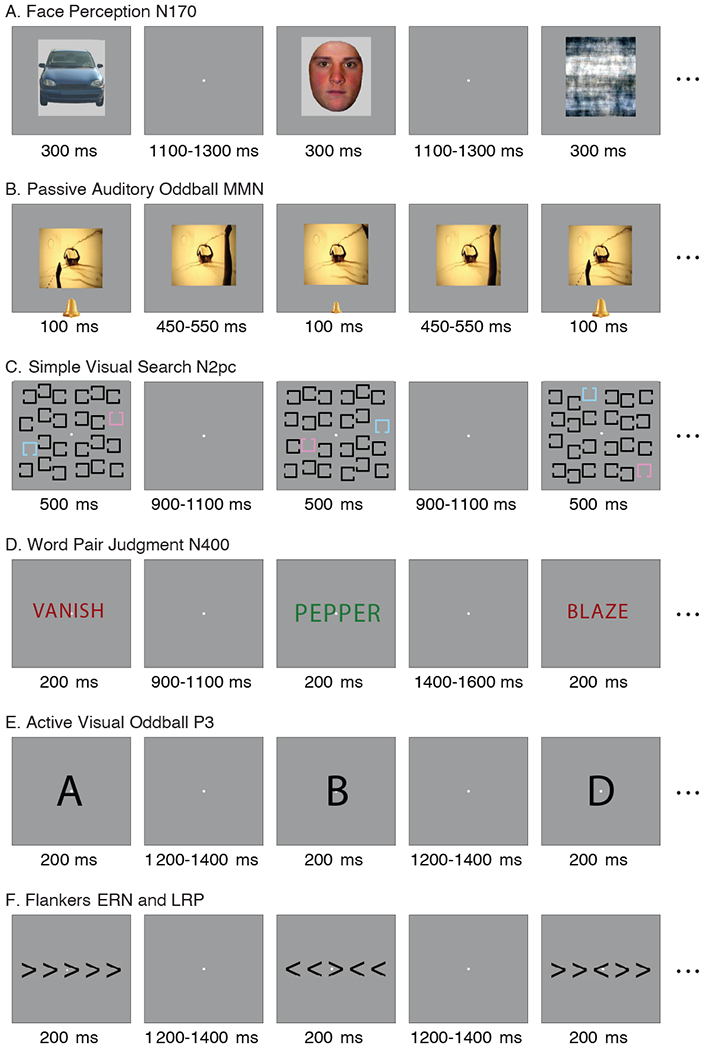
Figure 1.
Figure 1.
Examples of a subset of the trials in each of the six tasks. The stimuli are not drawn to scale; see Supplementary Materials and Methods for actual sizes. (A) Face perception task used to elicit the N170. On each trial, an image of a face, car, scrambled face, or scrambled car was presented in the center of the screen, and participants indicated whether a given stimulus was an “object” (face or car) or a “texture” (scrambled face or scrambled car). (B) Passive auditory oddball task used to elicit the mismatch negativity (MMN). Standard tones (80 dB, p = .8) and deviant tones (70 dB, p = .2) were presented over speakers while participants watched a silent video and ignored the tones. (C) Simple visual search task used to elicit the N2pc. Either pink or blue was designated the target color at the beginning of a trial block, and participants indicated whether the gap in the target color square was on the top or bottom. (D) Word pair judgment task used to elicit the N400. Each trial consisted of a red prime word followed by a green target word, and participants indicated whether the target word was semantically related or unrelated to the prime word. (E) Active visual oddball task used to elicit the P3. The letters A, B, C, D, and E were presented in random order (p = .2 for each letter). One of the letters was designated the target for a given block of trials, and participants indicated whether each stimulus was the target or a non-target for that block. Thus, the probability of the target category was .2, but the same physical stimulus served as a target in some blocks and a nontarget in others. (F) Flankers task used to elicit the lateralized readiness potential (LRP) and the error-related negativity (ERN). The central arrowhead was the target, and it was flanked on both sides by arrowheads that pointed in the same direction (congruent trials) or the opposite direction (incongruent trials). Participants indicated the direction of the target arrowhead on each trial with a left- or right-hand buttonpress.
Figure 2.
Figure 2.
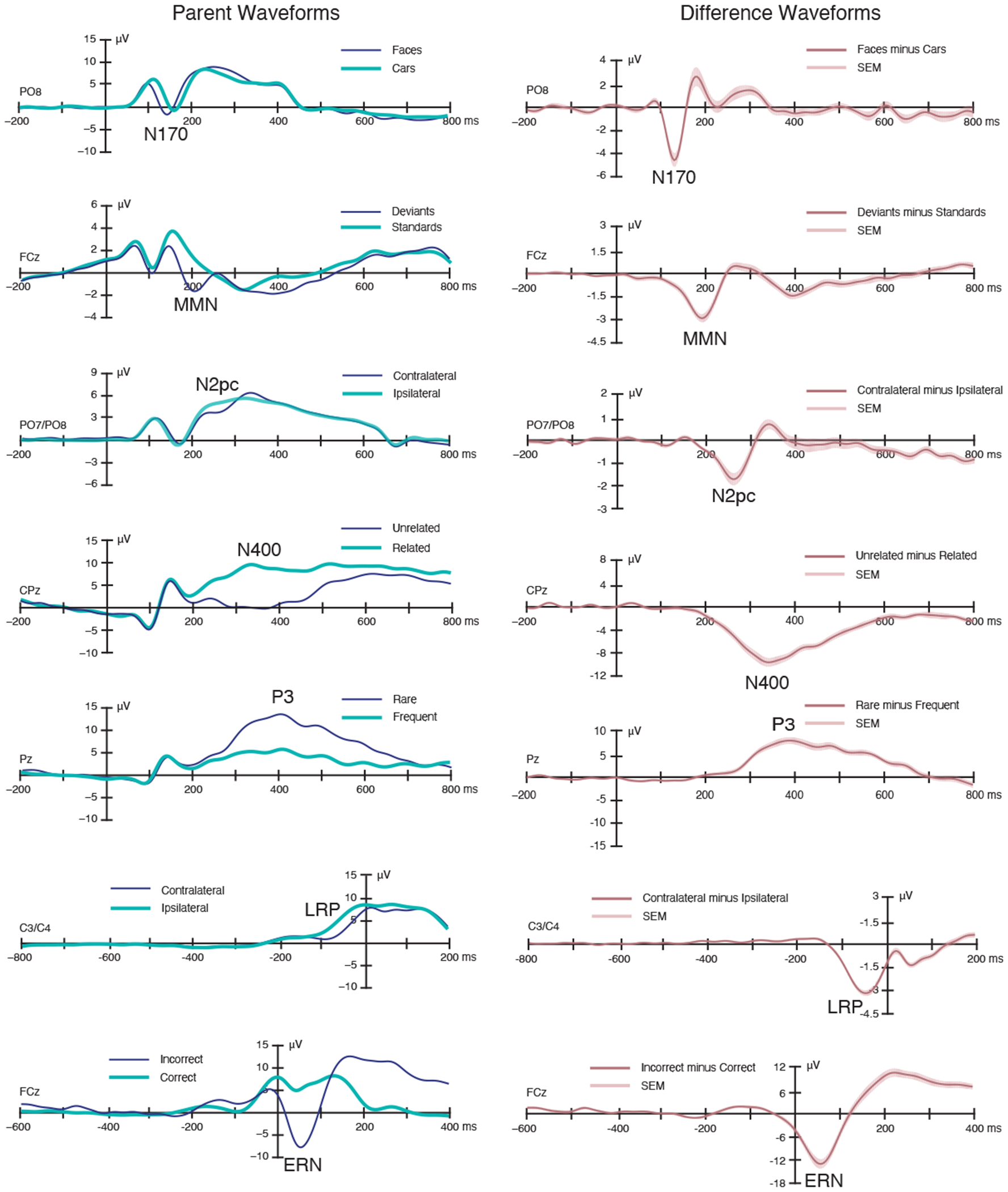
Grand average parent ERP waveforms (left) and difference waveforms (right). The shading surrounding the difference waveforms indicates the region that fell within ±1 SEM at a given time point (which reflects both measurement error and true differences among participants). A digital low-pass filter was applied offline before plotting the ERP waveforms (Butterworth impulse response function, half-amplitude cutoff at 20 Hz, 48 dB/oct roll-off).
Figure 3.
Figure 3.
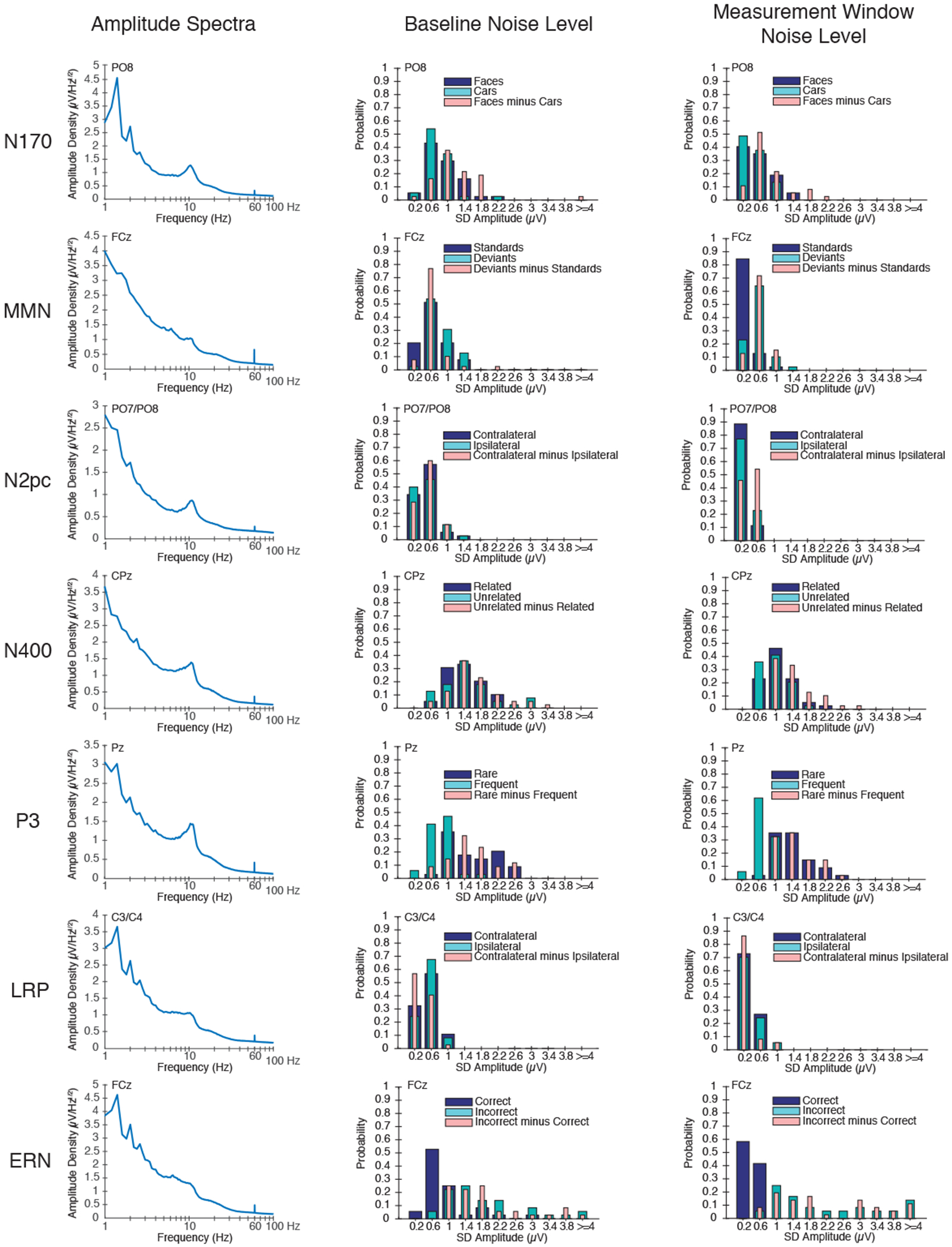
Quantification of the EEG signal and the ERP noise. (Left) Amplitude density as a function of frequency (on a log scale) for each ERP component at the electrode site where that component was maximal, calculated from individual participants and then averaged. Note that, although LRP and ERN were isolated in the same task, the spectra were obtained at different electrode sites and therefore differ slightly. (Middle) Probability histograms of the noise levels during the baseline period for the averaged ERP parent waveforms and difference waveforms. Bins are 0.4 μV in width, and the x-axis indicates the midpoint value for each bin. (Right) Probability histograms of the noise levels during the measurement time window of the plus-minus average parent waveforms and difference waveforms. Bins are 0.4 μV in width, and the x-axis indicates the midpoint value for each bin.
Figure 4.
Figure 4.
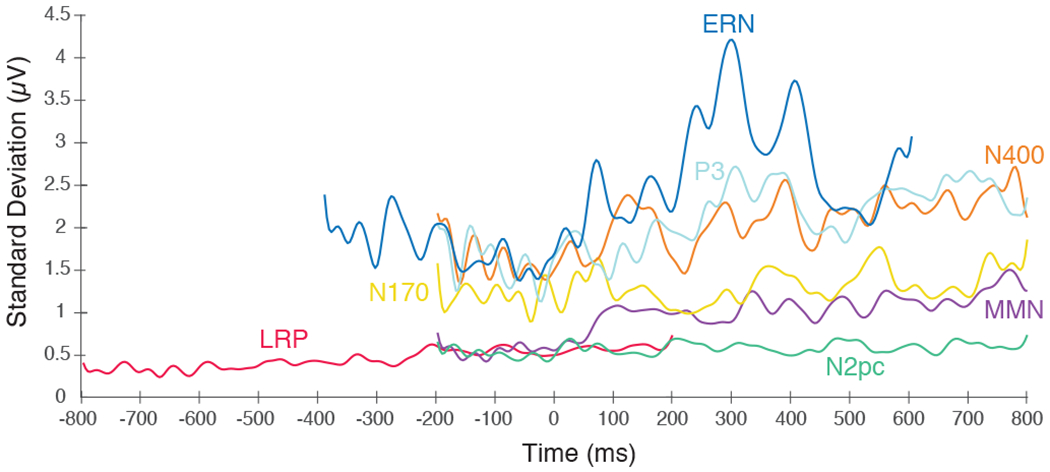
Noise level at each time point for each component at the electrode site where that component was maximal, measured as the standard deviation across participants of the plus-minus ERP difference waveforms at a given time point. Time zero represents the time-locking point for each ERP component (i.e., the onset of the stimulus for the N170, MMN, N2pc, N400, and P3, and the buttonpress for the LRP and ERN).

References

    1. Boudewyn MA, Luck SJ, Farrens JL, Kappenman ES, 2018. How many trials does it take to get a significant ERP effect? It depends. Psychophysiology. 55, e13049. 10.1111/psyp.13049 - DOI - PMC - PubMed
    1. Bukach CM, Stewart K, Couperus JW, Reed CL, 2019. Using Collaborative Models to Overcome Obstacles to Undergraduate Publication in Cognitive Neuroscience. Front. Psychol. 10, 549. - PMC - PubMed
    1. Buzsáki G, Anastassiou CA, Koch C, 2012. The origin of extracellular fields and currents — EEG, ECoG, LFP and spikes. Nat. Rev. Neurosci. 13, 407–420. 10.1038/nrn3241 - DOI - PMC - PubMed
    1. Carmel D, 2002. Domain specificity versus expertise: factors influencing distinct processing of faces. Cognition. 83, 1–29. 10.1016/S0010-0277(01)00162-7 - DOI - PubMed
    1. Delorme A, Makeig S, 2004. EEGLAB: an open source toolbox for analysis of single-trial EEG dynamics including independent component analysis. J. Neurosci. Methods. 134, 9–21. - PubMed

Publication types