


A novel rapid detection for SARS-CoV-2 spike 1 antigens using human angiotensin converting enzyme 2 (ACE2)
- PMID: 33099241
- PMCID: PMC7560266
- DOI: 10.1016/j.bios.2020.112715
A novel rapid detection for SARS-CoV-2 spike 1 antigens using human angiotensin converting enzyme 2 (ACE2)
Abstract
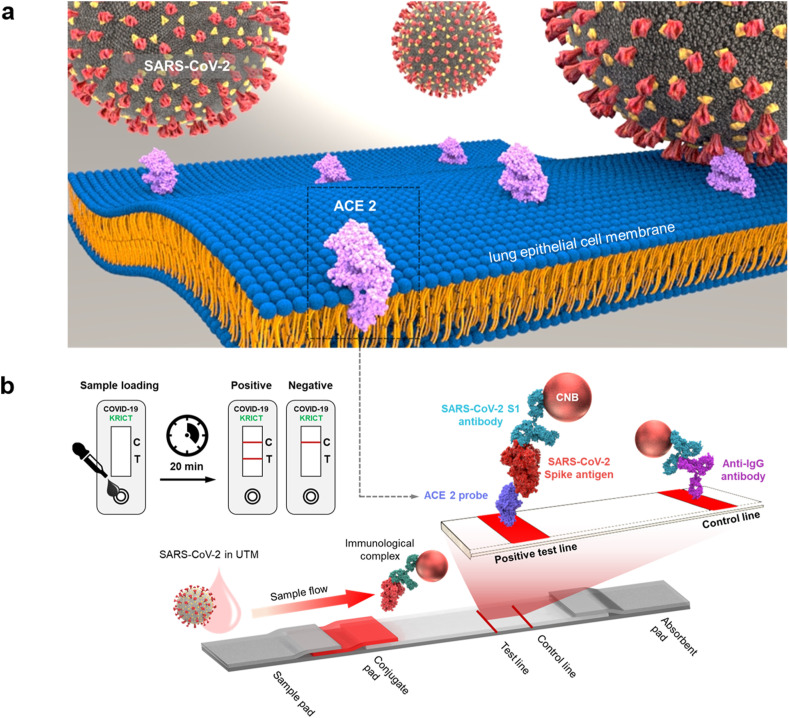
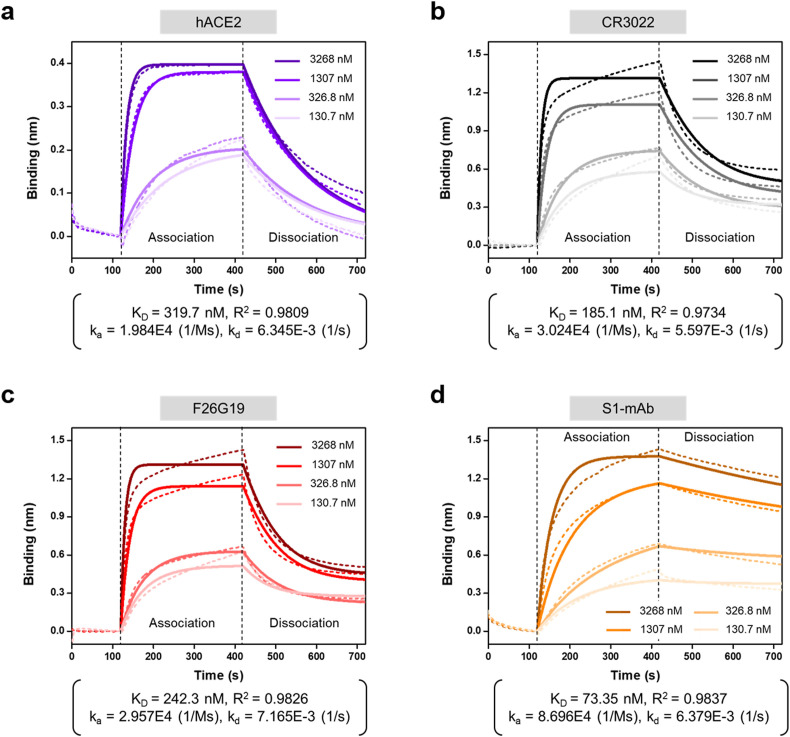
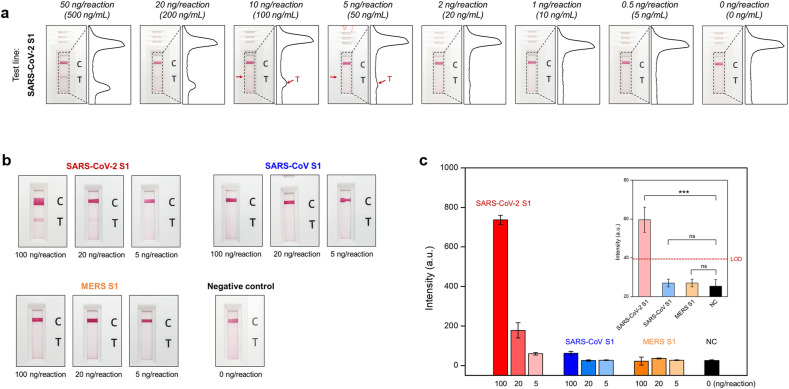
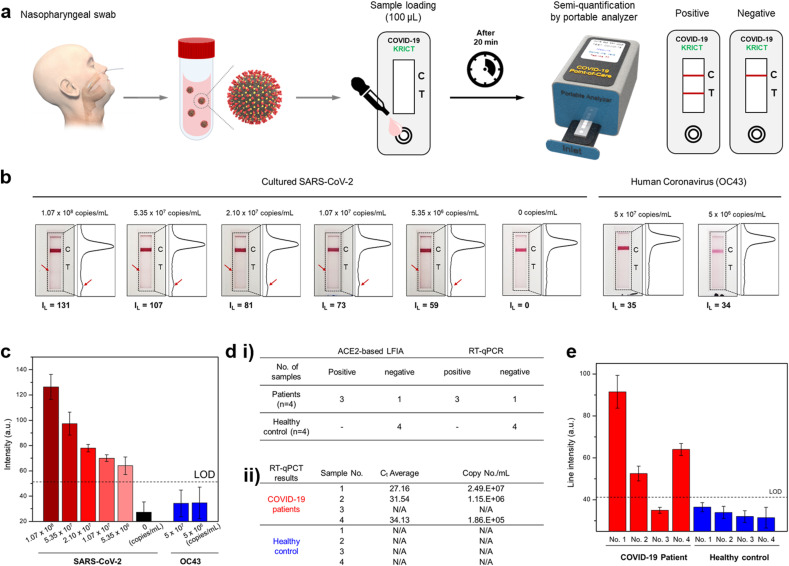
Severe acute respiratory syndrome coronavirus 2 (SARS-CoV-2) causes coronavirus disease 2019 (COVID-19), a newly emerging human infectious disease. Because no specific antiviral drugs or vaccines are available to treat COVID-19, early diagnostics, isolation, and prevention are crucial for containing the outbreak. Molecular diagnostics using reverse transcription polymerase chain reaction (RT-PCR) are the current gold standard for detection. However, viral RNAs are much less stable during transport and storage than proteins such as antigens and antibodies. Consequently, false-negative RT-PCR results can occur due to inadequate collection of clinical specimens or poor handling of a specimen during testing. Although antigen immunoassays are stable diagnostics for detection of past infection, infection progress, and transmission dynamics, no matched antibody pair for immunoassay of SARS-CoV-2 antigens has yet been reported. In this study, we designed and developed a novel rapid detection method for SARS-CoV-2 spike 1 (S1) protein using the SARS-CoV-2 receptor ACE2, which can form matched pairs with commercially available antibodies. ACE2 and S1-mAb were paired with each other for capture and detection in a lateral flow immunoassay (LFIA) that did not cross-react with SARS-CoV Spike 1 or MERS-CoV Spike 1 protein. The SARS-CoV-2 S1 (<5 ng of recombinant proteins/reaction) was detected by the ACE2-based LFIA. The limit of detection of our ACE2-LFIA was 1.86 × 10⁵ copies/mL in the clinical specimen of COVID-19 Patients without no cross-reactivity for nasal swabs from healthy subjects. This is the first study to detect SARS-CoV-2 S1 antigen using an LFIA with matched pair consisting of ACE2 and antibody. Our findings will be helpful to detect the S1 antigen of SARS-CoV-2 from COVID-19 patients.
Keywords: COVID-19; Human ACE2; Lateral flow immunoassay; SARS-CoV-2; Spike antigens.
Copyright © 2020. Published by Elsevier B.V.
Conflict of interest statement
The authors declare that they have no known competing financial interests or personal relationships that could have appeared to influence the work reported in this paper.
Figures


References
-
- Barr J.N., Fearns R. Genetic instability of RNA viruses. Genome Stability. 2016:21–35.
-
- Ge X.Y., Li J.L., Yang X.L., Chmura A.A., Zhu G., Epstein J.H., Mazet J.K., Hu B., Zhang W., Peng C., Zhang Y.J., Luo C.M., Tan B., Wang N., Zhu Y., Crameri G., Zhang S.Y., Wang L.F., Daszak P., Shi Z.L. Isolation and characterization of a bat SARS-like coronavirus that uses the ACE2 receptor. Nature. 2013;503(7477):535–538. - PMC - PubMed
-
- Huang C., Wang Y., Li X., Ren L., Zhao J., Hu Y., Zhang L., Fan G., Xu J., Gu X., Cheng Z., Yu T., Xia J., Wei Y., Wu W., Xie X., Yin W., Li H., Liu M., Xiao Y., Gao H., Guo L., Xie J., Wang G., Jiang R., Gao Z., Jin Q., Wang J., Cao B. Clinical features of patients infected with 2019 novel coronavirus in Wuhan, China. Lancet. 2020;395(10223):497–506. - PMC - PubMed
-
- Jung Y., Park G.-S., Moon J.H., Ku K., Beak S.-H., Lee C.-S., Kim S., Park E.C., Park D., Lee J.-H., Byeon C.W., Lee J.J., Maeng J.-S., Kim S.-J., Kim S.I., Kim B.-T., Lee M.J., Kim H.G. Comparative analysis of primer–probe sets for RT-qPCR of COVID-19 causative virus (SARS-CoV-2) ACS Infect. Dis. 2020;6(9):2513–2523. - PubMed
Publication types
MeSH terms
Substances
LinkOut - more resources
Full Text Sources
Other Literature Sources
Medical
Miscellaneous
