


Collateral damage caused by COVID-19: Change in volume and spectrum of neurosurgery patients
- PMID: 33099339
- PMCID: PMC7438073
- DOI: 10.1016/j.jocn.2020.07.055
Collateral damage caused by COVID-19: Change in volume and spectrum of neurosurgery patients
Abstract
Background: There has been a dramatic change in the pattern of patients being seen in hospitals and surgeries performed during the ongoing COVID-19 pandemic. The objective of this study is to study the change in the volume and spectrum of surgeries performed during the ongoing COVID-19 pandemic compared to pre-COVID-19 era.
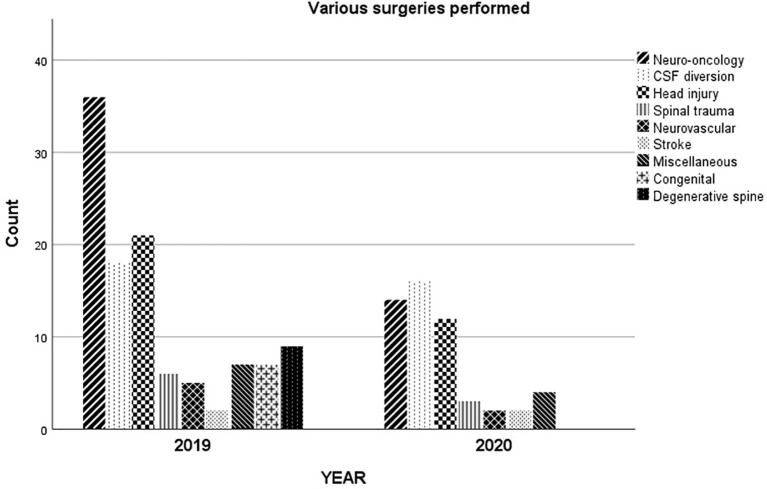
Methods: Details of all patients who were operated under department of neurosurgery at our institute since the onset of COVID-19 pandemic in India were collected and compared to the same time period last year. The demographic profile, diagnosis, surgery performed, type of surgery (routine/emergency, cranial/spinal and major/minor) in these two groups were compared. They were further categorized into various categories [neuro-oncology (brain and spine tumors), neuro-trauma (head injury and spinal trauma), congenital cases, degenerative spine, neuro-vascular, CSF diversion procedures, etc.] and compared between the two groups.
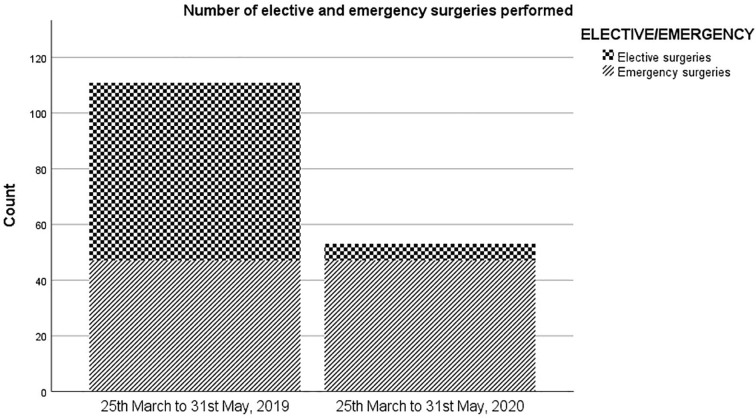
Results: Our study showed a drastic fall (52.2%) in the number of surgeries performed during the pandemic compared to pre-COVID era. 11.3% of patients operated during COVID-19 pandemic were non-emergent surgeries compared to 57.7% earlier (p = 0.000). There was increase in proportion of minor cases from 28.8% to 41.5% (p = 0.106). The proportion of spinal cases decreased from 27.9% to 11.3% during the COVID-19 pandemic (p = 0.043).
Conclusions: The drastic decrease in the number of surgeries performed will result in large backlog of patients waiting for 'elective' surgery. There is a risk of these patients presenting at a later stage with progressed disease and the best way forward would be to resume work with necessary precautions and universal effective COVID-19 testing.
Keywords: COVID-19 (coronavirus disease of 2019); COVID-19 testing; Elective surgeries; Emergency surgeries; India; Neurosurgical practice.
Copyright © 2020 Elsevier Ltd. All rights reserved.
Figures
References
-
- Reid D. India confirms its first coronavirus case. CNBC 2020. https://www.cnbc.com/2020/01/30/india-confirms-first-case-of-the-coronav... (accessed June 21, 2020).
-
- DehradunMarch 15 PT of I, March 15 2020UPDATED: Ist 2020 23:04. Uttarakhand reports first coronavirus case. India Today n.d. https://www.indiatoday.in/india/story/uttarakhand-reports-first-coronavi... (accessed June 21, 2020).
-
- MoHFW | Home n.d. https://www.mohfw.gov.in/ (accessed June 21, 2020).
-
- Over 8 lakh case count if no lockdown, MEA cites ICMR; Health says no such report. The Indian Express 2020. https://indianexpress.com/article/coronavirus/over-8-lakh-case-count-if-... (accessed June 21, 2020).
MeSH terms
LinkOut - more resources
Full Text Sources
