


Increases in Loneliness Among Young Adults During the COVID-19 Pandemic and Association With Increases in Mental Health Problems
- PMID: 33099414
- PMCID: PMC7576375
- DOI: 10.1016/j.jadohealth.2020.08.009
Increases in Loneliness Among Young Adults During the COVID-19 Pandemic and Association With Increases in Mental Health Problems
Abstract
Purpose: Young adults are at high risk for increases in loneliness and mental health problems during the COVID-19 pandemic. The present study examined increases in loneliness in a young adult sample, for whom increases were greater, and association with increases in depression and anxiety.
Method: Data from 564 young adults (ages 22-29, 60.7% women) were collected in January 2020 (pre-pandemic) and April/May 2020 (during pandemic).
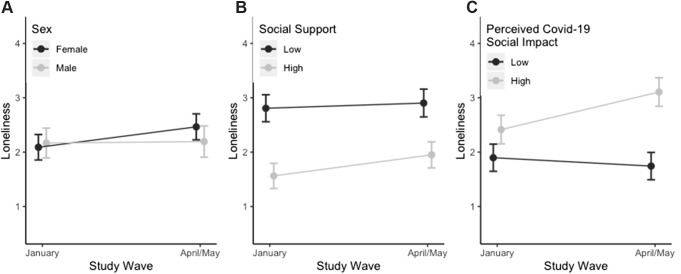
Results: Loneliness increased from January to April/May and changes in loneliness were greater for females, those with higher perceived social support in January, and those with greater concerns about the pandemic's social impacts. Depression (but not anxiety) increased during this time with changes in loneliness accounting for much of the increase in depression.
Conclusions: Intervention strategies with young adults need to address loneliness and feelings of reduced social support during this time, especially for those who may have had greater disruption in their social lives.
Keywords: COVID-19; Depression; Loneliness; Mental health; USA; Young adult.
Copyright © 2020 Society for Adolescent Health and Medicine. Published by Elsevier Inc. All rights reserved.
Figures
References
-
- Centers for Disease Control National Center on Health Statistics. Mental health: Household pulse survey. https://www.cdc.gov/nchs/covid19/pulse/mental-health.htm Available at:
Publication types
MeSH terms
Grants and funding
LinkOut - more resources
Full Text Sources
Medical
Miscellaneous
