


COVID-19 and Global Poverty: Are LDCs Being Left Behind?
- PMID: 33100600
- PMCID: PMC7575865
- DOI: 10.1057/s41287-020-00314-8
COVID-19 and Global Poverty: Are LDCs Being Left Behind?
Abstract
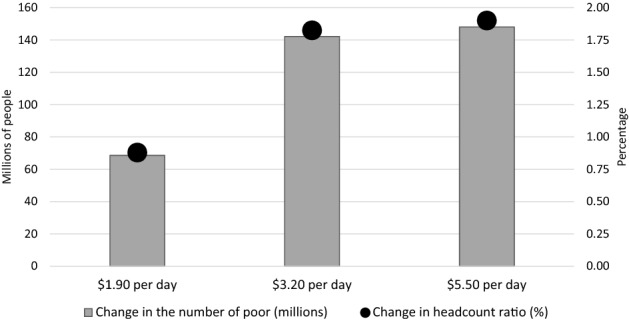
The paper provides a preliminary assessment of COVID-19's impact on global poverty in the light of IMF's growth forecasts. It shows that the pandemic will erode many of the gains recorded over the last decade in terms of poverty reduction. Our baseline case suggests that globally the number of people living below US$1.90 per day will increase by 68 million in 2020 alone; this rise could however approach 100 million, should the recession turn out to be more severe than initially expected, as many practitioners fear. Without effective international support, this setback will pose a critical threat to the achievement of the United Nations 2030 Agenda for Sustainable Development. The fallout from the pandemic will also exacerbate the geographic concentration of poverty, to the extent that the Least Developed Countries, with only 14% of the global population, are set to represent the main locus of extreme poverty worldwide.
Cet article fournit une évaluation préliminaire de l'impact de la COVID-19 sur la pauvreté dans le monde, à la lumière des prévisions de croissance du FMI. Il montre que la pandémie va éroder bon nombre des progrès réalisés au cours de la dernière décennie en termes de réduction de la pauvreté. Notre marqueur de référence suggère qu'à l'échelle mondiale, le nombre de personnes vivant avec moins de 1,90 USD par jour va augmenter, avec 68 millions de personnes supplémentaires rien qu'en 2020. Cependant, ce nombre pourrait atteindre les 100 millions, si la récession s'avérait plus sévère qu’on ne l’avait initialement prédit, comme le craignent de nombreux spécialistes. Sans un soutien international efficace, ce recul constituera une menace importante pour la réalisation du Programme de développement durable à l'horizon 2030 des Nations Unies. Les retombées de la pandémie aggraveront également la concentration géographique de la pauvreté, au point que les pays les moins avancés, qui ne représentent que 14% de la population mondiale, risquent de représenter le principal foyer d’extrême pauvreté dans le monde.
Keywords: Africa; COVID-19; Crisis impact; Least developed countries; Poverty; SDGS.
© European Association of Development Research and Training Institutes (EADI) 2020.
Conflict of interest statement
Conflict of interestThe corresponding author states that there is no conflict of interest.
Figures
References
-
- Atkinson AB. Measuring Poverty around the World. Princeton, NJ: Princeton University Press; 2019.
-
- Aung, T.T., P. Ruma, and P. McPherson. 2020. “All My Dreams Are Shattered”: Coronavirus Crushes Asia’s Garment Industry. Reuters, 19 May. https://www.reuters.com/article/us-health-coronavirus-garment-idUSKBN22U34V. Accessed 28 May 2020.
-
- Baldwin, R., and B. Weder di Mauro (eds). 2020. Economics in the Time of COVID-19: A New EBook. London: Centre for Economic Policy Research (CEPR). https://voxeu.org/article/economics-time-covid-19-new-ebook. Accessed 28 May 2020.
-
- Castaneda Aguilar A, Gerszon Mahler D, Newhouse D. Nowcasting Global Poverty. Washington, DC: In Data Blog; 2019.
-
- CDP and UNDESA. 2018. Handbook on the Least Developed Country Category: Inclusion, Graduation and Special Support Measures. Third Edition. New York: United Nations. https://www.un.org/development/desa/dpad/wp-content/uploads/sites/45/201.... Accessed 28 May 2020.
LinkOut - more resources
Full Text Sources