. 2020 Apr-Jun;30(2):139-148.
doi: 10.4103/ijri.IJRI_58_19. Epub 2020 Jul 13.

Imaging in congenital inner ear malformations-An algorithmic approach

Affiliations

Imaging in congenital inner ear malformations-An algorithmic approach

Abhinav C Bhagat et al. Indian J Radiol Imaging. 2020 Apr-Jun.

Abstract

Malformations of the inner ear are an important cause of congenital deaf-mutism. Arrest in embryologic development of inner ear during various stages gives rise to the variety of malformations encountered. Current treatment options include hearing aids, cochlear implants, and auditory brainstem implants (ABI). With the advent of cochlear implant surgery and ABI, decent functional outcomes can be obtained provided such cases are diagnosed correctly and timely. To that end, high-resolution computed tomography (HRCT) has a fundamental role in the assessment of these conditions, ably supplemented by magnetic resonance imaging (MRI). The purpose of this pictorial essay is to illustrate the imaging features of inner ear anomalies in children with congenital deaf-mutism as per the latest terminology and classification and provide an algorithmic approach for their diagnosis.

Keywords: Cochlear implant; Mondini; congenital deaf-mutism; high-resolution computed tomography; inner ear; magnetic resonance imaging.


Conflict of interest statement

There are no conflicts of interest.

Figures
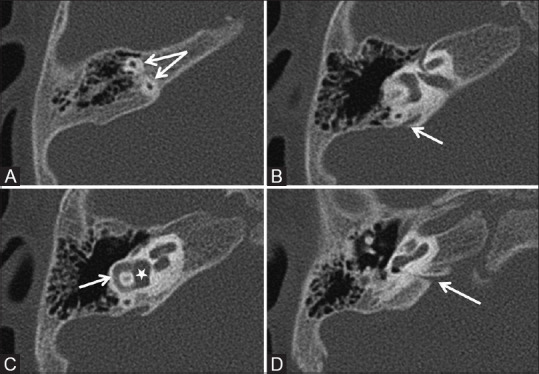
Figure 1 (A-D)
Figure 1 (A-D)
Axial CT images through temporal bone showing normal inner ear structures. Superior semicircular canal (A), vestibular aqueduct (B), lateral semicircular canal (arrow in C), vestibule (star) and cochlear aqueduct (D)
Figure 2 (A-E)
Figure 2 (A-E)
Schematic illustration of the normal inner ear (A) and normal cochlear anatomy at level of modiolus (B), and round window niche (C). Minimum intensity projection (MinIP) image of Stenvers projection nicely shows cochlear turns (D). 3D volume rendering of the normal inner ear (E). Green arrow: Modiolus, curved black arrow: Cochlear aperture, red arrows: Cochlear turns, arrowhead: Posterior semicircular canal
Figure 3 (A and B)
Figure 3 (A and B)
Schematic diagram (A) shows the cross-section of internal auditory canal with its contents. Coronal CT image (B) of temporal bone shows horizontal falciform crest (arrow) at the lateral end of the internal auditory canal (star) BB: Bill's bar, FC: Falciform crest, FNC: Facial nerve canal, CF: Cochlear fossa, SVF: Superior vestibular fossa, IVF: Inferior vestibular fossa
Figure 4
Figure 4
Schematic illustration of inner ear structures showing the location of vestibular and cochlear aqueduct. VA: Vestibular aqueduct, ED: Endolymphatic duct, ES: Endolymphatic sac, CA: Cochlear aqueduct, D: Dura mater, SAS: Subarachnoid space, CD: Cochlear duct, SD: Semicircular duct, U: Utricle, S: Saccule
Figure 5 (A-C)
Figure 5 (A-C)
Schematic illustration of normal inner ear (A) and axial 3D T2W SPACE images (B and C) through posterior fossa show osseous spiral lamina of basal cochlear turn (green arrow) separating the scala vestibuli (SV) and scala tympani (ST), interscalar septum between middle and apical turn of cochlea (blue arrow) and central modiolus (red arrow)
Figure 6 (A-C)
Figure 6 (A-C)
Axial 3D T2W SPACE images through superior (A) and inferior (B) part of IAC and oblique sagittal image (C) through IAC show the facial nerve and three divisions of vestibulocochlear nerve. FN: Facial nerve, SVN: Superior vestibular nerve, CN: Cochlear nerve, IVN: Inferior vestibular nerve
Figure 7 (A-E)
Figure 7 (A-E)
Complete labyrinthine aplasia. Axial (A, B and E) and coronal (C and D) CT images reveal complete absence of inner ear structures and hypoplastic petrous bone (white arrows) with absent bulge of promontory on the right side and stenotic IAC (black arrow)
Figure 8 (A-C)
Figure 8 (A-C)
Cochlear aplasia. Schematic illustration (A), right (B) and left (C) axial CT images show cochlear aplasia with dilated vestibule (white arrows). Note the anterior displacement of the labyrinthine segment of bilateral facial nerve (black arrows)
Figure 9 (A and B)
Figure 9 (A and B)
Common cavity. Schematic diagram (A) and axial CT (B) reveal a cystic structure (arrow) without internal architecture representing the assimilation of cochlea and vestibule
Figure 10 (A-E)
Figure 10 (A-E)
Cochlear hypoplasia. Schematic diagram (A) shows cochlea with reduced dimensions (arrow). Axial CT image (B) reveals normal basal turn (star) with hypoplastic middle and apical turns (curved arrow) in cochlear hypoplasia type IV. Axial CT images (C and D) show an overall small cochlea with less than two turns (black arrows) suggesting cochlear hypoplasia type III. Stenosis of IAC is also seen (white arrow). Cochlear hypoplasia type II (E) reveals an overall small cochlea with cystic appearance (square arrow)
Figure 11 (A-D)
Figure 11 (A-D)
Incomplete partition-I. Schematic illustration (A) and axial CT image (B) reveal empty cystic cochlea with no internal architecture (straight arrow) and dilated dysplastic vestibule (curved arrow). Axial T2W 3D CISS MR images (C and D) in a different patient show bilateral deformity (arrows)
Figure 12 (A-D)
Figure 12 (A-D)
Incomplete partition-I in association with Klippel-Feil syndrome. Sagittal CT reformats (A and B) and VRT image (C) of the cervical spine show fusion segmentation anomalies of cervical vertebrae with an associated incomplete partition-I malformation (D)
Figure 13 (A-D)
Figure 13 (A-D)
Incomplete partition-II. Schematic illustration (A) and axial CT images (B-D) show fusion of middle and apical turns of cochlea resulting in cystic apex (black arrow), mildly dilated vestibule (red arrow) with enlarged vestibular aqueduct (green arrow), and normal-appearing basal turn of cochlea (yellow arrow) forming Mondini's triad
Figure 14
Figure 14
Incomplete partition-III. Schematic illustration shows cochlea with absent modiolus (*) but interscalar septa (arrows) are present
Figure 15 (A-D)
Figure 15 (A-D)
Enlarged vestibular aqueduct. Axial CT images (A and B) show dilated vestibular aqueduct bilaterally (white arrows). Axial T2W 3D CISS MR images (C and D) in a different patient show the same finding (red arrows)
Figure 16
Figure 16
Oblique course of normal vestibular aqueduct (arrow) in Pöschl projection
Figure 17 (A-C)
Figure 17 (A-C)
Hypoplasia of cochlear aperture. Axial CT images (A and B) show hypoplasia of the cochlear nerve canal (black arrow) with associated stenosis of IAC (white arrow). Axial T2W 3D CISS MR image (C) in the same patient shows absence of neural elements within the stenotic IAC (arrow)
Figure 18 (A and B)
Figure 18 (A and B)
Vestibule-lateral semicircular canal dysplasia. Axial (A) and coronal (B) CT images show the fusion of lateral semicircular canal with dysplastic vestibule (arrows) in a case of incomplete partition-I
Figure 19 (A-F)
Figure 19 (A-F)
Duplicated IAC. Axial CT images (A-C) show two narrow bony canals with anterosuperior canal continuing as facial nerve (straight arrow) and posteroinferior canal extending to labyrinth (curved arrow). Vestibule-lateral semicircular canal dysplasia is also seen (star). Axial 3D T2W SPACE images (D and E) in the same patient show two nerves (straight arrows) entering the superior canal with the narrow empty inferior canal (curved arrow). 3D volume-rendered image (F) in a different patient shows double IAC (asterisks)
Figure 20
Figure 20
Algorithmic approach to classification and diagnosis of major inner ear malformations

References

    1. Huang BY, Zdanski C, Castillo M. Pediatric sensorineural hearing loss, Part 1: Practical aspects for neuroradiologists. Am J Neuroradiol. 2012;33:211–17. - PMC - PubMed
    1. Chen MM, Oghalai JS. Diagnosis and management of congenital sensorineural hearing loss. Curr Treat Options Pediatr. 2016;2:256–65. - PMC - PubMed
    1. Bartel-Friedrich S, Wulke C. Classification and diagnosis of ear malformations. GMS Curr Top Otorhinolaryngol Head Neck Surg. 2007;6:Doc05. - PMC - PubMed
    1. Young JY, Ryan ME, Young NM. Preoperative imaging of sensorineural hearing loss in pediatric candidates for cochlear implantation? Radiographics. 2014;34:E133–49. doi: 10.1148/rg.345130083. - PubMed

    1. Digge P, Solanki RN, Shah DC, Vishwakarma R, Kumar S. Imaging Modality of Choice for Pre-Operative Cochlear Imaging: HRCT vs. MRI Temporal Bone? J Clin Diagn Res. 2016;10:TC01–TC04. doi: 10.7860/JCDR/2016/18033.8592. - PMC - PubMed