


Clinical relevance of occipital condyle fractures
- PMID: 33100766
- PMCID: PMC7546049
- DOI: 10.4103/jcvjs.JCVJS_100_20
Clinical relevance of occipital condyle fractures
Abstract
Context: No consensus about classification, treatment, and clinical relevance of occipital condyle fractures (OCFs) exists.
Aims: The aim of the study was to determine radiological, clinical, and functional outcome of OCFs and thereby determine its clinical relevance.
Settings and design: This was a retrospective analysis of a prospective follow-up study.
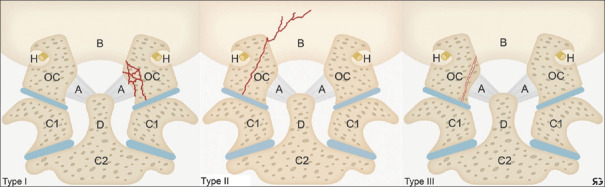
Materials and methods: From May 2005 to May 2008, all OCFs were included from a Level-1 trauma center. Patient files were reviewed for patient and fracture characteristics. Fracture classification was done according to the Anderson criteria. Clinical outcome was assessed by completing two questionnaires, radiological outcome by computed tomography imaging, and functional outcome by measuring active cervical range of motion using a Cybex EDI-320.
Statistical analysis used: A Fisher's exact Test was used in categorical variables and a one-sample t-test for comparing means of active cervical range of motion in occipital fracture patients with normal values. An independent samples t-test was carried out to compare the means of groups with and without accompanying cervical fractures for each motion.
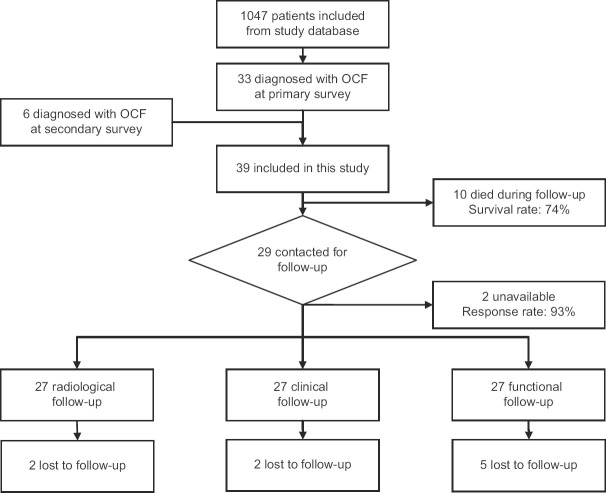
Results: Thirty-nine patients were included (4 type I, 16 type II, and 19 type III). Twenty-seven patients completed follow-up, of whom 26 were treated conservatively. Fracture healing was established in 25 of 28 fractures at a median follow-up of 19 months. Eleven patients had none to minimal pain or disability at follow-up, 12 had mild, and two had moderate pain or disability on questionnaires. No statistically significant difference in active cervical range of motion was identified comparing means stratified for accompanying cervical fractures.
Conclusions: Conservatively treated patients with an OCF generally show favorable radiological and clinical outcome.
Keywords: Fracture healing; neck disability index; neck pain and disability scale; occipital condyle fractures; range of motion.
Copyright: © 2020 Journal of Craniovertebral Junction and Spine.
Conflict of interest statement
There are no conflicts of interest.
Figures
References
-
- Musbahi O, Khan AH, Anwar MO, Chaudery H, Ali AM, Montgomery AS. Immobilisation in occipital condyle fractures: A systematic review. Clin Neurol Neurosurg. 2018;173:130–9. - PubMed
-
- Theodore N, Aarabi B, Dhall SS, Gelb DE, Hurlbert RJ, Rozzelle CJ, et al. Occipital condyle fractures. Neurosurgery. 2013;72(2):106–13. - PubMed
-
- Hanson JA, Deliganis AV, Baxter AB, Cohen WA, Linnau KF, Wilson AJ, et al. Radiologic and clinical spectrum of occipital condyle fractures: Retrospective review of 107 consecutive fractures in 95 patients. Am J Roentgenol. 2002;178:1261–8. - PubMed
LinkOut - more resources
Full Text Sources