


Exploring the Immediate Effects of COVID-19 Containment Policies on Crime: an Empirical Analysis of the Short-Term Aftermath in Los Angeles
- PMID: 33100804
- PMCID: PMC7571535
- DOI: 10.1007/s12103-020-09578-6
Exploring the Immediate Effects of COVID-19 Containment Policies on Crime: an Empirical Analysis of the Short-Term Aftermath in Los Angeles
Abstract
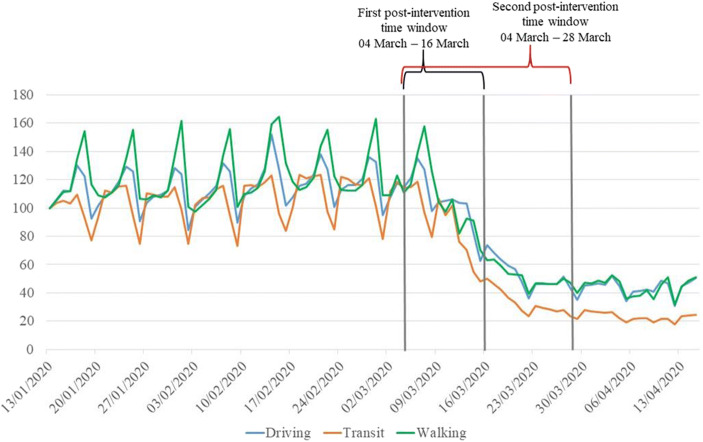
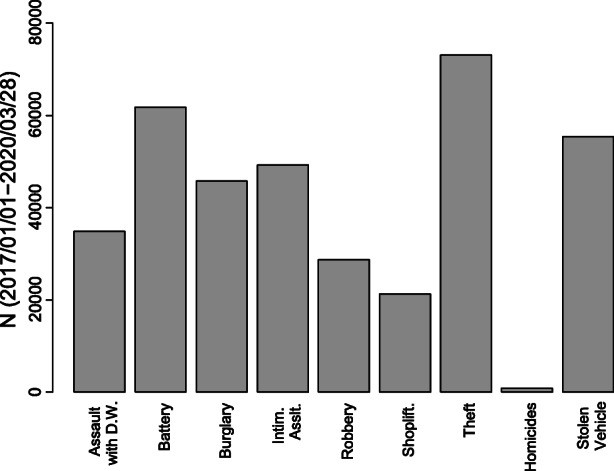
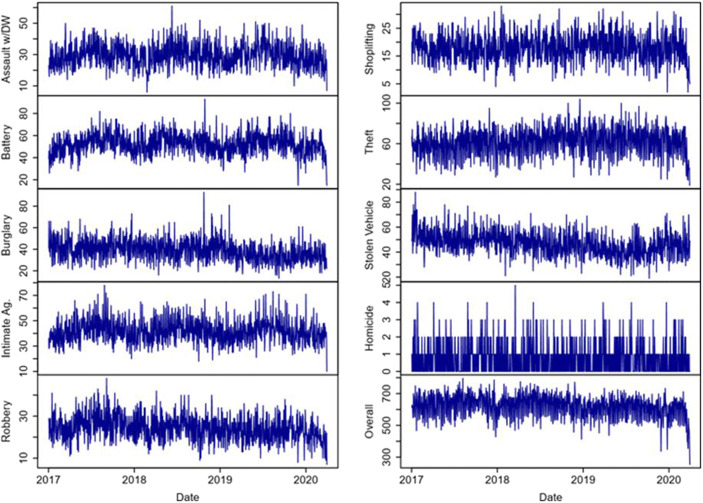
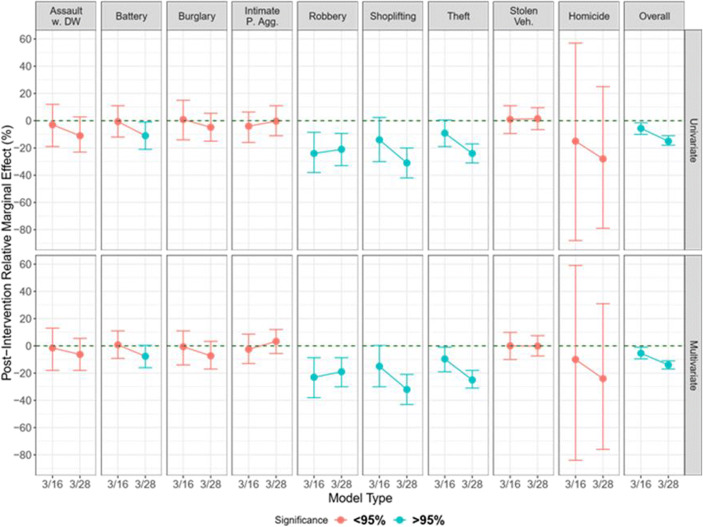
This work investigates whether and how COVID-19 containment policies had an immediate impact on crime trends in Los Angeles. The analysis is conducted using Bayesian structural time-series and focuses on nine crime categories and on the overall crime count, daily monitored from January 1st 2017 to March 28th 2020. We concentrate on two post-intervention time windows-from March 4th to March 16th and from March 4th to March 28th 2020-to dynamically assess the short-term effects of mild and strict policies. In Los Angeles, overall crime has significantly decreased, as well as robbery, shoplifting, theft, and battery. No significant effect has been detected for vehicle theft, burglary, assault with a deadly weapon, intimate partner assault, and homicide. Results suggest that, in the first weeks after the interventions are put in place, social distancing impacts more directly on instrumental and less serious crimes. Policy implications are also discussed.
Keywords: Bayesian Modelling; Causal impact; Coronavirus; Crime pattern theory; General strain theory; Routine activity theory.
© The Author(s) 2020.
Conflict of interest statement
Conflicts of Interest/Competing InterestsThe authors declare no competing interests.
Figures
References
-
- Agnew R. Foundation for a General Strain Theory of crime and delinquency. Criminology. 1992;30(1):47–88. doi: 10.1111/j.1745-9125.1992.tb01093.x. - DOI
-
- Agnew, R. (2001). Building on the Foundation of General Strain Theory: Specifying the Types of Strain Most Likely to Lead to Crime and Delinquency. Journal of Research in Crime and Delinquency. 10.1177/0022427801038004001.
-
- Andresen MA, Malleson N. Crime seasonality and its variations across space. Applied Geography. 2013;43:25–35. doi: 10.1016/j.apgeog.2013.06.007. - DOI
-
- Angel, S. (1968). Discouraging crime through city planning. Institute of Urban and Regional Development, University of California.
LinkOut - more resources
Full Text Sources