. 2020 Oct 1;32(10):103311.
doi: 10.1063/5.0029118.

Numerical investigation of aerosol transport in a classroom with relevance to COVID-19

Affiliations

Numerical investigation of aerosol transport in a classroom with relevance to COVID-19

Mohamed Abuhegazy et al. Phys Fluids (1994). .

Abstract

The present study investigates aerosol transport and surface deposition in a realistic classroom environment using computational fluid-particle dynamics simulations. Effects of particle size, aerosol source location, glass barriers, and windows are explored. While aerosol transport in air exhibits some stochasticity, it is found that a significant fraction (24%-50%) of particles smaller than 15 µm exit the system within 15 min through the air conditioning system. Particles larger than 20 µm almost entirely deposit on the ground, desks, and nearby surfaces in the room. Source location strongly influences the trajectory and deposition distribution of the exhaled aerosol particles and affects the effectiveness of mitigation measures such as glass barriers. Glass barriers are found to reduce the aerosol transmission of 1 µm particles from the source individual to others separated by at least 2.4 m by ∼92%. By opening windows, the particle exit fraction can be increased by ∼38% compared to the case with closed windows and reduces aerosol deposition on people in the room. On average, ∼69% of 1 µm particles exit the system when the windows are open.


Figures

FIG. 1.
FIG. 1.
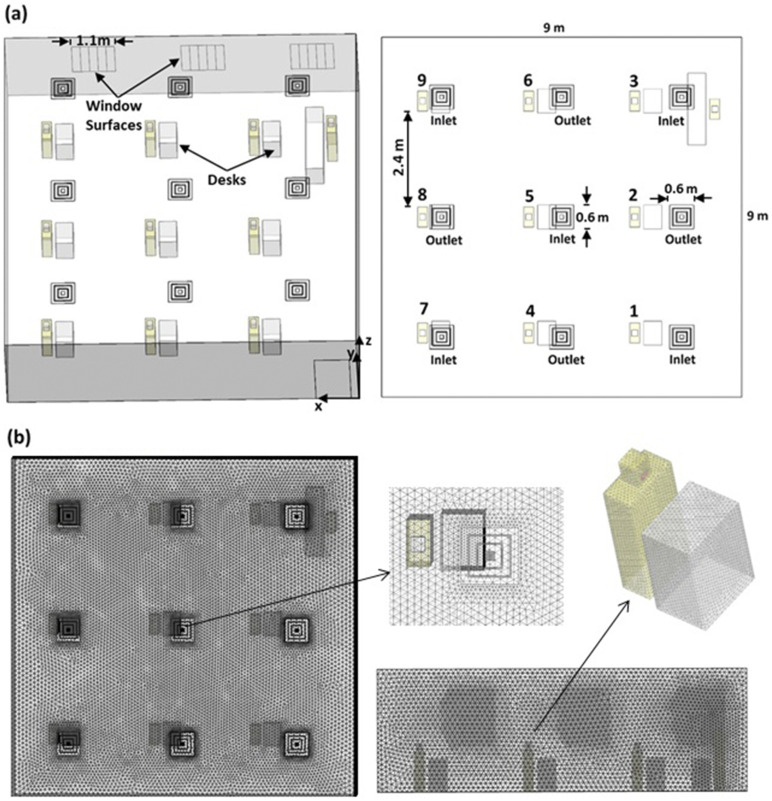
Illustration of (a) the classroom model and (b) the computational mesh used in the CFD simulations.
FIG. 2.
FIG. 2.
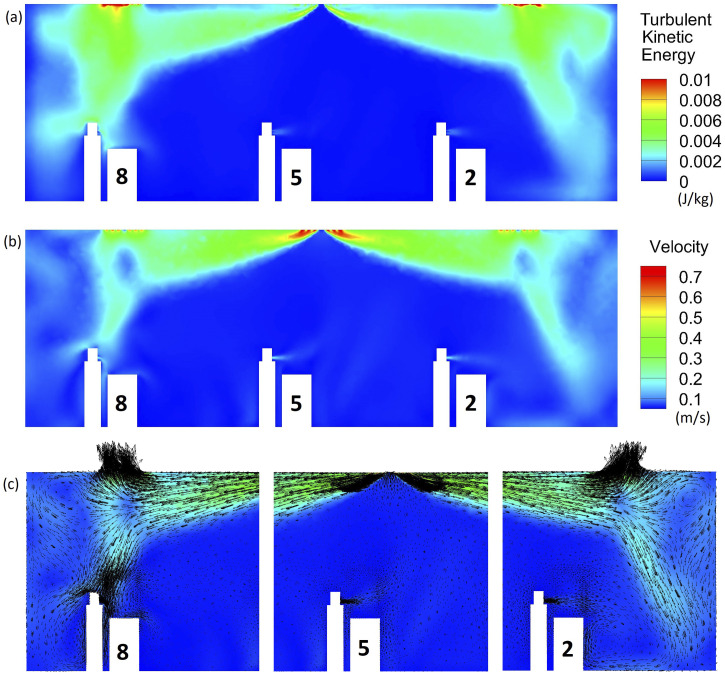
(a) Turbulent kinetic energy, (b) velocity magnitude distribution, and (c) velocity vectors across a slice going through students 2, 5, and 8.
FIG. 3.
FIG. 3.
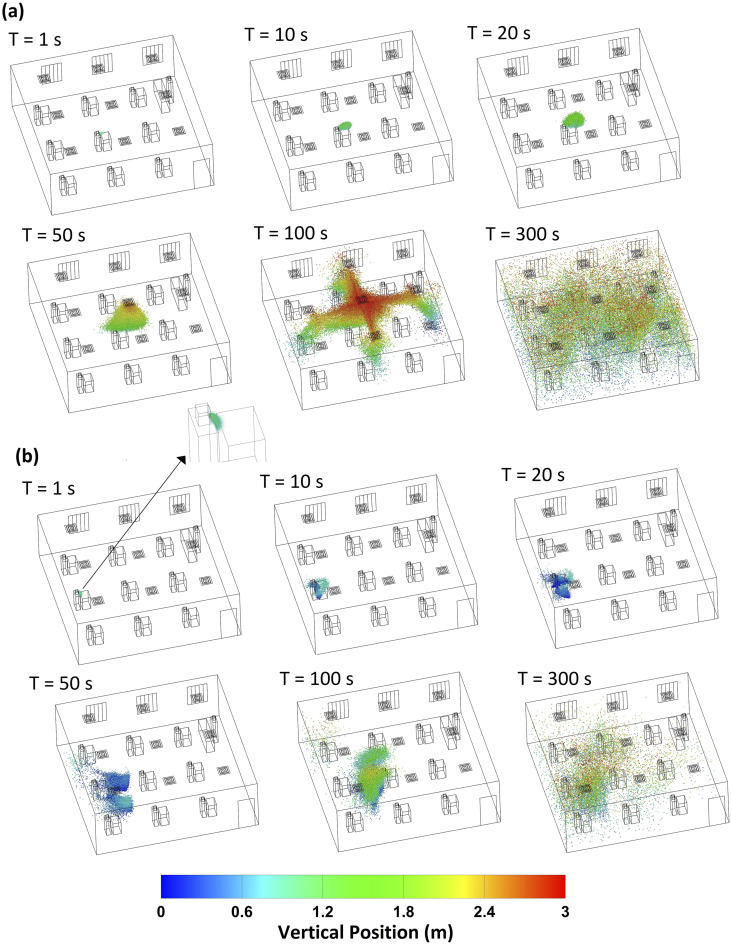
Distribution of 1 µm aerosol particles in the classroom at different points in time for the (a) student 5 source and (b) student 8 source.
FIG. 4.
FIG. 4.
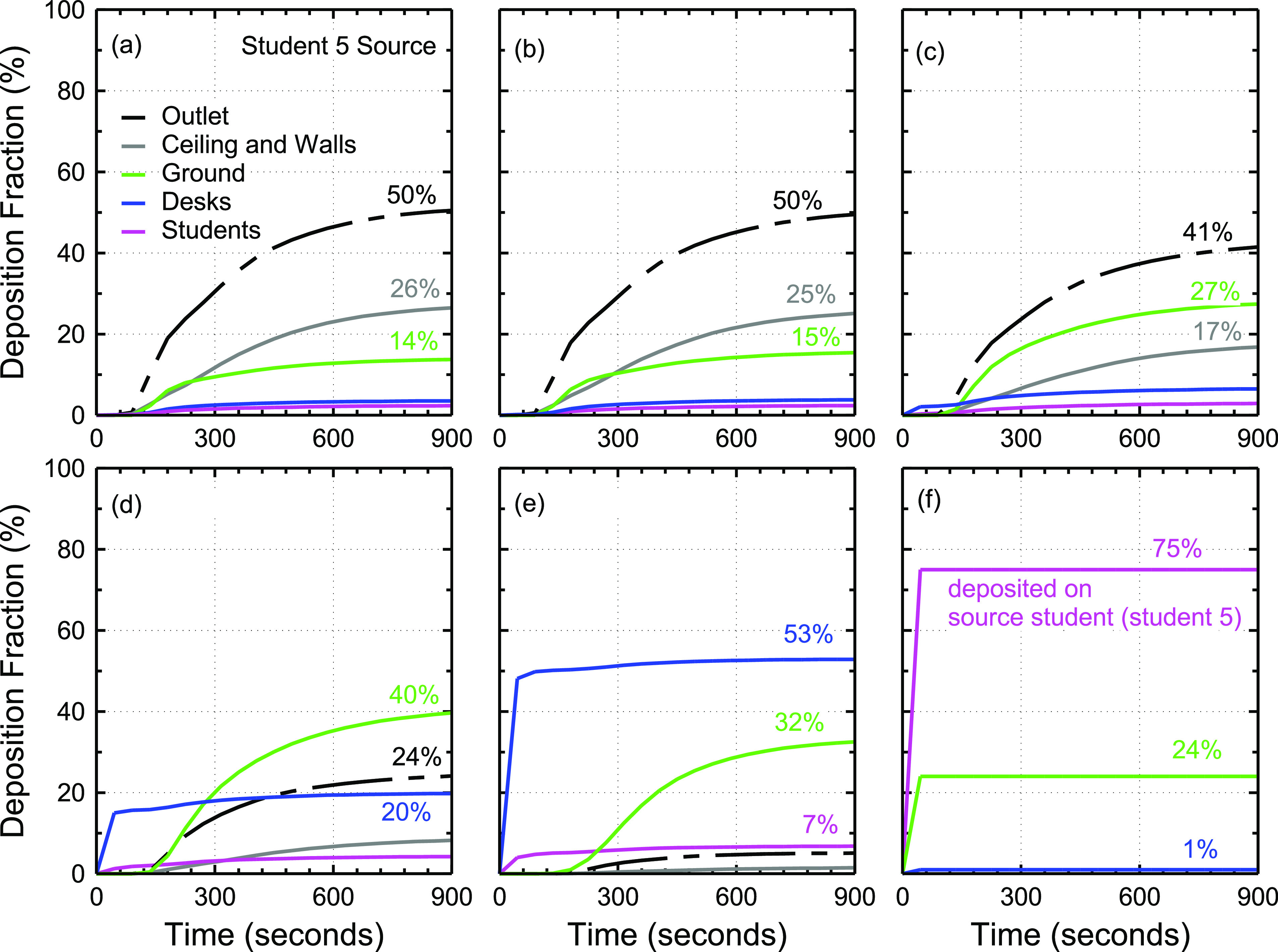
Effect of particle size on aerosol deposition and removal from the classroom model as a function of time since particle release from student 5’s mouth. This figure shows the deposition fraction for (a) 1 µm particles, (b) 4 µm particles, (c) 10 µm particles, (d) 15 µm particles, (e) 20 µm particles, and (f) 50 µm particles.
FIG. 5.
FIG. 5.
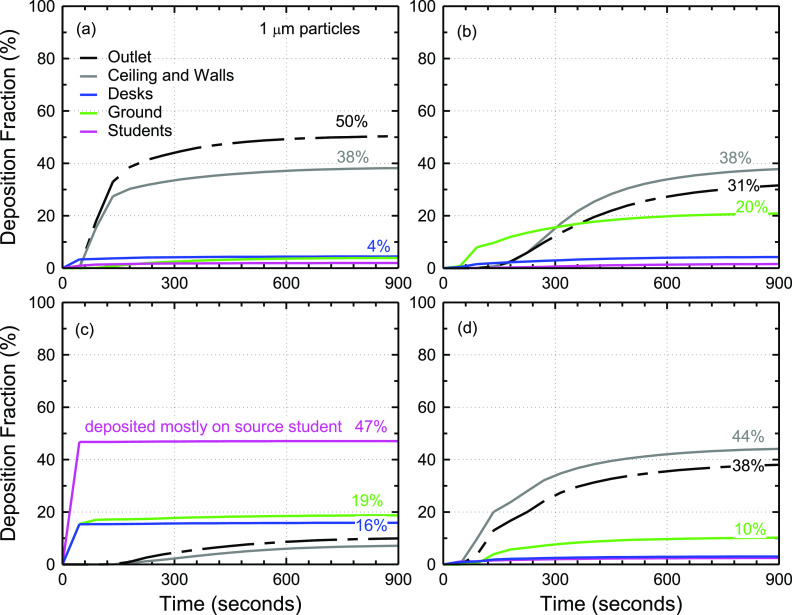
Effect of student location on aerosol deposition and removal from the classroom model using 1 µm particles. This figure shows four different student sources: (a) student 1, (b) student 2, (c) student 8, and (d) student 9.
FIG. 6.
FIG. 6.
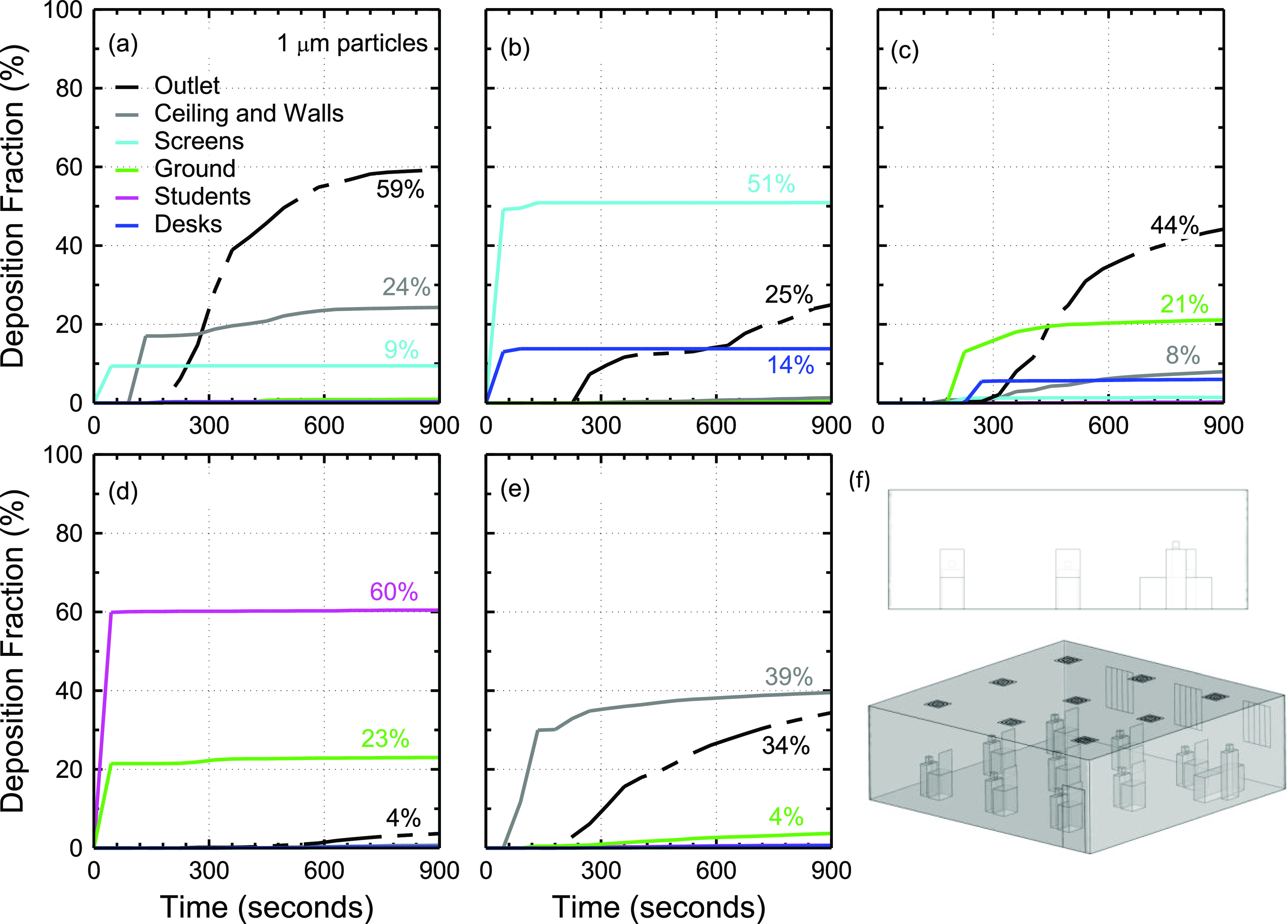
Effect of glass barriers on aerosol deposition and removal from the classroom model using 1 µm particles for different student sources. This figure shows five different student sources: (a) student 1, (b) student 2, (c) student 5, (d) student 8, and (e) student 9. The glass barriers are shown in (f).
FIG. 7.
FIG. 7.
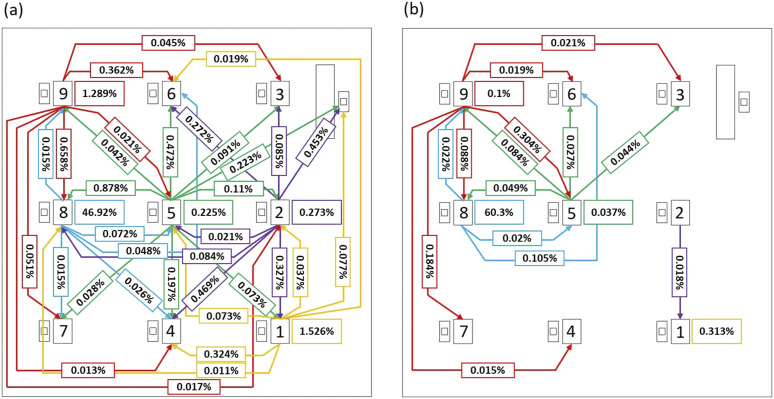
Effect of glass barriers on aerosol transmission between students. Sources considered are student 1, student 2, student 5, student 8, and student 9, and particle size is 1 µm. Source–receiver maps are shown for cases with (a) no glass screens or sneeze guards and (b) glass screens employed.
FIG. 8.
FIG. 8.
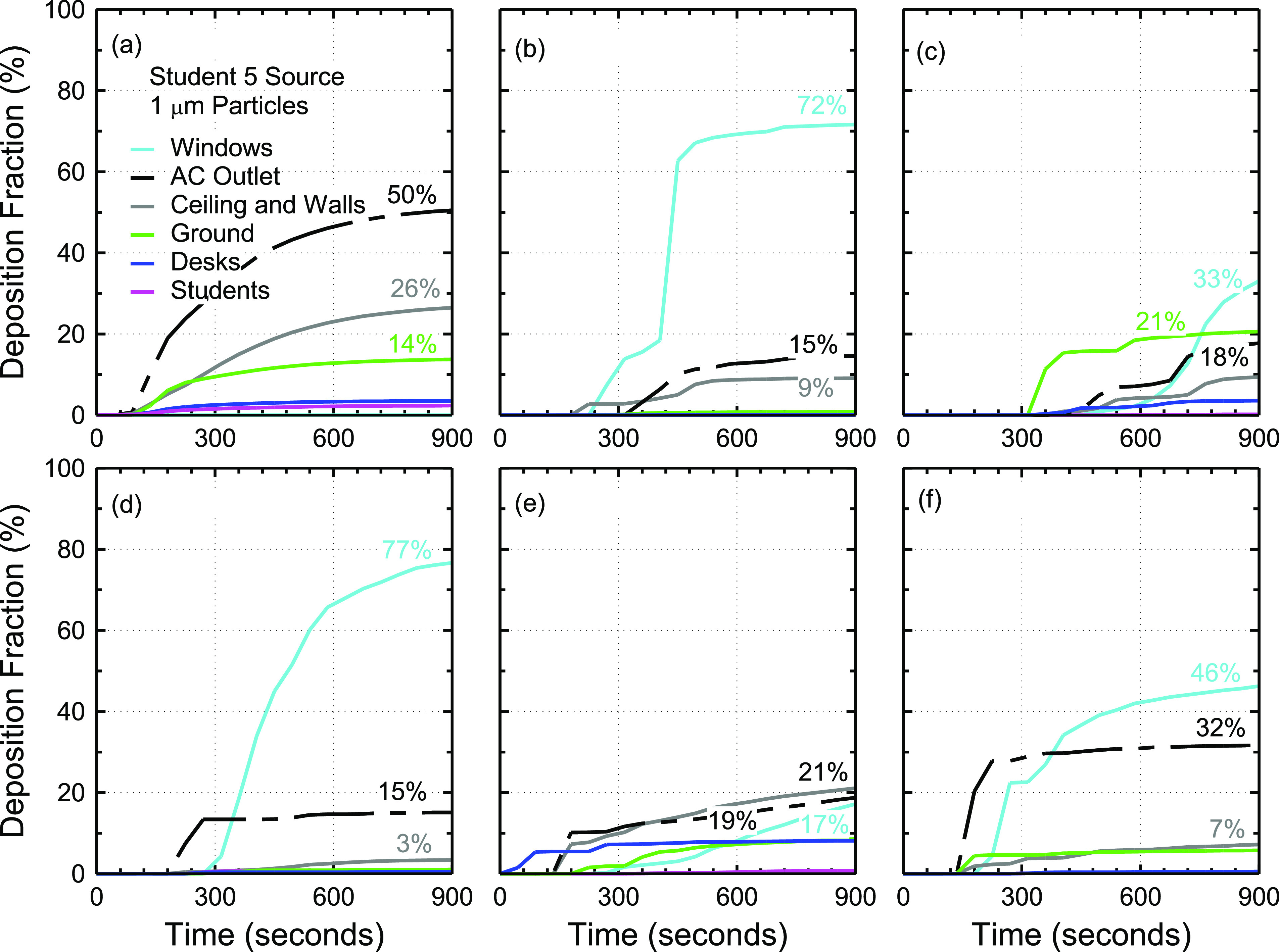
Effect of opening windows on aerosol deposition and removal using 1 µm particles and the student 5 source. This figure shows the deposition fractions for cases with (a) 0%, (b) 10%, (c) 20%, (d) 30%, (e) 40%, and (f) 50% open windows.

References

    1. Jayaweera M., Perera H., Gunawardana B., and Manatunge J., “Transmission of COVID-19 virus by droplets and aerosols: A critical review on the unresolved dichotomy,” Environ. Res. 188, 109819 (2020). 10.1016/j.envres.2020.109819 - DOI - PMC - PubMed
    1. Mittal R., Ni R., and Seo J.-H., “The flow physics of COVID-19,” J. Fluid Mech. 894, F2 (2020). 10.1017/jfm.2020.330 - DOI
    1. Kohanski M. A., Lo L. J., and Waring M. S., “Review of indoor aerosol generation, transport, and control in the context of COVID-19,” Int. Forum Allergy Rhinol. (2020). 10.1002/alr.22661 - DOI - PMC - PubMed
    1. Anfinrud P., Stadnytskyi V., Bax C. E., and Bax A., “Visualizing speech-generated oral fluid droplets with laser light scattering,” N. Engl. J. Med. 382, 2061 (2020). 10.1056/nejmc2007800 - DOI - PMC - PubMed
    1. Morawska L., Tang J. W., Bahnfleth W., Bluyssen P. M., Boerstra A., Buonanno G., Cao J., Dancer S., Floto A., Franchimon F., Haworth C., Hogeling J., Isaxon C., Jimenez J. L., Kurnitski J., Li Y., Loomans M., Marks G., Marr L. C., Mazzarella L., Melikov A. K., Miller S., Milton D. K., Nazaroff W., Nielsen P. V., Noakes C., Peccia J., Querol X., Sekhar C., Seppänen O., Tanabe S.-i., Tellier R., Tham K. W., Wargocki P., Wierzbicka A., and Yao M., “How can airborne transmission of COVID-19 indoors be minimised?,” Environ. Int. 142, 105832 (2020). 10.1016/j.envint.2020.105832 - DOI - PMC - PubMed

LinkOut - more resources