Review
. 2020 Oct 9:12:1179573520962230.
doi: 10.1177/1179573520962230. eCollection 2020.

Hyperhomocysteinemia: Clinical Insights

Affiliations
Review

Hyperhomocysteinemia: Clinical Insights

Fuad Al Mutairi. J Cent Nerv Syst Dis. .

Abstract

Homocysteine (Hcy) is a sulfhydryl-containing amino acid, and intermediate metabolite formed in metabolising methionine (Met) to cysteine (Cys); defective Met metabolism can increase Hcy. The effect of hyperhomocysteinemia (HHcy) on human health, is well described and associated with multiple clinical conditions. HHcy is considered to be an independent risk factor for common cardiovascular and central nervous disorders, where its role in folate metabolism and choline catabolism is fundamental in many metabolic pathways. HHcy induces inflammatory responses via increasing the pro-inflammatory cytokines and downregulation of anti-inflammatory cytokines which lead to Hcy-induced cell apoptosis. Conflicting evidence indicates that the development of the homocysteine-associated cerebrovascular disease may be prevented by the maintenance of normal Hcy levels. In this review, we discuss common conditions associated with HHcy and biochemical diagnostic workup that may help in reaching diagnosis at early stages. Furthermore, future systematic studies need to prove the exact pathophysiological mechanism of HHcy at the cellular level and the effect of Hcy lowering agents on disease courses.

Keywords: Homocysteine; cobalamin; folate; homocystinurea; methylenetetrahydrofolate reductase; vitamin B-12.


Conflict of interest statement

Declaration of conflicting interests:The author declared no potential conflicts of interest with respect to the research, authorship, and/or publication of this article.

Figures
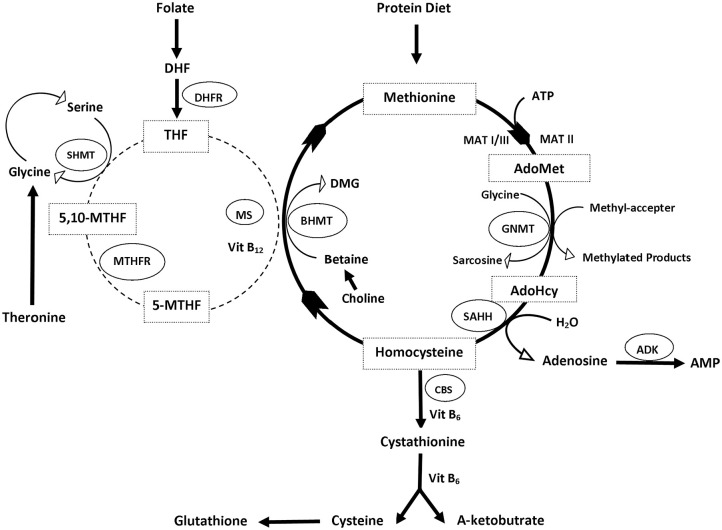
Figure 1.
Figure 1.
The homocysteine metabolic cycle. Abbreviations: ADK, adenosine kinase; AdoHCys or SAH, S-adenosyl homocysteine; AdoMet or SAM, adenosyl methionine; BHMT, betaine-homocysteine methyltransferase; Cbl, cobalamin—vitamin B12; CBS, cystathionine beta-synthase; DMG, dimethylglycine; GNMT, glycine N-methyltransferase; Hcy, homocysteine; MAT, methionine adenosyltransferase; 5-methyl-THF, 5-N-methyl tetrahydrofolate; 5,10-methylene-THF, 5,10-methylenetetrahydrofolate; MS, methionine synthase; MTHFR, methylenetetrahydrofolate reductase; SAHH, S-adenosylhomocysteine hydrolase; SHMT, serine hydroxymethyltransferase.
Figure 2.
Figure 2.
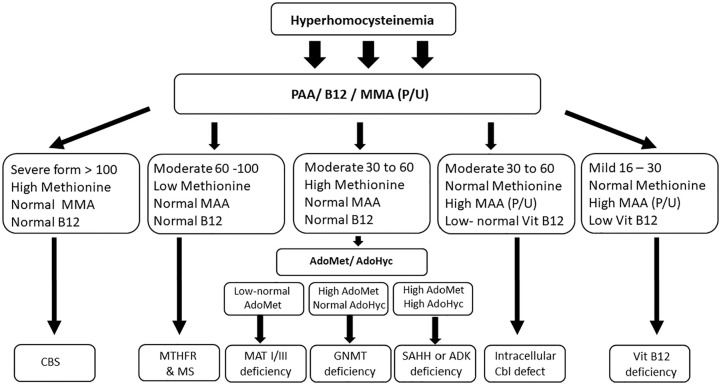
Algorithm for diagnosis of hyperhomocysteinemia. Abbreviations: ADK, adenosine kinase; AdoHCys or SAH, S-adenosyl homocysteine; AdoMet or SAM, adenosyl methionine; Cbl, cobalamin—vitamin B12; CBS, cystathionine beta-synthase; GNMT, glycine N-methyltransferase; Hcy, homocysteine; HHcy, hyperhomocysteinemia; MAT, methionine adenosyltransferase; MS, methionine synthase; MTHFR, methylenetetrahydrofolate reductase; SAHH, S-adenosylhomocysteine hydrolase.

References

    1. Kumar A, Palfrey HA, Pathak R, Kadowitz PJ, Gettys TW, Murthy SN. The metabolism and significance of homocysteine in nutrition and health. Nutr Metab (Lond). 2017;14:78. - PMC - PubMed
    1. Skovierova H, Vidomanova E, Mahmood S, et al. The molecular and cellular effect of homocysteine metabolism imbalance on human health. Int J Mol Sci. 2016;17:1733. - PMC - PubMed
    1. Selhub J. Homocysteine metabolism. Annu Rev Nutr. 1999;19:217-246. - PubMed
    1. Blom HJ, Smulders Y. Overview of homocysteine and folate metabolism. With special references to cardiovascular disease and neural tube defects. J Inherit Metab Dis. 2011;34:75-81. - PMC - PubMed
    1. Refsum H, Smith AD, Ueland PM, et al. Facts and recommendations about total homocysteine determinations: an expert opinion. Clin Chem. 2004;50:3-32. - PubMed

LinkOut - more resources