


Prospective validation of a core curriculum progress assimilation instrument for radiation oncology residentship
- PMID: 33100910
- PMCID: PMC7569179
- DOI: 10.1016/j.rpor.2020.09.003
Prospective validation of a core curriculum progress assimilation instrument for radiation oncology residentship
Abstract
Objectives: To develop a tool that could assess residents' knowledge beyond simple information gathering and evaluate its reliability.
Methods: An assessment tool of 40 objective questions and at least one essay-based question was developed to assess residents' comprehension of general radiation oncology accordingly to validated training curricula beyond level 2 in the Bloom scale. With randomized content, questions were developed such as to be classified as at least 2 in the Bloom scale, so that reasoning and not only information gathering could be assessed. Criteria validation was made using the Classical Test Theory to describe difficulty and discrimination of each item. Reliability was tested by internal consistency using the Cronbach alpha test.
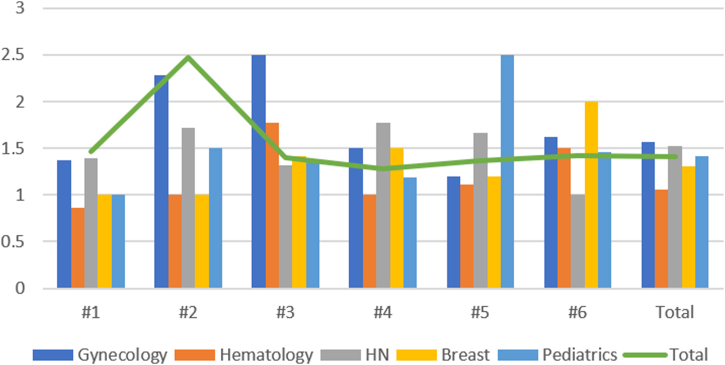
Results: Between 2016 and 2019, 24 residents were assessed. Six different versions of the test were made with a total of 240 objective questions and 18 essay-based questions. Five of the six versions were deemed valid and reliable. Comparisons between 1st (PGY-1) and 3rd (PGY-3) year residents were made. Consistently, PGY-3 residents had scores 150% higher than PGY-1 residents. Only two different PGY-3 reached the most complex level of answers in the essay-based questions. The results demonstrated that the major part of the acquired knowledge and retention occurs in the first six months of training rather than in all the following period.
Conclusion: The instrument can be considered valid. This developed instrument also raised the hypothesis that residents may not assess and analyze their acquired knowledge beyond the application level.
Keywords: Educational measurement; Graduate medical education; Radiation oncology; Residency.
© 2020 Greater Poland Cancer Centre. Published by Elsevier B.V. All rights reserved.
Figures
References
-
- Tyler R.W. 2013. Basic principles of curriculum and instruction. University of Chicago press.
-
- Benstead K., Lara P.C., Andreopoulos D. Recommended ESTRO core curriculum for radiation oncology/radiotherapy 4th edition. Radiother Oncol. 2019;141:1–4. - PubMed
LinkOut - more resources
Full Text Sources
