


Do We Belittle Essential Tremor by Calling It a Syndrome Rather Than a Disease? No
- PMID: 33101188
- PMCID: PMC7554602
- DOI: 10.3389/fneur.2020.586606
Do We Belittle Essential Tremor by Calling It a Syndrome Rather Than a Disease? No
Abstract
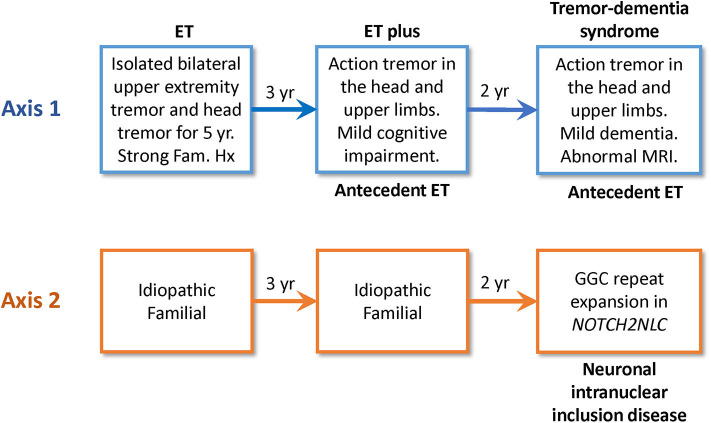
A task force of the International Parkinson and Movement Disorder Society (MDS) recently published a tremor classification scheme that is based on the nosologic principle of two primary axes for classifying an illness: clinical manifestations (Axis 1) and etiology (Axis 2). An Axis 1 clinical syndrome is a recurring group of clinical symptoms, signs (physical findings), and possibly laboratory results that suggests the presence of at least one underlying Axis 2 etiology. Syndromes must be defined and used consistently to be of value in finding specific etiologies and effective treatments. The MDS task force concluded that essential tremor is a common neurological syndrome that has never been defined consistently by clinicians and researchers. The MDS task force defined essential tremor as a syndrome of bilateral upper limb action tremor of at least 3 years duration, with or without tremor in other locations (e.g., head, voice, or lower limbs), in the absence of other neurological signs (e.g., dystonia, parkinsonism, myoclonus, ataxia, peripheral neuropathy, and cognitive impairment). Deviations from this definition should not be labeled as essential tremor. Patients with additional questionably-abnormal signs or with signs of uncertain relevance to tremor are classified as essential tremor plus. The MDS classification scheme encourages a thorough unbiased phenotyping of patients with tremor, with no assumptions of etiology, pathology, pathophysiology, or relationship to other neurological disorders. The etiologies, pathology, and clinical course of essential tremor are too heterogeneous for this syndrome to be viewed as a disease or a family of diseases.
Keywords: classification; diagnostic axes; essential tremor; syndrome; tremor.
Copyright © 2020 Elble.
Figures
Similar articles
-
Is essential tremor a family of diseases or a syndrome? A syndrome.Int Rev Neurobiol. 2022;163:31-59. doi: 10.1016/bs.irn.2022.02.002. Epub 2022 Mar 21. Int Rev Neurobiol. 2022. PMID: 35750367
-
Consensus Statement on the classification of tremors. from the task force on tremor of the International Parkinson and Movement Disorder Society.Mov Disord. 2018 Jan;33(1):75-87. doi: 10.1002/mds.27121. Epub 2017 Nov 30. Mov Disord. 2018. PMID: 29193359 Free PMC article. Review.
-
The essential tremor syndromes.Curr Opin Neurol. 2016 Aug;29(4):507-12. doi: 10.1097/WCO.0000000000000347. Curr Opin Neurol. 2016. PMID: 27257943 Review.
-
The MDS consensus tremor classification: The best way to classify patients with tremor at present.J Neurol Sci. 2022 Apr 15;435:120191. doi: 10.1016/j.jns.2022.120191. Epub 2022 Feb 19. J Neurol Sci. 2022. PMID: 35247714 Review.
-
Systematic clinical approach for diagnosing upper limb tremor.J Neurol Neurosurg Psychiatry. 2020 Aug;91(8):822-830. doi: 10.1136/jnnp-2019-322676. Epub 2020 May 26. J Neurol Neurosurg Psychiatry. 2020. PMID: 32457087 Free PMC article. Review.
Cited by
-
What's in a Name? Nomenclature of essential tremor: Syndrome or family of diseases?Int Rev Neurobiol. 2022;163:1-5. doi: 10.1016/S0074-7742(22)00044-7. Epub 2022 Jun 21. Int Rev Neurobiol. 2022. PMID: 36185589 Free PMC article. No abstract available.
-
Tremor Syndromes: An Updated Review.Front Neurol. 2021 Jul 26;12:684835. doi: 10.3389/fneur.2021.684835. eCollection 2021. Front Neurol. 2021. PMID: 34381412 Free PMC article. Review.
-
Cutaneous alpha-synuclein deposition in postural tachycardia patients.Ann Clin Transl Neurol. 2021 Apr;8(4):908-917. doi: 10.1002/acn3.51347. Epub 2021 Mar 25. Ann Clin Transl Neurol. 2021. PMID: 33764697 Free PMC article.
-
Diagnosis Versus Classification of Essential Tremor: A Research Perspective.J Mov Disord. 2023 May;16(2):152-157. doi: 10.14802/jmd.23020. Epub 2023 May 24. J Mov Disord. 2023. PMID: 37258278 Free PMC article. No abstract available.
-
Bayesian Interpretation of Essential Tremor Plus.J Clin Neurol. 2022 Mar;18(2):127-139. doi: 10.3988/jcn.2022.18.2.127. J Clin Neurol. 2022. PMID: 35274833 Free PMC article. Review.
References
-
- MacMahon B, Pugh TF, Causes entities of disease In: Clark DW, MacMahon B. editors. Preventive Medicine. Boston, MA: Little, Brown; (1967). p. 26–33.
LinkOut - more resources
Full Text Sources
Research Materials
Miscellaneous
