


The Potential Intermediate Hosts for SARS-CoV-2
- PMID: 33101254
- PMCID: PMC7554366
- DOI: 10.3389/fmicb.2020.580137
The Potential Intermediate Hosts for SARS-CoV-2
Abstract
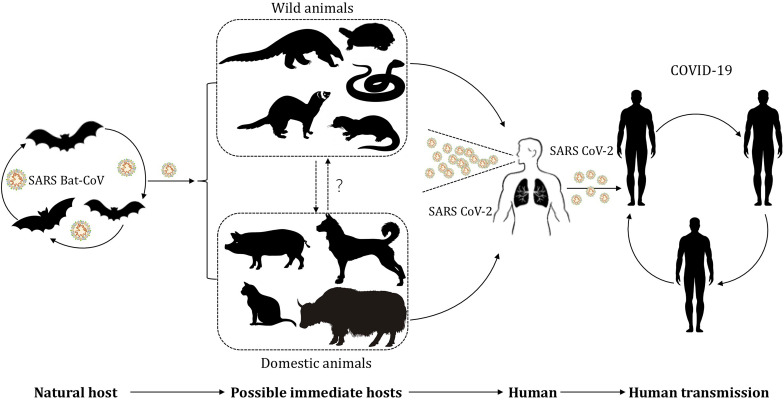
The coronavirus disease 19 (COVID-19) caused by severe acute respiratory syndrome coronavirus 2 (SARS-CoV-2), has become a global pandemic since the first report in Wuhan. COVID-19 is a zoonotic disease and the natural reservoir of SARS-CoV-2 seems to be bats. However, the intermediate host explaining the transmission and evolvement is still unclear. In addition to the wildlife which has access to contact with bats in the natural ecological environment and then infects humans in wildlife market, domestic animals are also able to establish themselves as the intermediate host after infected by SARS-CoV-2. Although recent studies related to SARS-CoV-2 have made a lot of progress, many critical issues are still unaddressed. Here, we reviewed findings regarding the investigations of the intermediate host, which may inspire future investigators and provide them with plenty of information. The results demonstrate the critical role of the intermediate host in the transmission chain of SARS-CoV-2, and the efficient intervention on this basis may be useful to prevent further deterioration of COVID-19.
Keywords: COVID-19; SARS-CoV-2; intermediate host; review; transmission.
Copyright © 2020 Zhao, Cui and Tian.
Figures
References
-
- Chan Y. A., Zhan S. H. (2020). Single source of pangolin CoVs with a near identical spike RBD to SARS-CoV-2. [Preprint] 10.1101/2020.07.07.184374 - DOI
-
- Chen D. S., Sun J., Zhu J. C., Ding X. N., Lan T. M., Zhu L. N., et al. (2020). Single-cell screening of SARS-CoV-2 target cells in pets, livestock, poultry and wildlife. [Preprint] 10.1101/2020.06.13.149690 - DOI
Publication types
LinkOut - more resources
Full Text Sources
Miscellaneous
