. 2020 Sep 30:11:559576.
doi: 10.3389/fimmu.2020.559576. eCollection 2020.

High Metabolic Function and Resilience of NKG2A-Educated NK Cells

Affiliations

High Metabolic Function and Resilience of NKG2A-Educated NK Cells

Andrew J Highton et al. Front Immunol. .

Abstract

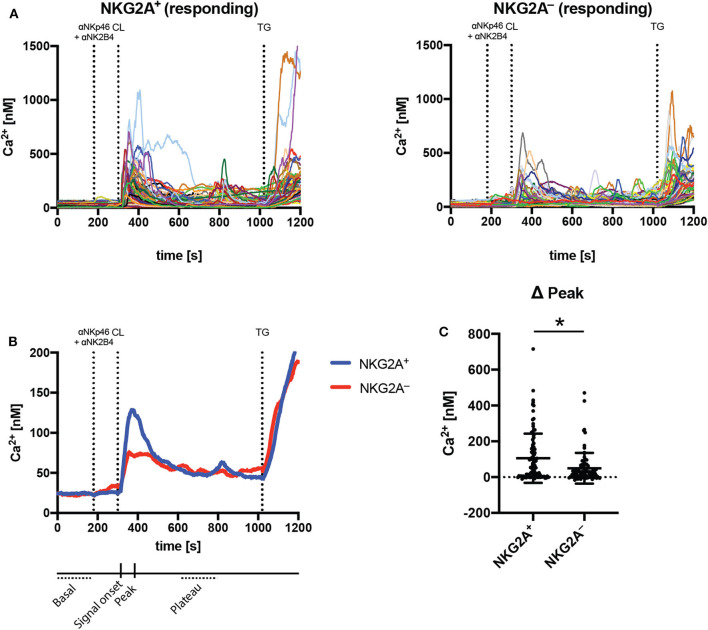
Natural killer (NK) cells are an important component of the innate immune system for the control of intracellular pathogens and cancer cells. NK cells demonstrate heterogeneous expression of inhibitory surface receptors. Signaling through these various receptors during NK cell development promotes functionality, referred to as NK cell education. Here we investigated the impact of education on NK cell metabolism through functional assessment of critical metabolic pathways and calcium signaling. Educated NK cells had an increased uptake of the metabolic substrates 2-NBDG, a fluorescent glucose analog, and BODIPY FL C16, a fluorescent palmitate, compared to uneducated NK cells. Comparison of NK cells educated via KIRs or NKG2A showed that NKG2A-educated NK cells were the main contributor to these differences in uptake of metabolites, and that NKG2A-educated NK cells were functionally more resilient in response to metabolic blockade of oxidative phosphorylation. Furthermore, NKG2A-educated NK cells exhibited higher peak calcium concentration following stimulation, indicating stronger signaling events taking place in these educated NK cells. These results demonstrate that cellular metabolism plays an important role in the functional differences observed between educated and uneducated NK cells, and show that NKG2A-educated NK cells remain more functionally competent than KIR-educated NK cells when oxidative phosphorylation is restricted. Understanding metabolic programming during NK cell education may unveil future targets to manipulate NK cell function for use in clinical settings, such as cancer therapies.

Keywords: KIR; NK cell education; NKG2A; glycolysis; immunometabolism; oxidative phoshorylation.


Figures

Figure 1
Figure 1
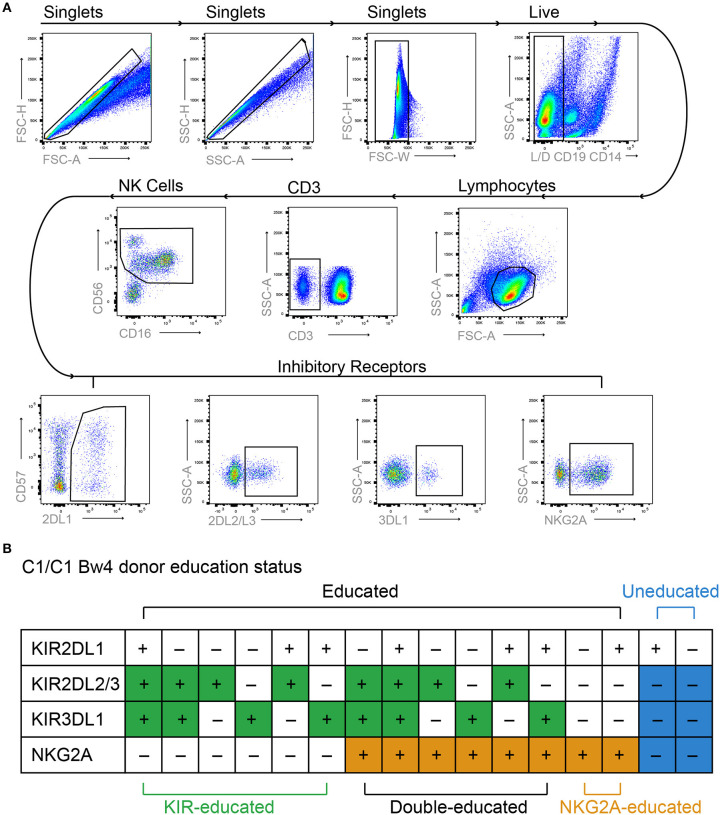
Gating strategy and NK cell education status. PBMCs were labeled with lymphocyte lineage markers as well as KIR2DL1, KIR2DL2/L3, KIR3DL1 NKG2A, and Live/Dead dye. (A) Doublets, dead cells, and non-NK cell lymphocytes were excluded from analysis and NK cells were identified based on expression of CD56 and CD16. Boolean gating was used to identify NK cells expressing different combinations of inhibitory receptors. (B) Educated and uneducated NK cells were identified based on inhibitory receptor expression and specific donor HLA genotype as exemplified for a donor homozygous for HLA-C1 and expressing the Bw4 epitope.
Figure 2
Figure 2
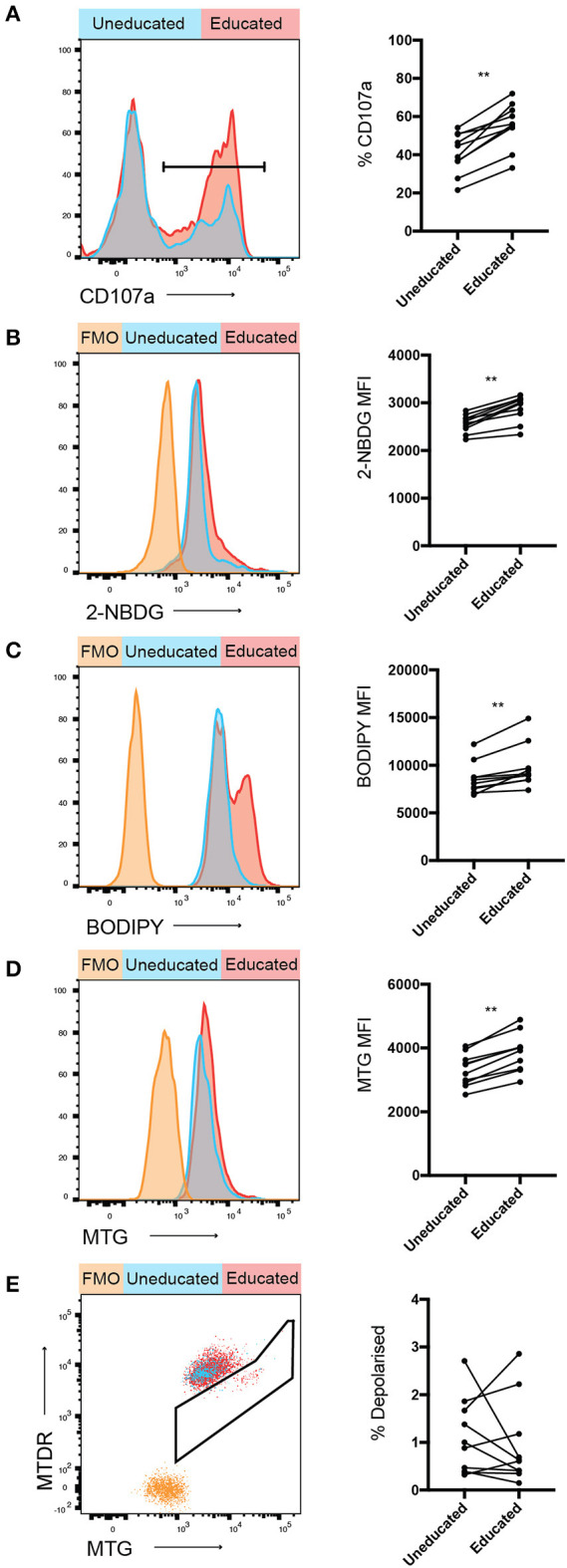
Increased 2-NBDG and BODIPY uptake in educated vs. uneducated NK cells. PBMCs were stimulated with K562 cells for 4 h in media containing anti-CD107a antibody. (A) Degranulation of uneducated and educated NK cell populations was determined. Immediately following stimulation, PBMCs were cultured in media containing (B) 2-NBDG; or (C) BODIPY and uptake of these metabolite analogs was assessed using flow cytometry. (D) Mitochondrial mass of stimulated educated and uneducated NK cells was determined using MitoTracker Green. (E) PBMCs were stained with MitoTracker DeepRed and the combination of MitoTracker Green and MitoTracker DeepRed was used to determine the mitochondrial polarization state of educated and uneducated NK cells. Left panels show representative histograms, right panels show pooled data from healthy donors. Data are representative of three independent experiments, mean ± SD shown, n = 10, **p < 0.01.
Figure 3
Figure 3
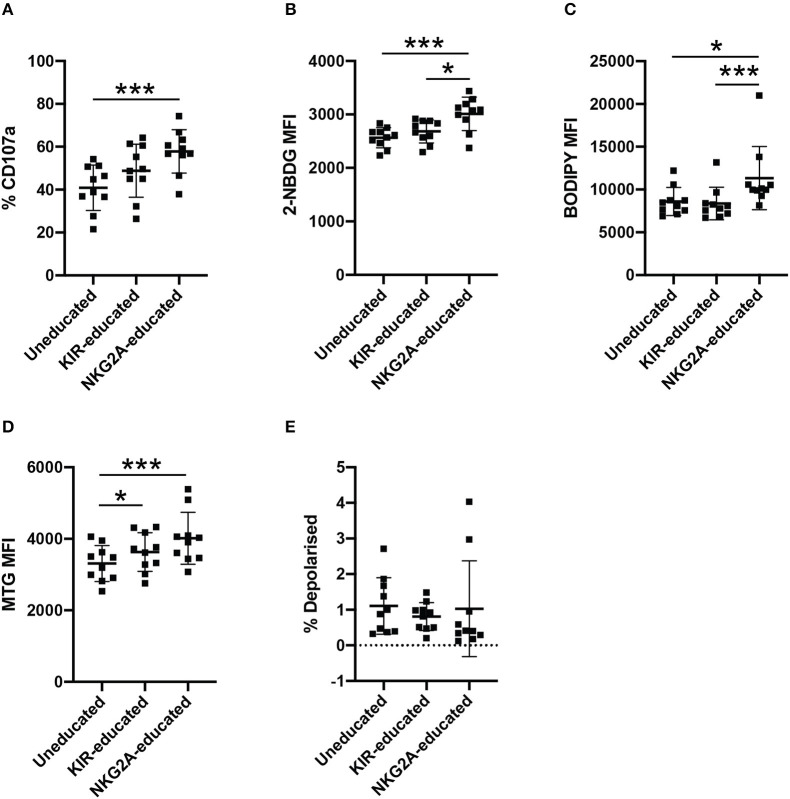
NKG2A-educated NK cells have increased 2-NBDG and BODIPY uptake compared to uneducated or KIR-educated NK cells. PBMCs were stimulated with K562 cells for 4 h in media containing anti-CD107a antibody. (A) Degranulation of uneducated NK cells or those educated via KIR or NKG2A was determined in bulk NK cells. Immediately following stimulation, PBMCs were cultured in media containing (B) 2-NBDG; or (C) BODIPY and uptake of these metabolite analogs was assessed in uneducated NK cells or those educated via KIR or NKG2A. (D) Mitochondrial mass of uneducated NK cells or those educated via KIR or NKG2A was determined using MitoTracker Green. (E) Stimulated PBMCs were stained with MitoTracker Green and MitoTracker DeepRed to determine the polarization state of uneducated NK cells or those educated via KIR or NKG2A. Data are representative of three independent experiments, mean ± SD shown, n = 10, *p < 0.05, ***p < 0.001.
Figure 4
Figure 4
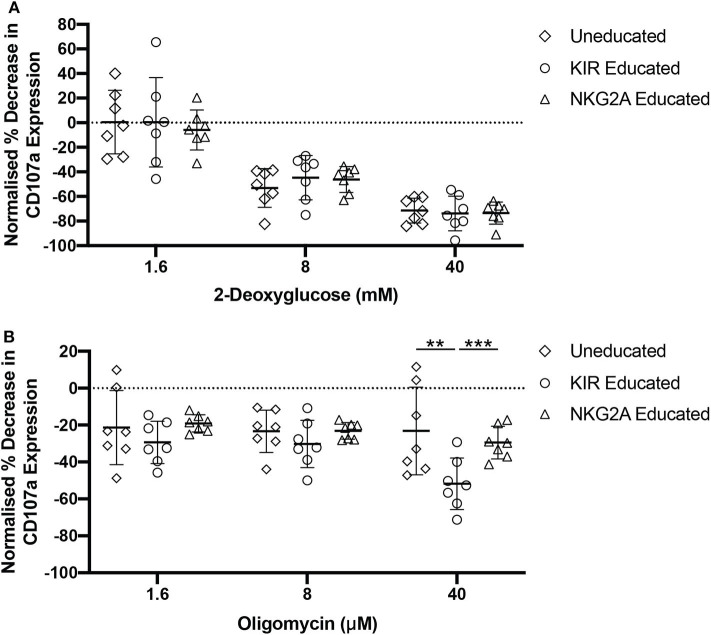
NKG2A-educated NK cells are more resilient to oligomycin pre-treatment. PBMCs were incubated in media containing 2-DG, oligomycin, or both and subsequently stimulated for 4 h with K562 cells. Degranulation was assessed in uneducated NK cells or those educated via KIRs or NKG2A following inhibition with (A) 2-DG; or (B) oligomycin. Data are representative of three independent experiments, mean ± SD shown, n = 7, **p < 0.01, ***p < 0.001.
Figure 5
Figure 5
NKG2A-educated NK cells have increased peak calcium signal compared to uneducated NK cells following stimulation. Calcium signaling was assessed using fluorescent microscopy and the ratiometric dye Fura2 in sorted NKG2A+ and NKG2A NK cell populations. (A) Intracellular calcium was detected following stimulation with cross-linked anti-NKp46 and anti-2B4 antibodies in individual responding NK cells over time; (B) the mean calcium signal of NKG2A+ and NKG2A NK cells over time; and (C) the peak signal following cross-linking. Data are from seven pooled experiments, mean ± SD shown, n = 7, *p < 0.05.

References

    1. Yu J, Heller G, Chewning J, Kim S, Yokoyama WM, Hsu KC. Hierarchy of the human natural killer cell response is determined by class and quantity of inhibitory receptors for self-HLA-B and HLA-C ligands. J Immunol. (2007) 179:5977–89. 10.4049/jimmunol.179.9.5977 - DOI - PubMed
    1. Fernandez NC, Treiner E, Vance RE, Jamieson AM, Lemieux S, Raulet DH. A subset of natural killer cells achieves self-tolerance without expressing inhibitory receptors specific for self-MHC molecules. Blood. (2005) 105:4416–23. 10.1182/blood-2004-08-3156 - DOI - PMC - PubMed
    1. Kim S, Poursine-Laurent J, Truscott SM, Lybarger L, Song Y-J, Yang L, et al. Licensing of natural killer cells by host major histocompatibility complex class I molecules. Nature. (2005) 436:709–13. 10.1038/nature03847 - DOI - PubMed
    1. Colonna M, Borsellino G, Falco M, Ferrara GB, Strominger JL. HLA-C is the inhibitory ligand that determines dominant resistance to lysis by NK1- and NK2-specific natural killer cells. Proc Natl Acad Sci USA. (1993) 90:12000–4. 10.1073/pnas.90.24.12000 - DOI - PMC - PubMed
    1. Colonna M, Spies T, Strominger JL, Ciccone E, Moretta A, Moretta L, et al. Alloantigen recognition by two human natural killer cell clones is associated with HLA-C or a closely linked gene. Proc Natl Acad Sci USA. (1992) 89:7983–5. 10.1073/pnas.89.17.7983 - DOI - PMC - PubMed

Publication types

MeSH terms

Substances

LinkOut - more resources