


Collaborating network in managing post the Mount Merapi's disruption, Indonesia
- PMID: 33101600
- PMCID: PMC7564765
- DOI: 10.4102/jamba.v12i1.927
Collaborating network in managing post the Mount Merapi's disruption, Indonesia
Abstract
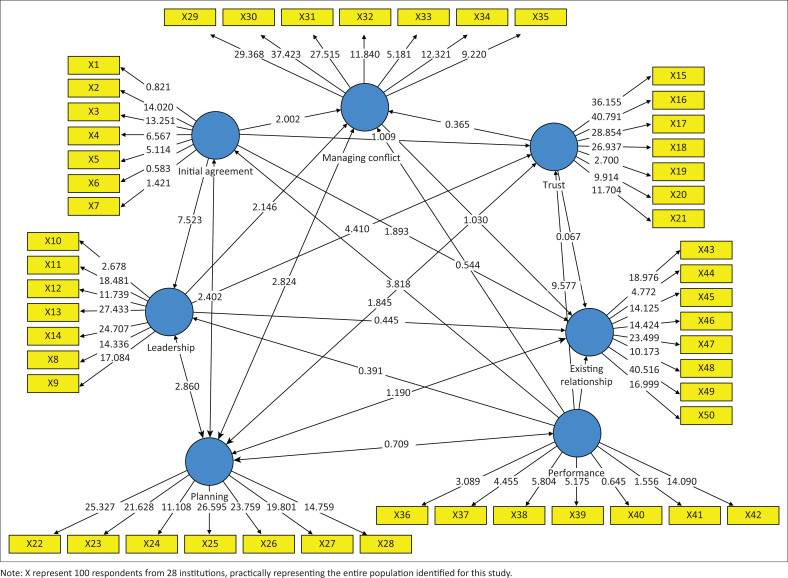
Collaborative governance and social capital can help to form a resilient community in the wake of a disaster, such as the eruptions of Mount Merapi in Indonesia. This study examines the successfulness of the handling of disasters in Indonesia, with particular focus on eruptions of Mount Merapi. Disasters foster a close relationship between the government and the community in response to the emergency. This study uses a mixed method to analyse social networks in evaluating the structure of disaster networks in Indonesia and their implications for disaster management. Data were collected via a survey of 100 respondents from 28 institutions representing, for practical purposes, each population identified by each institution (government, non-governmental organisations and volunteers) that participated in handling the Merapi eruption disaster. The findings revealed that considerable miscommunication between institutions reduced the effectiveness of disaster management so that close discussion about conflict resolution was needed to develop more mature and systematic planning. Inter-agency trust is also felt to be necessary in disaster management. Trust between agency members and other institutions strongly supports the success of systematic disaster management. Meanwhile, every institution must foster open leadership by giving individuals with precise knowledge of the situation and the condition of the disaster area a mandate to lead directly in the field. Disaster governance is carried out through the agreement of each institution formed in the Disaster Emergency Planning (Rencana Penanggulangan Kedaruratan Bencana - RPKB) guidelines. These guidelines expect the Government and the community to coordinate with each other in a structured and systematic manner in the process of disaster management.
Keywords: PLS–SEM; collaborative governance; disaster management; social capital; stakeholders.
© 2020. The Authors.
Conflict of interest statement
The authors declare that they have no financial or personal relationships that may have inappropriately influenced them in writing this article.
Figures

References
-
- Almarez D., Peòaroya J.E. & Rubio C., 2015, ‘The comprehensive land use plan of Iligan City and the disaster risk reduction and management framework of the Philippines’, Jurnal Studi Pemerintahan 6(1), 115–124.
-
- Andrews R. & Entwistle T., 2010, ‘Does cross-sectoral partnership deliver ? An empirical exploration of public service effectiveness, efficiency, and equity’, Journal of Public Administration Research and Theory 20(1), 679–701. 10.1093/jopart/mup045 - DOI
-
- Ansell C. & Gash A., 2008, ‘Collaborative governance in theory and practice’, Journal of Public Administration Research and Theory: J-PART 18(4), 543–571. 10.1093/jopart/mum032 - DOI
-
- Badan Nasional Peanggulangan Bencana (BNPB) , 2019, Sebaran Abu Vulkanik Erupsi Gunung Merapi, BNPB, Jakarta Timur: https://bnpb.go.id/berita/-update-sebaran-abu-vulkanik-erupsi-gunung-merapi
-
- Bryson J.M., Crosby B.C. & Stone M.M., 2006, ‘The design and implementation of cross-sector collaborations: Propositions from the literature’, Public Administration Review 66(s1), 44–55. 10.1111/j.1540-6210.2006.00665.x - DOI
Publication types
LinkOut - more resources
Full Text Sources