Complex Movement Disorders in Ataxia with Oculomotor Apraxia Type 1: Beyond the Cerebellar Syndrome
- PMID: 33101765
- PMCID: PMC7546098
- DOI: 10.5334/tohm.557
Complex Movement Disorders in Ataxia with Oculomotor Apraxia Type 1: Beyond the Cerebellar Syndrome
Abstract
Background: Ataxia with oculomotor apraxia (AOA1) is characterized by early-onset progressive cerebellar ataxia with peripheral neuropathy, oculomotor apraxia and hypoalbuminemia and hypercholesterolemia.
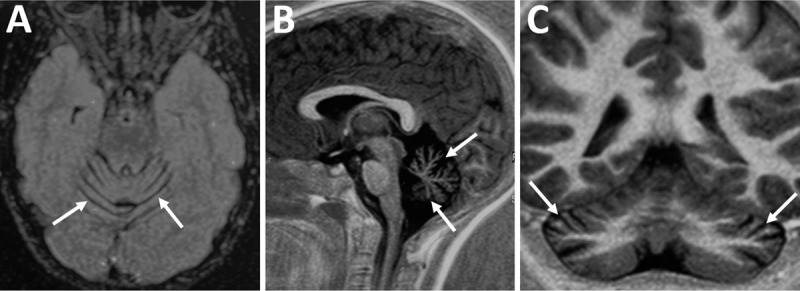
Case report: A 23-year-old previously healthy woman presented with slowly-progressive gait impairment since the age of six years. Neurological examination revealed profound areflexia, chorea, generalized dystonia and oculomotor apraxia. Brain MRI revealed mild cerebellar atrophy and needle EMG showed axonal sensorimotor neuropathy. Whole exome sequencing revealed a mutation in the aprataxin gene.
Discussion: AOA1 can present with choreoathetosis mixed with dystonic features, resembling ataxia-telangiectasia. This case is instructive since mixed and complex movement disorders is not very common in AOA1.
Highlights: Ataxia with oculomotor apraxia type 1 (AOA1) is characterized by early-onset ataxia and oculomotor apraxia caused by variants in the APTX gene.Ataxia is usually not the sole movement abnormality in AOA1.Hyperkinetic movement disorders, especially chorea and dystonia, may occur.Mixed and complex movement disorders is not very common in AOA1.Patients with early-onset ataxia associated with mixed movement disorders should also be investigated for AOA1.
Keywords: ataxia; ataxia with oculomotor apraxia; ataxia with oculomotor apraxia type 1; cerebellum; movement disorders.
Copyright: © 2020 The Author(s).
Conflict of interest statement
The authors have no competing interests to declare.
Figures
References
-
- Anheim M, Fleury M, Monga B, et al. Epidemiological, clinical, paraclinical and molecular study of a cohort of 102 patients affected with autosomal recessive progressive cerebellar ataxia from Alsace, Eastern France: implications for clinical management. Neurogenetics. 2010; 11: 1–12. DOI: 10.1007/s10048-009-0196-y - DOI - PubMed
Publication types
MeSH terms
Substances
Supplementary concepts
LinkOut - more resources
Full Text Sources
Medical