


Proinflammation, profibrosis, and arterial aging
- PMID: 33103036
- PMCID: PMC7574637
- DOI: 10.1002/agm2.12099
Proinflammation, profibrosis, and arterial aging
Abstract
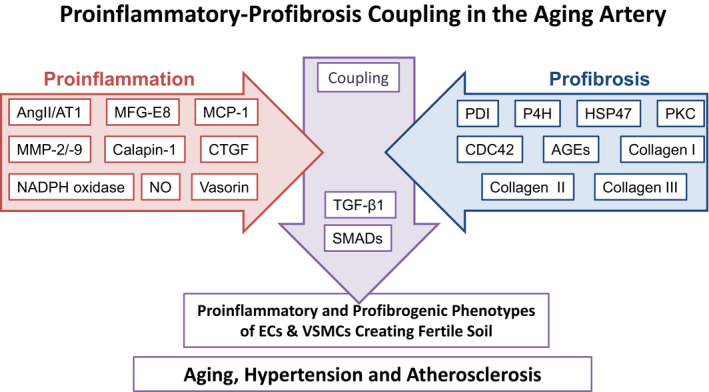
Aging is a major risk factor for quintessential cardiovascular diseases, which are closely related to arterial proinflammation. The age-related alterations of the amount, distribution, and properties of the collagen fibers, such as cross-links and degradation in the arterial wall, are the major sequelae of proinflammation. In the aging arterial wall, collagen types I, II, and III are predominant, and are mainly produced by stiffened vascular smooth muscle cells (VSMCs) governed by proinflammatory signaling, leading to profibrosis. Profibrosis is regulated by an increase in the proinflammatory molecules angiotensin II, milk fat globule-EGF-VIII, and transforming growth factor-beta 1 (TGF-β1) signaling and a decrease in the vasorin signaling cascade. The release of these proinflammatory factors triggers the activation of matrix metalloproteinase type II (MMP-2) and activates profibrogenic TGF-β1 signaling, contributing to profibrosis. The age-associated increase in activated MMP-2 cleaves latent TGF-β and subsequently increases TGF-β1 activity leading to collagen deposition in the arterial wall. Furthermore, a blockade of the proinflammatory signaling pathway alleviates the fibrogenic signaling, reduces profibrosis, and prevents arterial stiffening with aging. Thus, age-associated proinflammatory-profibrosis coupling is the underlying molecular mechanism of arterial stiffening with advancing age.
Keywords: aging; artery; collagen; profibrosis; proinflammation; stiffening.
© 2020 The Authors. Aging Medicine published by Beijing Hospital and John Wiley & Sons Australia, Ltd.
Conflict of interest statement
Nothing to disclose.
Figures
References
Publication types
LinkOut - more resources
Full Text Sources
Miscellaneous