


Emergency department use among postpartum women with mental health disorders
- PMID: 33103100
- PMCID: PMC7574686
- DOI: 10.1016/j.ajogmf.2020.100269
Emergency department use among postpartum women with mental health disorders
Abstract
Background: Mental health disorders are becoming more recognized in pregnancy. Whether mental health disorders are associated with health services utilization after child birth is not completely understood.
Objective: This study aimed to investigate postpartum emergency department use within 30 days of delivery among women with preexisting mental health disorders during pregnancy.
Study design: This was a retrospective cohort study evaluating emergency department use among postpartum women with or without mental health disorders who delivered at an academic center between January 2014 and June 2018. Demographic and outcome data were medical record abstracted and analyzed. Multivariate regression was performed to adjust for covariates.
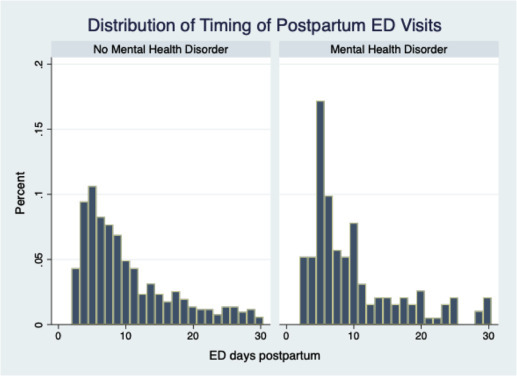
Results: During the study period, 13,605 women delivered at the institution, 2355 of whom (17.3%) had an underlying mental health disorder. The primary diagnoses of mental health disorder were anxiety (48.8%), depression (34.8%), substance use disorder (11.4%), bipolar disorder (3.4%), psychosis (0.7%), and other (0.8%). There were a total of 565 emergency department visits within 30 days of delivery. Women who presented to the emergency department after delivery were more likely to have public insurance, identify as black or Asian, and have an underlying mental health disorder. Among women with mental health disorders, 155 (6.6%) used the emergency department within 30 days of their delivery compared with 410 (3.6%) of patients without mental health disorder (adjusted odds ratio, 1.74; 95% confidence interval, 1.42-2.13; P<.001). When assessing the risk of emergency department usage per the type of mental health disorder, anxiety (adjusted odds ratio, 1.73; 95% confidence interval, 1.31-2.27) and depression (adjusted odds ratio, 2.13; 95% confidence interval, 1.59-2.86) carried the highest risk. Compared with women without mental health disorders, women with underlying mental health disorders had more presentations for hypertension (15.5% vs 11.2%) and psychiatric evaluations (4.5% vs 0.2%; both P<.001).
Conclusion: Women with mental health disorders use the emergency department during the postpartum period for psychiatric and obstetrical reasons more frequently than women without mental health disorders. Increased surveillance, treatment, and follow-up during pregnancy and the early postpartum period may be warranted for this high-risk population.
Keywords: anxiety; depression; emergency department; fourth trimester; maternal; mood disorders; obstetrical; perinatal; pregnancy; psychiatric.
© 2020 Elsevier Inc. All rights reserved.
Figures


References
-
- Clark S.L., Belfort M.A., Dildy G.A., et al. Emergency department use during the postpartum period: implications for current management of the puerperium. Am J Obstet Gynecol. 2010;203:38.e1–38.e6. - PubMed
-
- Batra P., Fridman M., Leng M., Gregory K.D. Emergency department care in the postpartum period: California births, 2009-2011. Obstet Gynecol. 2017;130:1073–1081. - PubMed
-
- ACOG Committee on Practice Bulletins--Obstetrics ACOG Practice Bulletin: clinical management guidelines for obstetrician-gynecologists number 92, April 2008 (replaces Practice Bulletin number 87, November 2007). Use of psychiatric medications during pregnancy and lactation. Obstet Gynecol. 2008;111:1001–1020. - PubMed
-
- Grigoriadis S., VonderPorten E.H., Mamisashvili L., et al. The impact of maternal depression during pregnancy on perinatal outcomes: a systematic review and meta-analysis. J Clin Psychiatry. 2013;74:e321–e341. - PubMed
MeSH terms
LinkOut - more resources
Full Text Sources
Other Literature Sources
Medical
