


Implementation of a National 5-Year Plan for Prehospital Emergency Care in Singapore and Impact on Out-of-Hospital Cardiac Arrest Outcomes From 2011 to 2016
- PMID: 33103542
- PMCID: PMC7763405
- DOI: 10.1161/JAHA.119.015368
Implementation of a National 5-Year Plan for Prehospital Emergency Care in Singapore and Impact on Out-of-Hospital Cardiac Arrest Outcomes From 2011 to 2016
Abstract
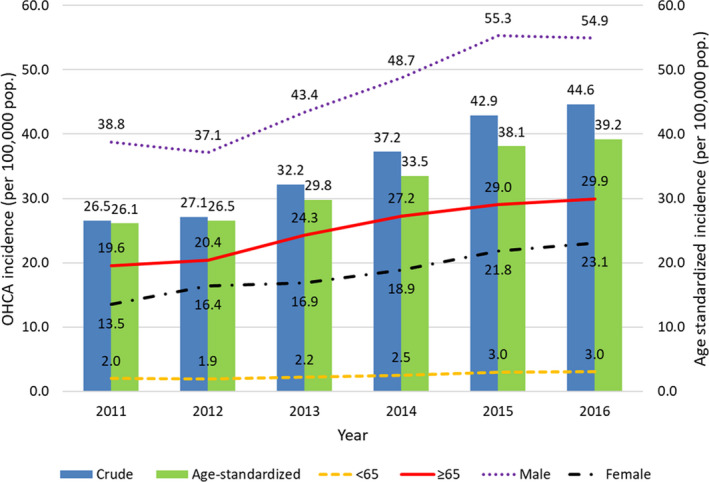
Background Outcomes of patients from out-of-hospital cardiac arrest (OHCA) vary widely globally because of differences in prehospital systems of emergency care. National efforts had gone into improving OHCA outcomes in Singapore in recent years including community and prehospital initiatives. We aimed to document the impact of implementation of a national 5-year Plan for prehospital emergency care in Singapore on OHCA outcomes from 2011 to 2016. Methods and Results Prospective, population-based data of OHCA brought to Emergency Departments were obtained from the Pan-Asian Resuscitation Outcomes Study cohort. The primary outcome was Utstein (bystander witnessed, shockable rhythm) survival-to-discharge or 30-day postarrest. Mid-year population estimates were used to calculate age-standardized incidence. Multivariable logistic regression was performed to identify prehospital characteristics associated with survival-to-discharge across time. A total of 11 465 cases qualified for analysis. Age-standardized incidence increased from 26.1 per 100 000 in 2011 to 39.2 per 100 000 in 2016. From 2011 to 2016, Utstein survival rates nearly doubled from 11.6% to 23.1% (P=0.006). Overall survival rates improved from 3.6% to 6.5% (P<0.001). Bystander cardiopulmonary resuscitation rates more than doubled from 21.9% to 56.3% and bystander automated external defibrillation rates also increased from 1.8% to 4.6%. Age ≤65 years, nonresidential location, witnessed arrest, shockable rhythm, bystander automated external defibrillation, and year 2016 were independently associated with improved survival. Conclusions Implementation of a national prehospital strategy doubled OHCA survival in Singapore from 2011 to 2016, along with corresponding increases in bystander cardiopulmonary resuscitation and bystander automated external defibrillation. This can be an implementation model for other systems trying to improve OHCA outcomes.
Keywords: bystander CPR; emergency medical services; interventions; outcomes; out‐of‐hospital‐cardiac arrest; prehospital; resuscitation.
Conflict of interest statement
Ong reports funding from the Zoll Medical Corporation for a study involving mechanical cardiopulmonary resuscitation devices; grants from the Laerdal Foundation, Laerdal Medical, and Ramsey Social Justice Foundation for funding of the Pan‐Asian Resuscitation Outcomes Study; an advisory relationship with Global Healthcare SG, a commercial entity that manufactures cooling devices; and funding from Laerdal Medical on an observation program to their Community CPR Training Centre Research Program in Norway. Ong has a licensing agreement and patent filed (Application no: 13/047,348) with ZOLL Medical Corporation for a study titled “Method of predicting acute cardiopulmonary events and survivability of a patient.” The remaining authors have no disclosures to report.
Figures
References
-
- Ong MEH, Perkins GD, Cariou A. Out‐of‐hospital cardiac arrest: prehospital management. Lancet. 2018;391:980–988. - PubMed
-
- Ong ME, Shin SD, De Souza NN, Tanaka H, Nishiuchi T, Song KJ, Ko PC, Leong BS, Khunkhlai N, Naroo GY, et al. Outcomes for out‐of‐hospital cardiac arrests across 7 countries in Asia: the Pan Asian Resuscitation Outcomes Study (PAROS). Resuscitation. 2015;96:100–108. - PubMed
-
- Ong ME, Cho J, Ma MH, Tanaka H, Nishiuchi T, Al Sakaf O, Abdul Karim S, Khunkhlai N, Atilla R, Lin CH, et al. Comparison of emergency medical services systems in the Pan‐Asian resuscitation outcomes study countries: report from a literature review and survey. Emerg Med Australas. 2013;25:55–63. - PubMed
-
- Shin SD, Ong ME, Tanaka H, Ma MH, Nishiuchi T, Alsakaf O, Karim SA, Khunkhlai N, Lin CH, Song KJ, et al. Comparison of emergency medical services systems across Pan‐Asian countries: a Web‐based survey. Prehosp Emerg Care. 2012;16:477–496. - PubMed
Publication types
MeSH terms
LinkOut - more resources
Full Text Sources
Medical
