


A novel RFC1 repeat motif (ACAGG) in two Asia-Pacific CANVAS families
- PMID: 33103729
- PMCID: PMC7780484
- DOI: 10.1093/brain/awaa263
A novel RFC1 repeat motif (ACAGG) in two Asia-Pacific CANVAS families
Erratum in
-
Corrigendum to: A novel RFC1 repeat motif (ACAGG) in two Asia-Pacific CANVAS families.Brain. 2021 Jun 22;144(5):e51. doi: 10.1093/brain/awab038. Brain. 2021. PMID: 33991090 Free PMC article. No abstract available.
Abstract
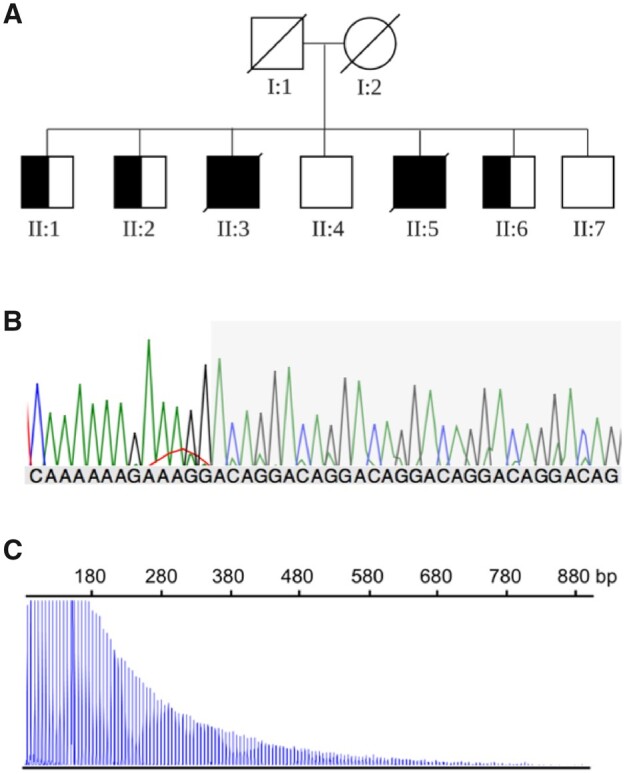
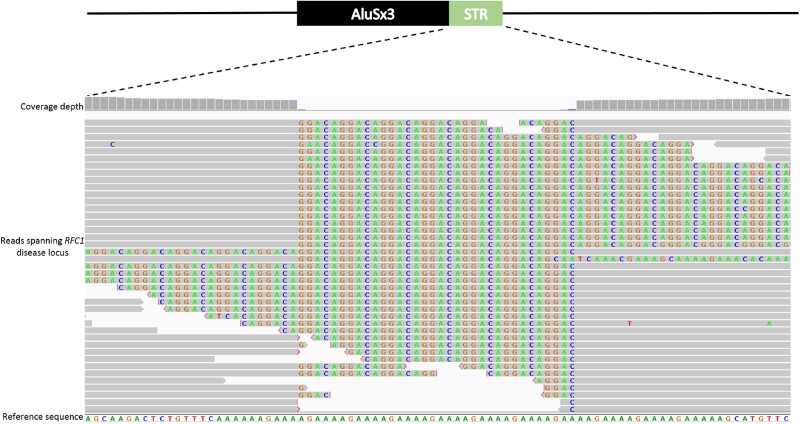
Cerebellar ataxia, neuropathy and vestibular areflexia syndrome (CANVAS) is a progressive late-onset, neurological disease. Recently, a pentanucleotide expansion in intron 2 of RFC1 was identified as the genetic cause of CANVAS. We screened an Asian-Pacific cohort for CANVAS and identified a novel RFC1 repeat expansion motif, (ACAGG)exp, in three affected individuals. This motif was associated with additional clinical features including fasciculations and elevated serum creatine kinase. These features have not previously been described in individuals with genetically-confirmed CANVAS. Haplotype analysis showed our patients shared the same core haplotype as previously published, supporting the possibility of a single origin of the RFC1 disease allele. We analysed data from >26 000 genetically diverse individuals in gnomAD to show enrichment of (ACAGG) in non-European populations.
Keywords: neuropathy; sensory neuropathy; cerebellar ataxia; vestibular areflexia syndrome; CANVAS; RFC1; repeat expansion.
© The Author(s) (2020). Published by Oxford University Press on behalf of the Guarantors of Brain. All rights reserved. For permissions, please email: journals.permissions@oup.com.
Figures
References
-
- Abecasis GR, Cherny SS, Cookson WO, Cardon LR.. Merlin-rapid analysis of dense genetic maps using sparse gene flow trees. Nat Genet 2002; 30: 97–101. - PubMed
-
- Australian Department of Foreign Affairs and Trade. Niue country brief. 2019. Available from: https://www.dfat.gov.au/geo/niue/Pages/niue-country-brief (9 March 2020, date last accessed).
-
- Bahlo M, Bromhead CJ.. Generating linkage mapping files from Affymetrix SNP chip data. Bioinformatics 2009; 25: 1961–2. - PubMed
Publication types
MeSH terms
Substances
Grants and funding
LinkOut - more resources
Full Text Sources
Medical
