


Effect of Timing of and Adherence to Social Distancing Measures on COVID-19 Burden in the United States : A Simulation Modeling Approach
- PMID: 33105091
- PMCID: PMC7598093
- DOI: 10.7326/M20-4096
Effect of Timing of and Adherence to Social Distancing Measures on COVID-19 Burden in the United States : A Simulation Modeling Approach
Abstract
Background: Across the United States, various social distancing measures were implemented to control the spread of coronavirus disease 2019 (COVID-19). However, the effectiveness of such measures for specific regions with varying population demographic characteristics and different levels of adherence to social distancing is uncertain.
Objective: To determine the effect of social distancing measures in unique regions.
Design: An agent-based simulation model.
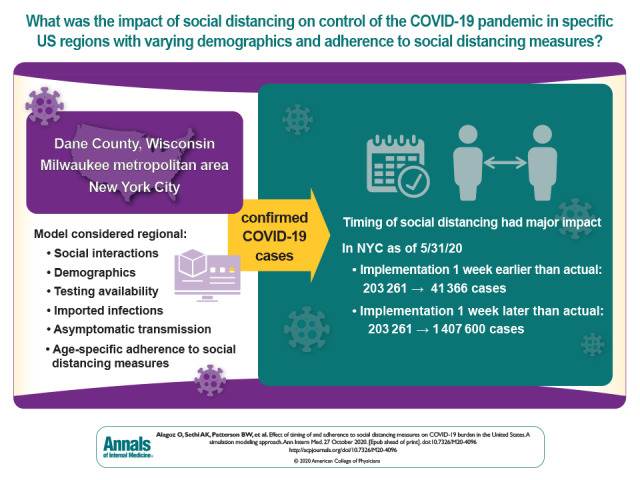
Setting: Agent-based model applied to Dane County, Wisconsin; the Milwaukee metropolitan (metro) area; and New York City (NYC).
Patients: Synthetic population at different ages.
Intervention: Different times for implementing and easing social distancing measures at different levels of adherence.
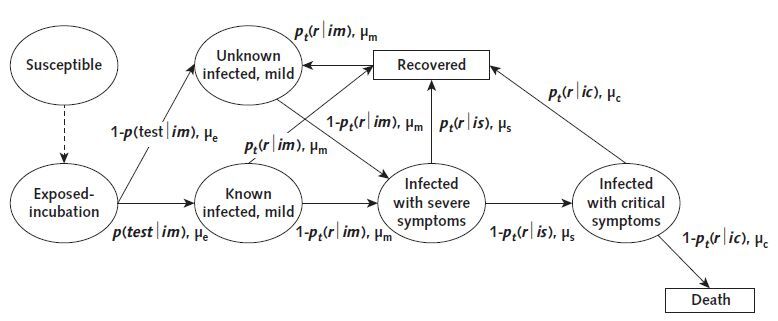
Measurements: The model represented the social network and interactions among persons in a region, considering population demographic characteristics, limited testing availability, "imported" infections, asymptomatic disease transmission, and age-specific adherence to social distancing measures. The primary outcome was the total number of confirmed COVID-19 cases.
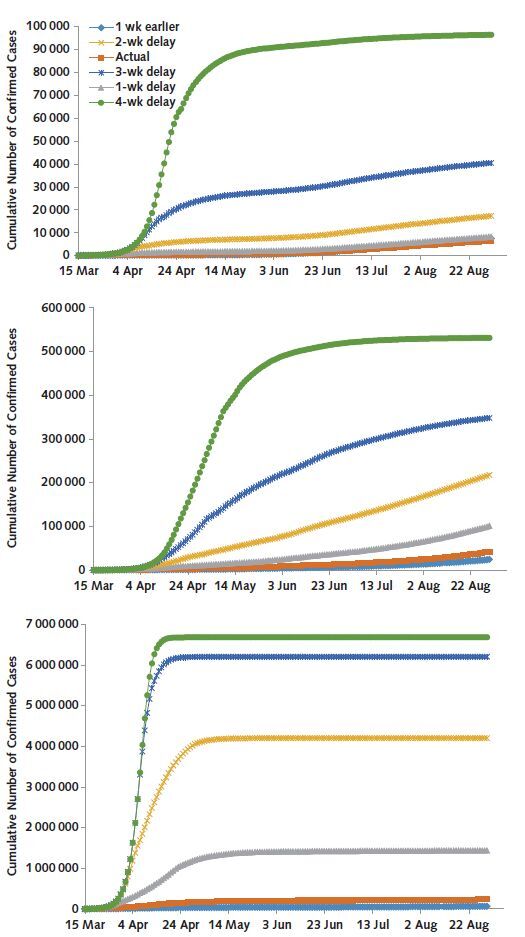
Results: The timing of and adherence to social distancing had a major effect on COVID-19 occurrence. In NYC, implementing social distancing measures 1 week earlier would have reduced the total number of confirmed cases from 203 261 to 41 366 as of 31 May 2020, whereas a 1-week delay could have increased the number of confirmed cases to 1 407 600. A delay in implementation had a differential effect on the number of cases in the Milwaukee metro area versus Dane County, indicating that the effect of social distancing measures varies even within the same state.
Limitation: The effect of weather conditions on transmission dynamics was not considered.
Conclusion: The timing of implementing and easing social distancing measures has major effects on the number of COVID-19 cases.
Primary funding source: National Institute of Allergy and Infectious Diseases.
Conflict of interest statement
Figures
Update of
-
Impact of Timing of and Adherence to Social Distancing Measures on COVID-19 Burden in the US: A Simulation Modeling Approach.medRxiv [Preprint]. 2020 Jun 9:2020.06.07.20124859. doi: 10.1101/2020.06.07.20124859. medRxiv. 2020. Update in: Ann Intern Med. 2021 Jan;174(1):50-57. doi: 10.7326/M20-4096. PMID: 32577703 Free PMC article. Updated. Preprint.
Comment in
-
Recalculating Readmissions: A Work in Progress.Ann Intern Med. 2021 Jan;174(1):113-114. doi: 10.7326/M20-6254. Epub 2020 Oct 13. Ann Intern Med. 2021. PMID: 33045177 No abstract available.
-
Maxims for a Pandemic: Time, Distance, and Data.Ann Intern Med. 2021 Jan;174(1):111-112. doi: 10.7326/M20-6934. Epub 2020 Oct 27. Ann Intern Med. 2021. PMID: 33105096 Free PMC article.
References
-
- Davies NG, Kucharski AJ, Eggo RM, et al; Centre for the Mathematical Modelling of Infectious Diseases COVID-19 working group. Effects of non-pharmaceutical interventions on COVID-19 cases, deaths, and demand for hospital services in the UK: a modelling study. Lancet Public Health. 2020;5:e375-e385. [PMID: 32502389] doi:10.1016/S2468-2667(20)30133-X - PMC - PubMed
-
- The White House. Guidelines for opening up America again. Accessed at www.whitehouse.gov/openingamerica on 29 April 2020.
-
- Modeling COVID-19 spread vs healthcare capacity. Accessed at https://alhill.shinyapps.io/COVID19seir on 2 April 2020.
-
- Predictive Healthcare at Penn Medicine. COVID-19 hospital impact model for epidemics (CHIME). Accessed at https://penn-chime.phl.io on 2 April 2020.
-
- Institute for Health Metrics and Evaluation. COVID-19 projections. Accessed at https://covid19.healthdata.org/united-states-of-america on 26 April 2020.
Publication types
MeSH terms
Grants and funding
LinkOut - more resources
Full Text Sources
Other Literature Sources
Medical
