. 2021 Jan 6;29(21):3516-3531.
doi: 10.1093/hmg/ddaa237.

NMIHBA results from hypomorphic PRUNE1 variants that lack short-chain exopolyphosphatase activity

Affiliations

NMIHBA results from hypomorphic PRUNE1 variants that lack short-chain exopolyphosphatase activity

Harikiran Nistala et al. Hum Mol Genet. .

Abstract

Neurodevelopmental disorder with microcephaly, hypotonia and variable brain anomalies (NMIHBA) is an autosomal recessive neurodevelopmental and neurodegenerative disorder characterized by global developmental delay and severe intellectual disability. Microcephaly, progressive cortical atrophy, cerebellar hypoplasia and delayed myelination are neurological hallmarks in affected individuals. NMIHBA is caused by biallelic variants in PRUNE1 encoding prune exopolyphosphatase 1. We provide in-depth clinical description of two affected siblings harboring compound heterozygous variant alleles, c.383G > A (p.Arg128Gln), c.520G > T (p.Gly174*) in PRUNE1. To gain insights into disease biology, we biochemically characterized missense variants within the conserved N-terminal aspartic acid-histidine-histidine (DHH) motif and provide evidence that they result in the destabilization of protein structure and/or loss of exopolyphosphatase activity. Genetic ablation of Prune1 results in midgestational lethality in mice, associated with perturbations to embryonic growth and vascular development. Our findings suggest that NMIHBA results from hypomorphic variant alleles in humans and underscore the potential key role of PRUNE1 exopolyphoshatase activity in neurodevelopment.


Figures

Figure 1
Figure 1
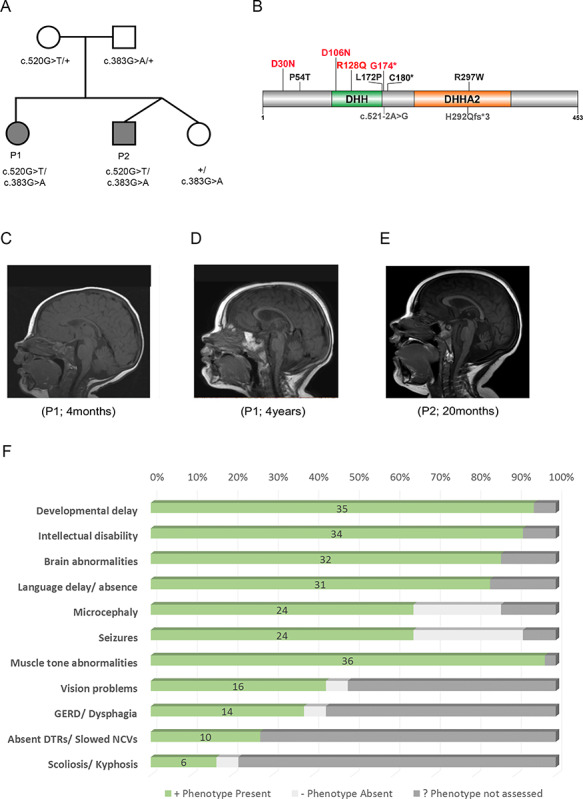
Clinical presentation of NMIHBA patients. (A) Immediate family pedigree and genotypes of patient 1 (P1) and patient 2 (P2). (B) Pathogenic variants in PRUNE1 identified in NMIHBA patients reported to date. The majority of pathogenic variants cluster in the DHH and DHHA2 domains. Variants characterized in this study are highlighted in red. (CE) Sagittal T1-weighted brain MRI images. (C) Image of patient 1 at 4 months of age showing no significant findings. (D) Image of patient 1 at 4 years of age showing severe cortical and cerebellar atrophy and milder corpus callosum and brainstem atrophy. The craniofacial ratio is decreased. The cerebellar vermis decreased in height from 29.5 to 25.6 mm between the time the two images were obtained. (E) Image obtained for patient 2 at 20 months of age demonstrating cerebellar vermis hypoplasia and mild cortical atrophy. (F) Frequency of clinical manifestations ascertained in reported NMIHBA cases.
Figure 2
Figure 2
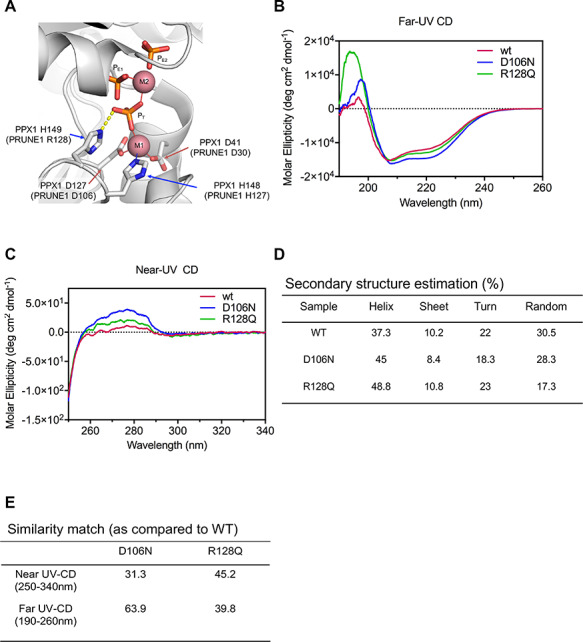
Missense mutations perturb secondary and tertiary structure of PRUNE1. (A) Homology modeling (based on 1.6 Å resolved S.c. PPX1 structure, 2QB7) demonstrated D30, D106 and R128 residues fall within a metal-ion and phosphate binding interface representing the active-site for phosphate hydrolysis. Disruption of these charged residues within the active-site impair metal coordination (D30N and D106N) and substrate binding R128Q. Three bound phosphate moieties PT, PE1 and PE2 shown in ball-and-stick, and the catalytic metal ions (M1 and M2) as pink spheres. (B) Far-UV CD spectra reveal secondary structure differences between wild-type and missense (D106N and R128Q) mutants. (C) Near-UV CD spectra signify change in the tertiary conformation of missense (D106N and R128Q) mutants as compared with the wild-type. (D) Spectral deconvolution of far-UV CD spectra revealed differences in alpha-helical content between wild-type and D106N or R128Q mutants. (E) Similarity match scores (based on quantitative assessment of similarity of far-UV and near-UV spectra) reveal low similarity of the missense mutants as compared with wild-type.
Figure 3
Figure 3
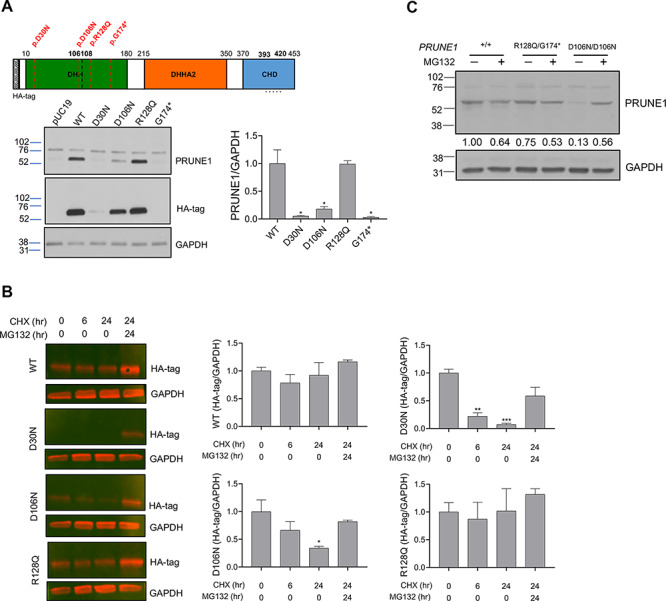
D30N and D106N variants result in reduced protein stability and proteosomal degradation, whereas R128Q variant results in stable mutant protein. (A) HEK293 cells were transfected with N-terminal HA-tagged wild-type or mutant PRUNE1 cDNA. Equal amounts of protein from whole cell lysate were used for immunoblotting using antibodies against N-terminal HA-tag, and C-terminal PRUNE1 epitope (a.a. 393-420, dotted line). GAPDH was used as a loading control. G174*mutant showed no expression, whereas D30N and D106N mutants showed significantly reduced expression as compared with wild-type and R128Q levels. (B) Immunoblots of cells overexpressing N-terminal HA-tagged wild-type or mutant PRUNE1 treated with cycloheximide (CHX) at 200 μM for 0, 6 and 24 h (with or without proteasome inhibitor MG132 at 15 μM). Bar graphs in (A) and (B) represent densitometry analyses of three independent experiments. *P < 0.05, **P < 0.01, ***P < 0.001, error bars: SEM. (C) Immunoblotting of endogenous PRUNE1 in patient derived fibroblasts harboring compound heterozygous R128Q; G174* variants or homozygous D106N missense variant treated with or without MG132 (15 μM). Densitometry analysis of the representative immunoblot shown in numerical format.
Figure 4
Figure 4
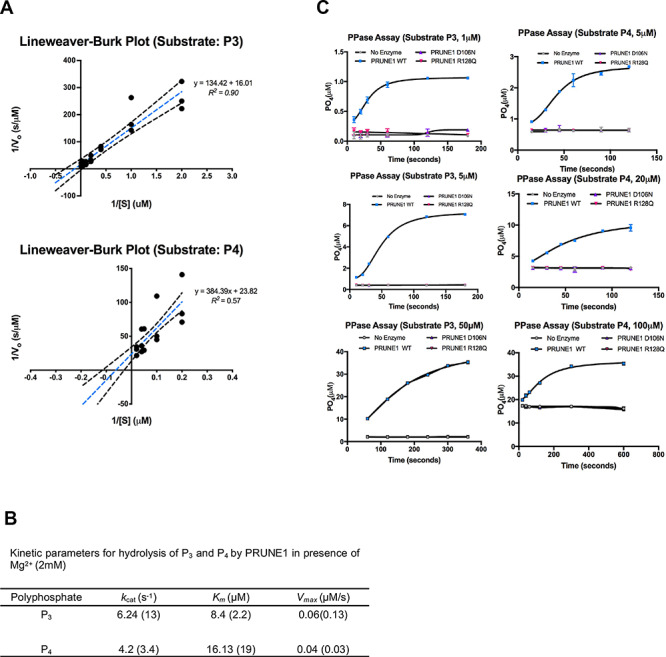
D106N and R128Q variants result in loss of short chain exopolyphosphatase activity. (A) Lineweaver−Burk plots depicting short-chain exopolyphosphatase kinetics of wild-type PRUNE1 using sodium tripolyphosphate (P3) and sodium tetrapolyphosphate (P4) as substrates. Dotted black lines represent 95% CI. (B) Kinetic parameters for hydrolysis of polyphosphates (P3 and P4) by wild-type PRUNE1 in the presence of Mg2+ (2 mM) as the cofactor. Values reported by Tammenkoski et al. are shown within parenthesis (17). (C) Short-chain exopolyphosphatase activity of wild-type, D106N and R128Q mutants on P3 and P4 determined using fixed-time BIOMOL Green phosphate detection assay. Data represented as mean ± SEM over three independent experiments with six technical replicates per sample.
Figure 5
Figure 5
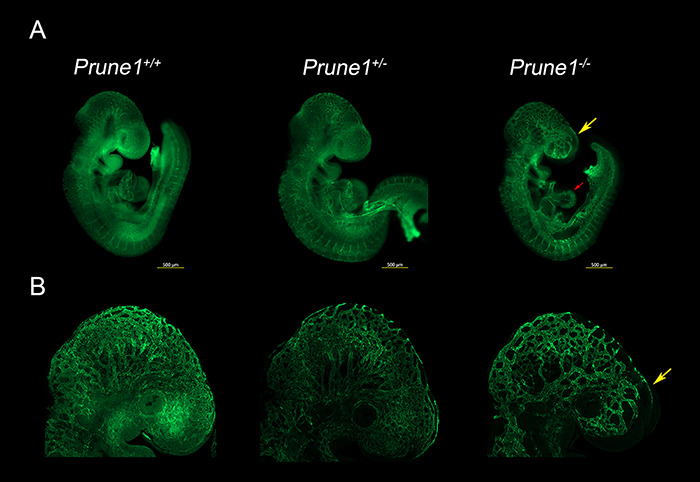
Loss of Prune1 results in vascular defects with significant disruption of the cephalic vascular plexus. (A) Representative whole mount Pecam1 staining at E9.5 demonstrated reduced plexus branching and perturbed capillary sprouting within the cephalic region (frontonasal prominence and brain, yellow arrow) in the Prune1−/− embryos as compared with wild-type and heterozygous littermates. Moreover, Prune1−/− embryos displayed cardiac defects observed as a less intricate appearance of the endocardium when compared with littermate controls (red arrow) (B) Higher magnification (6.3X) images further highlight the disruption of the cephalic vascular plexus. A total of three Prune1+/+, 2 Prune1+/− and 5 Prune1−/− embryos were analyzed in two independent experiments.

References

    1. Lovett S.T. and Kolodner R.D. (1989) Identification and purification of a single-stranded-DNA-specific exonuclease encoded by the recJ gene of Escherichia coli. Proc. Natl. Acad. Sci. U. S. A., 86, 2627–2631. - PMC - PubMed
    1. Shintani T., Uchiumi T., Yonezawa T., Salminen A., Baykov A.A., Lahti R. and Hachimori A. (1998) Cloning and expression of a unique inorganic pyrophosphatase from Bacillus subtilis: evidence for a new family of enzymes. FEBS Lett., 439, 263–266. - PubMed
    1. Wurst H. and Kornberg A. (1994) A soluble exopolyphosphatase of Saccharomyces cerevisiae. Purification and characterization. J. Biol. Chem., 269, 10996–11001. - PubMed
    1. Aravind L. and Koonin E.V. (1998) A novel family of predicted phosphoesterases includes drosophila prune protein and bacterial RecJ exonuclease. Trends Biochem. Sci., 23, 17–19. - PubMed
    1. Carotenuto P., Marino N., Bello A.M., D'Angelo A., Di Porzio U., Lombardi D. and Zollo M. (2006) PRUNE and NM23-M1 expression in embryonic and adult mouse brain. J. Bioenerg. Biomembr., 38, 233–246. - PubMed

Publication types

MeSH terms

Substances