. 2020 Oct 26;10(1):18229.
doi: 10.1038/s41598-020-75426-6.

Optimization of T4 phage engineering via CRISPR/Cas9

Affiliations

Optimization of T4 phage engineering via CRISPR/Cas9

Michelle M Duong et al. Sci Rep. .

Abstract

A major limitation hindering the widespread use of synthetic phages in medical and industrial settings is the lack of an efficient phage-engineering platform. Classical T4 phage engineering and several newly proposed methods are often inefficient and time consuming and consequently, only able to produce an inconsistent range of genomic editing rates between 0.03-3%. Here, we review and present new understandings of the CRISPR/Cas9 assisted genome engineering technique that significantly improves the genomic editing rate of T4 phages. Our results indicate that crRNAs selection is a major rate limiting factor in T4 phage engineering via CRISPR/Cas9. We were able to achieve an editing rate of > 99% for multiple genes that functionalizes the phages for further applications. We envision that this improved phage-engineering platform will accelerate the fields of individualized phage therapy, biocontrol, and rapid diagnostics.


Conflict of interest statement

The authors declare no competing interests.

Figures
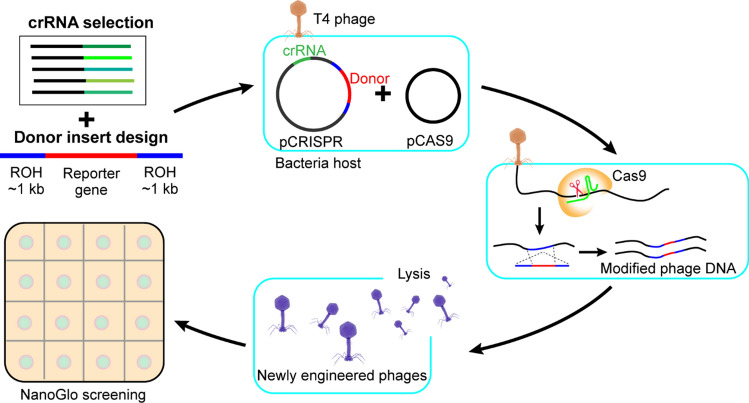
Figure 1
Figure 1
CRISPR/Cas9 T4 Phage Engineering Workflow. Candidate crRNAs targeting the T4 gene of interest were validated by a plaque assay. The most effective crRNA was selected based on largest reduction in Efficiency of Plating (EOP) and inserted into the synthetic CRISPR array in pCRISPR. The donor insert was designed to contain a reporter gene flanked by regions of homology to the crRNA recognition sequence and cloned into pCRISPR. A strain containing pCas9 and pCRISPR was infected with T4 phages. CRISPR/Cas9-mediated T4 genome cleavage followed by homologous recombination with the donor plasmid resulted in genomic incorporation of the reporter gene. NanoGlo screening was used for luminescent detection of recombinant phages by addition of the reporter enzyme substrate to phage plaques.
Figure 2
Figure 2
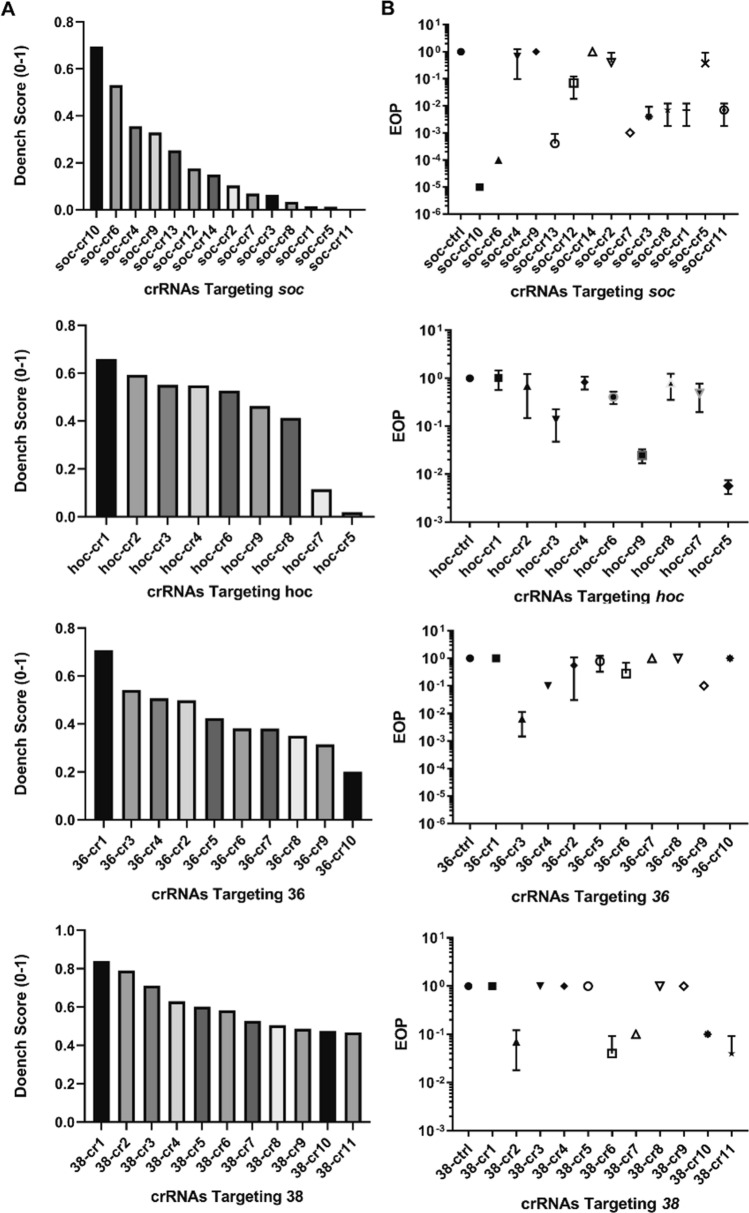
Doench scoring is not a good predictive measurement for selecting effective crRNAs. Experimental efficacy of DNA cleavage via EOP as evaluated in the soc, hoc, gp36, and gp38 genes in T4 phages does not align with theoretical projection. (A) Doench scoring (0–1) to theoretically assess crRNAs on-target activity and off-target sites in which values closer to 1 resemble the most potent crRNA. The crRNAs are ranked in descending efficacy order. (B) Validation of the crRNAs’ theoretical selection via plaque assay as demonstrated by the EOPs for soc, hoc, gp36, and gp38. Error bars indicate standard deviation of three experimental replicates. Lower EOP value represents better T4 phage DNA cleavage.
Figure 3
Figure 3
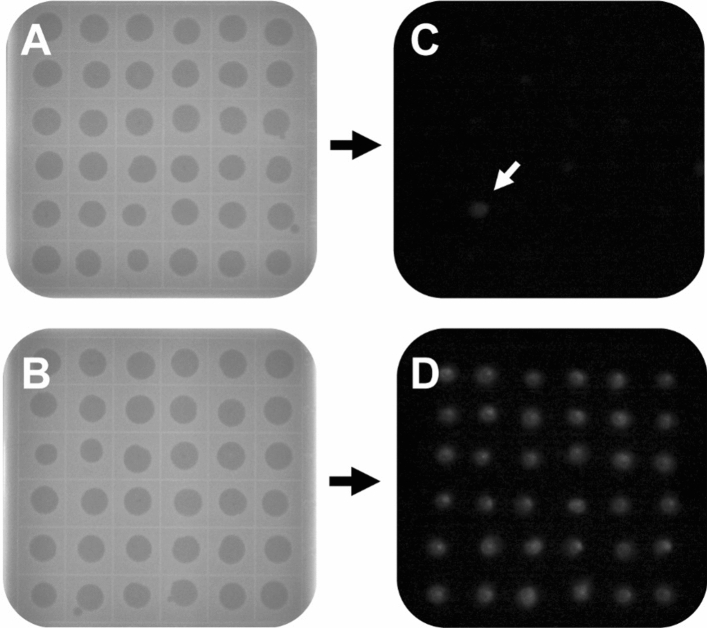
nluc insertion in T4 phages provides visual screening for recombinant phages. Comparing the efficiency of homologous recombination versus CRISPR/Cas9 assisted recombination. The schematic outlines the double plaque assay of T4 phage infection (A) of homologous recombination and (B) of CRISPR/Cas9 assisted recombination (representative images shown). The Nano-Glo luciferase assay system on the right demonstrates successful engineering of T4 phages (C) for homologous recombination (arrow) and (D) for CRISPR/Cas9-assisted recombination.
Figure 4
Figure 4
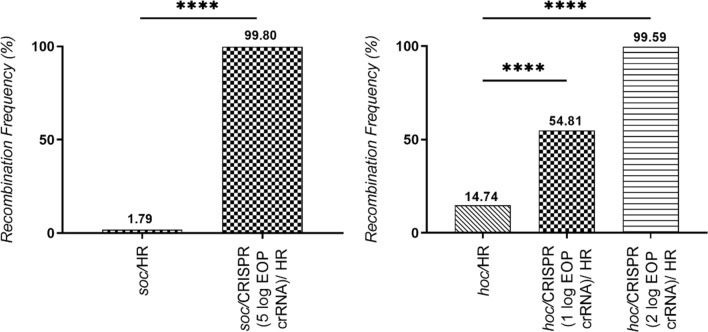
CRISPR/Cas9-assisted recombination resulted in > 99% recombination frequency. (A) soc was engineered using the CRISPR/Cas9 assisted platform with a 5 log EOP reduction crRNA, resulting in the production of > 99% recombinant phages. The CRISPR/Cas9 assisted recombination frequency is significantly higher than the natural homologous observed in the control (p < 0.0001, n = 1007 plaques) (B) hoc engineered using the CRISPR/Cas9-assisted platform with a 1 log EOP reduction crRNA and a 2 log EOP reduction crRNA also resulted in significantly higher recombination frequency than the control (p < 0.0001, n = 1102 plaques). Asterisks indicate significance (**** = p < 0.0001) by Chi-square Test.

References

    1. Mertz L. Battling superbugs: how phage therapy went from obscure to promising. IEEE Pulse. 2019;10:3–9. doi: 10.1109/MPULS.2019.2942816. - DOI - PubMed
    1. Chan BK, Abedon ST, Loc-Carrillo C. Phage cocktails and the future of phage therapy. Fut. Microbiol. 2013;8:769–783. doi: 10.2217/fmb.13.47. - DOI - PubMed
    1. Loc-Carrillo C, Abedon ST. Pros and cons of phage therapy. Bacteriophage. 2011;1:111–114. doi: 10.4161/bact.1.2.14590. - DOI - PMC - PubMed
    1. Westwater C, et al. Use of genetically engineered phage to deliver antimicrobial agents to bacteria: an alternative therapy for treatment of bacterial infections. Antimicrob. Agents Chemother. 2003;47:1301–1307. doi: 10.1128/AAC.47.4.1301-1307.2003. - DOI - PMC - PubMed
    1. LaVergne S, et al. Phage therapy for a multidrug-resistant acinetobacter baumannii craniectomy site infection. Open Forum Infect. Dis. 2018;5:1–3. doi: 10.1093/ofid/ofy064. - DOI - PMC - PubMed

Publication types

MeSH terms