


Impact of early intervention with onabotulinumtoxinA treatment in adult patients with post-stroke lower limb spasticity: results from the double-blind, placebo-controlled, phase 3 REFLEX study
- PMID: 33106968
- PMCID: PMC7666298
- DOI: 10.1007/s00702-020-02251-6
Impact of early intervention with onabotulinumtoxinA treatment in adult patients with post-stroke lower limb spasticity: results from the double-blind, placebo-controlled, phase 3 REFLEX study
Abstract
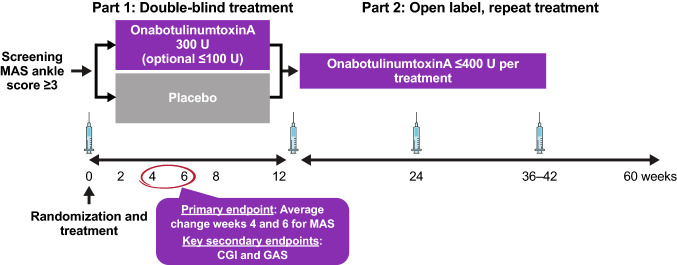
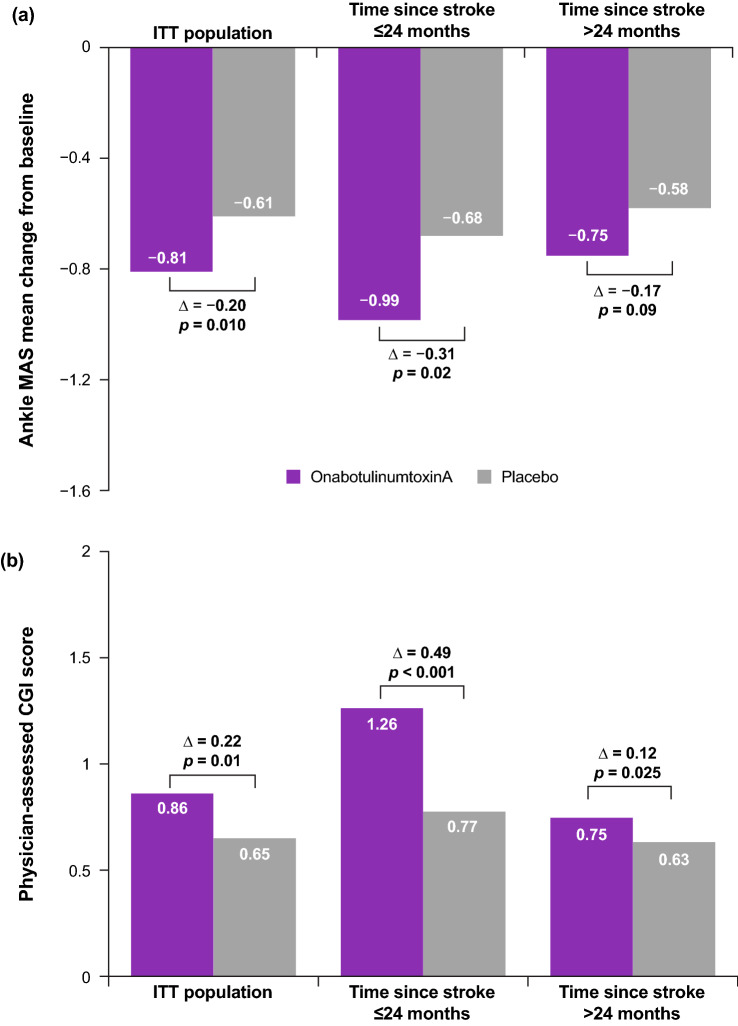
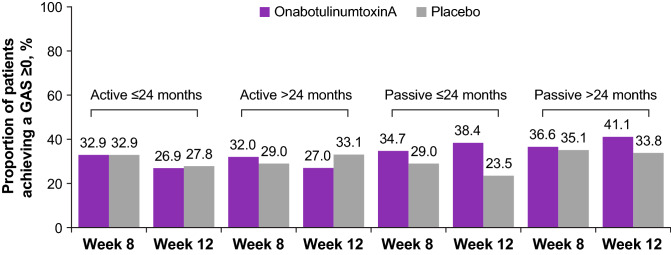
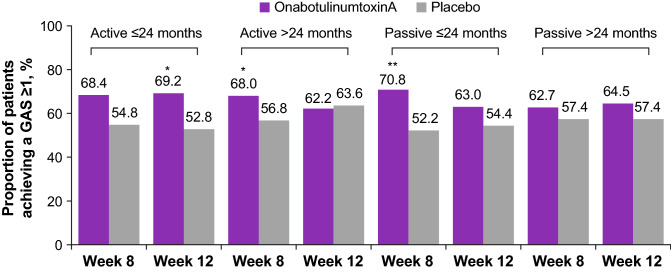
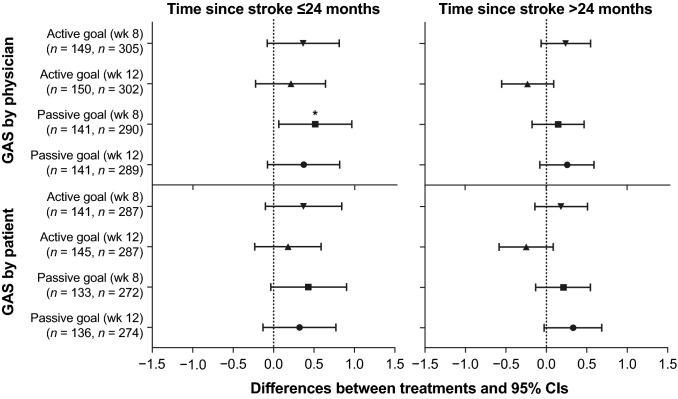
The aim of this study in patients with post-stroke lower limb spasticity (PSLLS) was to evaluate the relationship between time of onabotulinumtoxinA treatment relative to stroke and efficacy outcomes. This was a phase 3, international, multicenter, randomized, 12-week, double-blind study, followed by a repeated treatment, open-label extension. Patients were aged 18-85 years with PSLLS (Modified Ashworth Scale [MAS] ≥ 3) of the ankle with the most recent stroke occurring ≥ 3 months before screening. Patients (double-blind phase) were randomized (n = 468) to onabotulinumtoxinA 300-400 U (300 U, mandatory ankle muscles (gastrocnemius, soleus, tibialis posterior); and ≤ 100 U, optional lower limb muscles (flexor digitorum longus, flexor hallucis longus, flexor digitorum brevis, extensor hallucis, and rectus femoris]) or placebo. Primary endpoint: MAS change from baseline (average score of weeks 4 and 6). Secondary endpoints: physician-assessed Clinical Global Impression of Change (CGI) average score of weeks 4 and 6 and physician-assessed Goal Attainment Scale (GAS; active and passive, weeks 8 and 12). When stratified by time since stroke (≤ 24 months, n = 153; > 24 months, n = 315, post hoc), patients treated ≤ 24 months post-stroke experienced greater improvements from baseline versus placebo in MAS (- 0.31 vs - 0.17), CGI (0.49 vs 0.12), and passive GAS scores (week 12, 0.37 vs 0.26). A ≥ - 1-point improvement in active (week 12; p = 0.04) and passive (week 8; p = 0.02) GAS scores versus placebo was achieved by more patients treated ≤ 24 months post-stroke; in patients treated > 24 months post-stroke, improvements were only observed in active scores (week 8; p = 0.04). OnabotulinumtoxinA 300-400 U was well tolerated, with no new safety findings.
Keywords: Early intervention; OnabotulinumtoxinA; Spasticity; Stroke.
Conflict of interest statement
Atul T. Patel has received research grant support from Allergan plc, Merz, and Ipsen, and speaking honoraria from Merz and Allergan plc. Anthony B. Ward is a speaker and consultant for Allergan plc, Ipsen, and Merz. Carolyn Geis has received research support from and is a speaker/consultant for Allergan plc. Wolfgang H. Jost is a speaker and consultant for Allergan plc, Ipsen, and Merz. Chengcheng Liu and Rozalina Dimitrova are employees of Allergan plc.
Figures
References
-
- Adis R&D Insight Drug pipeline database, Botulinum toxin A - Allergan. https://adisinsight.springer.com/drugs/800008810. Accessed 20 Dec 2017
-
- Allergan plc (2016) BOTOX® for injection, for intramuscular, intradetrusor, or intradermal use. Allergan plc, Irvine, CA
-
- Burbaud P, Wiart L, Dubos JL, Gaujard E, Debelleix X, Joseph PA, Mazaux JM, Bioulac B, Barat M, Lagueny A. A randomised, double blind, placebo controlled trial of botulinum toxin in the treatment of spastic foot in hemiparetic patients. J Neurol Neurosurg Psychiatry. 1996;61:265–269. doi: 10.1136/jnnp.61.3.265. - DOI - PMC - PubMed
Publication types
MeSH terms
Substances
LinkOut - more resources
Full Text Sources
Medical
