


Fluid responsiveness to passive leg raising in patients with and without coronary artery disease: A prospective observational study
- PMID: 33109801
- PMCID: PMC7879910
- DOI: 10.4103/aca.ACA_73_19
Fluid responsiveness to passive leg raising in patients with and without coronary artery disease: A prospective observational study
Abstract
Introduction: Hemodynamic stability and fluid responsiveness (FR) assume importance in perioperative management of patients undergoing major surgery. Passive leg raising (PLR) is validated in assessing FR in intensive care unit patients. Very few studies have examined FR to PLR in intraoperative scenario. We prospectively studied FR to PLR using transesophageal echocardiography (TEE), in patients with no coronary artery disease (CAD) undergoing major neurosurgery and those with CAD undergoing coronary artery bypass grafting (CABG).
Methods: We enrolled 29 adult consenting patients undergoing major neurosurgery with TEE monitoring and 25 patients undergoing CABG. After induction of anesthesia, baseline hemodynamic parameters were obtained which was followed by PLR using automated adjustment of the operating table. Clinical and TEE-derived hemodynamic parameters were recorded at 1 and 10 min after PLR following which patients were returned to supine position.
Results: A total of 162 TEE and clinical examinations were done across baseline, 1 and 10 min after PLR; and paired comparison was done at data intervals of baseline versus 1 min PLR, baseline versus 10 min PLR, and 1 min versus 10 min PLR. There was no significant change in hemodynamic variables at any of the paired comparison intervals in patients undergoing neurosurgery. CABG cases had significant hemodynamic improvement 1 min after PLR, partially sustained at 10 min.
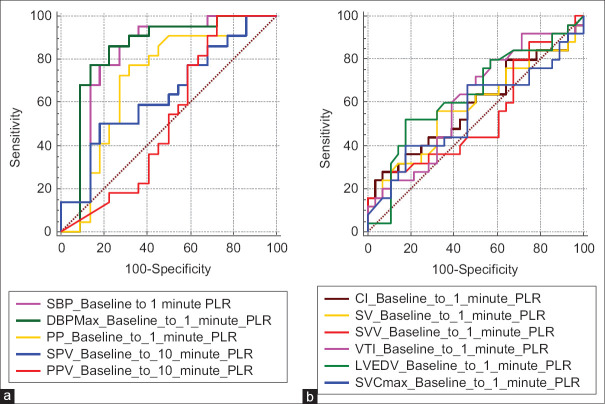
Conclusion: Patients undergoing CABG had significant hemodynamic response to PLR, whereas non-CAD patients undergoing neurosurgery did not. A blood pressure-left ventricular end-diastolic volume combination represented strong correlation in response prediction (Pearson's coefficient 0.641; P < 0.01).
Keywords: Coronary artery disease; fluid responsiveness; passive leg raising; transesophageal echocardiography.
Conflict of interest statement
None
Figures
References
-
- Aditianingsih D, George YW. Guiding principles of fluid and volume therapy. Best Pract Res Clin Anaesthesiol. 2014;28:249–60. - PubMed
-
- Rivers E, Nguyen B, Havstad S, Ressler J, Muzzin A, Knoblich B, et al. Early goal-directed therapy in the treatment of severe sepsis and septic shock. N Engl J Med. 2001;345:1368–77. - PubMed
-
- Andre AS, DelRossi AL. Hemodynamic management of patients in the first 24 hours after cardiac surgery. Crit Care Med. 2005;33:2082–93. - PubMed
-
- Lichtwarck-Aschoff M, Beale R, Pfeiffer UJ. Central venous pressure, pulmonary artery occlusion pressure, intrathoracic blood volume, and right ventricular end-diastolic volume as indicators of cardiac preload. J Crit Care. 1996;11:180–8. - PubMed
Publication types
MeSH terms
LinkOut - more resources
Full Text Sources
Medical
Miscellaneous