


Investigating Prescriptions and Mechanisms of Acupuncture for Chronic Stable Angina Pectoris: An Association Rule Mining and Network Analysis Study
- PMID: 33110434
- PMCID: PMC7578734
- DOI: 10.1155/2020/1931839
Investigating Prescriptions and Mechanisms of Acupuncture for Chronic Stable Angina Pectoris: An Association Rule Mining and Network Analysis Study
Abstract
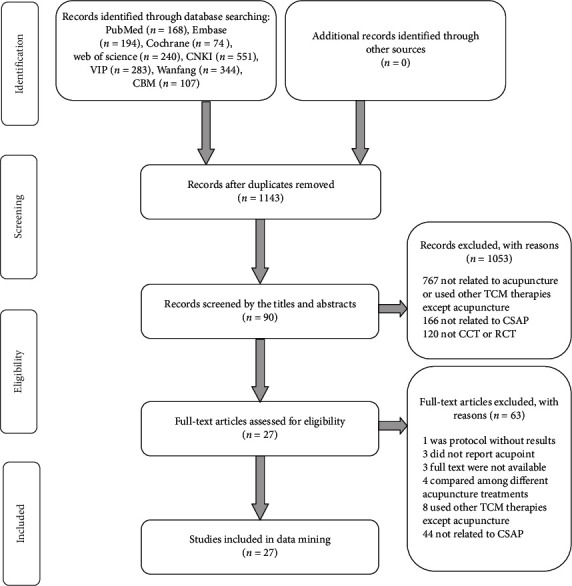
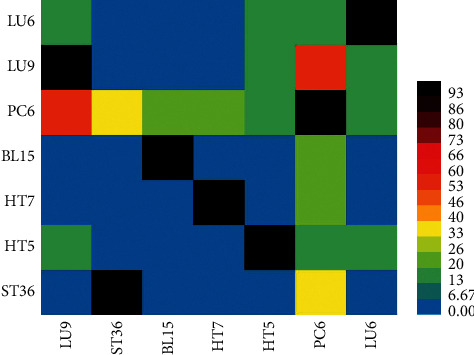
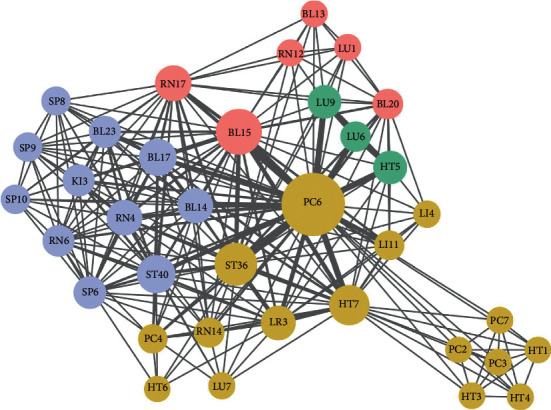
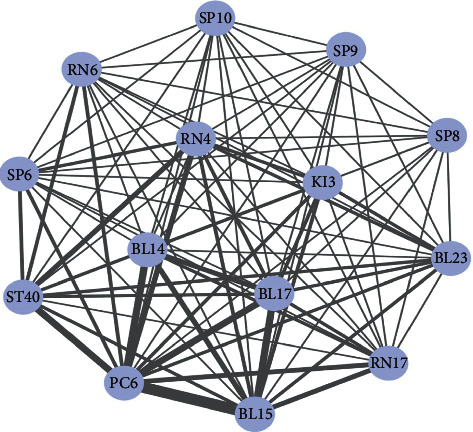
Chronic stable angina pectoris (CSAP) is a worldwide cardiovascular disease that severely affects people's quality of life and causes serious cardiovascular accidents. Although acupuncture had been confirmed as a potential adjunctive treatment for CSAP, the basic rules and mechanisms of acupoints were little understood. We conducted a systematic search of the China Biology Medicine (CBM), VIP database, Wangfang database, China National Knowledge Infrastructure (CNKI), PubMed, Cochrane Library, Embase, and Web of Science to identify eligible clinical controlled trials (CCTs) and randomized controlled trials (RCTs), from their inception to 18th February 2020. The acupoint prescriptions in the treatment of CSAP were extracted and analyzed based on the association rule mining (ARM) and network analysis. In addition, potential mechanisms of acupuncture for treating CSAP were summarized by data mining. A total of 27 eligible trials were included. Analysis of acupoint prescriptions covered 36 conventional acupoints and 1 experience acupoint, distributing in 10 meridians. The top three frequently used acupoints were PC6, LU9, and ST36. The top three frequently used meridians were the pericardial meridian, lung meridian, and heart meridian. The most frequently used acupoint combinations were LU9 combined with PC6. Besides, network analysis indicated that the core acupoints included PC6, BL15, ST40, and RN17. Moreover, potential mechanisms of acupuncture for treating CSAP involved the regulation of autonomic nerve function, the content of matrix metalloproteinase-9 (MMP-9), volume and the equivalent block of coronary artery calcified plaque (CACP), endothelin (ET), and nitric oxide (NO), neutrophil-lymphocyte ratio (NLR), the content of C-reactive protein (CRP), and tumor necrosis factor-α (TNF-α). In conclusion, our findings concerning acupoint prescriptions and potential mechanisms in the acupuncture treatment of CSAP could provide an optimized acupuncture treatment plan for clinical treatment of CSAP and promote further mechanism research and network research of CSAP.
Copyright © 2020 Jie Yu et al.
Conflict of interest statement
The authors declare that they have no conflicts of interest.
Figures
References
-
- Task Force M., Montalescot G., Sechtem U., et al. 2013 ESC guidelines on the management of stable coronary artery disease: the Task Force on the management of stable coronary artery disease of the European Society of Cardiology. European Heart Journal. 2013;34(38):2949–3003. doi: 10.1093/eurheartj/eht296. - DOI - PubMed
-
- Fox K., Garcia M. A., Ardissino D., et al. Guidelines on the management of stable angina pectoris: executive summary: the task force on the management of stable Angina pectoris of the European society of Cardiology. European Heart Journal. 2006;27(11):1341–1381. doi: 10.1093/eurheartj/ehl258. - DOI - PubMed
-
- Haybar H., Javid A. Z., Haghighizadeh M. H., Valizadeh E., Mohaghegh S. M., Mohammadzadeh A. The effects of Melissa officinalis supplementation on depression, anxiety, stress, and sleep disorder in patients with chronic stable angina. Clinical Nutrition ESPEN. 2018;26:47–52. doi: 10.1016/j.clnesp.2018.04.015. - DOI - PubMed
LinkOut - more resources
Full Text Sources
Research Materials
Miscellaneous
