Fertility is a key predictor of the double burden of malnutrition among women of child-bearing age in sub-Saharan Africa
- PMID: 33110582
- PMCID: PMC7568927
- DOI: 10.7189/jogh.10.020423
Fertility is a key predictor of the double burden of malnutrition among women of child-bearing age in sub-Saharan Africa
Abstract
Background: The ongoing nutrition transition in sub-Saharan Africa (SSA) is exhibiting spatial heterogeneity and temporal variability leading to different forms of malnutrition burden across SSA, with some regions exhibiting the double burden of malnutrition. This study aimed to develop a predictive understanding of the malnutrition burden among women of child-bearing age.
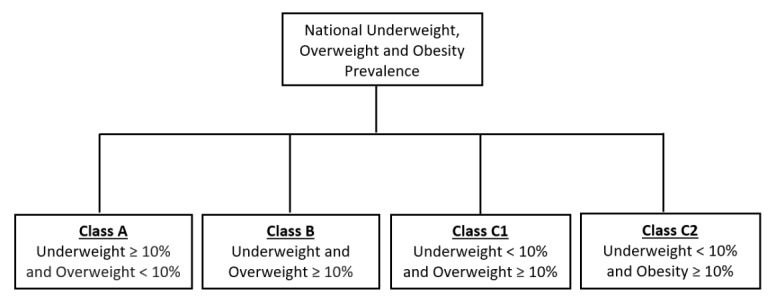
Methods: Data from 34 SSA countries were acquired from the Demographic and Health Survey, World Bank, and Swiss Federal Institute of Technology. The SSA countries were classified into malnutrition classes based on their national prevalence of underweight, overweight, and obesity using a 10% threshold. Next, random forest analysis was used to examine the association between country-level demographic variables and the national prevalence of underweight, overweight and obesity. Finally, random forest analysis and multinomial logistic regression models were utilized to investigate the association between individual-level social and demographic variables and Body Mass Index (BMI) categories of underweight, normal weight, and combined overweight and obesity.
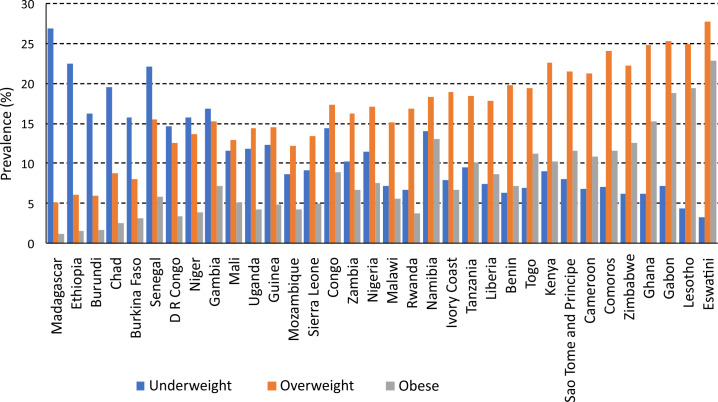
Results: Four malnutrition classes were identified: Class A had 5 countries with ≥10% of the women underweight; Class B had 11 countries with ≥10% each of underweight and overweight; Class C1 had 7 countries with ≥10% overweight; and Class C2 had 11 countries with ≥10% obesity. At the country-level, fertility rate predicted underweight, overweight and obesity prevalence, but economic indicators were also important, including the gross domestic product per capita - a measure of economic opportunity that predicted both overweight and obesity prevalence, and the GINI coefficient - a measure of economic inequality that predicted both underweight and overweight prevalence. At the individual-level, parity was a risk factor for underweight in underweight burdened countries and a risk factor for overweight/obesity in overweight/obesity burdened countries, whereas age and wealth were protective factors for underweight but risk factors for overweight/obesity.
Conclusions: Beyond the effect of economic indicators, this study revealed the important role of fertility rate and parity, which may represent risk factors for both underweight and combined overweight and obesity among women of child-bearing age. Health professionals should consider combining reproductive health services with nutritional programs when addressing the challenge of malnutrition in SSA.
Copyright © 2020 by the Journal of Global Health. All rights reserved.
Conflict of interest statement
Competing interest: The authors completed the Unified Competing Interest form at www.icmje.org/coi_disclosure.pdf (available upon request from the corresponding author), and declare no conflicts of interest.
Figures
References
-
- World Health Organization (WHO). Fact Sheet: Obesity and Overweight. Available: https://www.who.int/news-room/fact-sheets/detail/obesity-and-overweight. Accessed: 5 January 2019.
-
- NCD Risk Factor Collaboration (NCD-RisC) Worldwide trends in body-mass index, underweight, overweight, and obesity from 1975 to 2016: A pooled analysis of 2416 population-based measurement studies in 128.9 million children, adolescents, and adults. Lancet. 2017;390:2627-42. 10.1016/S0140-6736(17)32129-3 - DOI - PMC - PubMed
Publication types
MeSH terms
LinkOut - more resources
Full Text Sources
Medical
Research Materials
Miscellaneous