Genome-based classification of Acidihalobacter prosperus F5 (=DSM 105917=JCM 32255) as Acidihalobacter yilgarnensis sp. nov
- PMID: 33112221
- PMCID: PMC8049490
- DOI: 10.1099/ijsem.0.004519
Genome-based classification of Acidihalobacter prosperus F5 (=DSM 105917=JCM 32255) as Acidihalobacter yilgarnensis sp. nov
Abstract
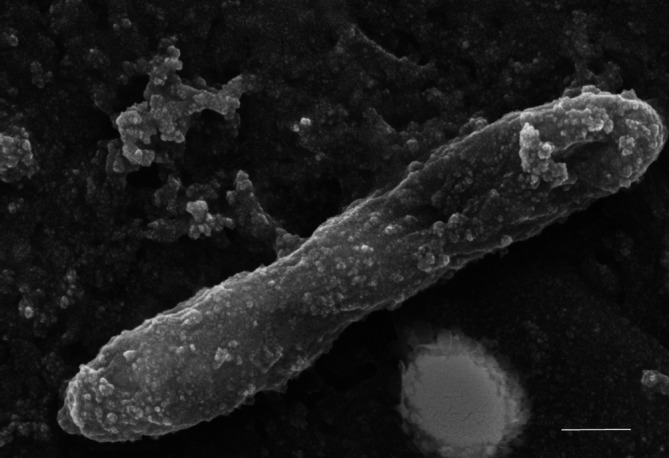
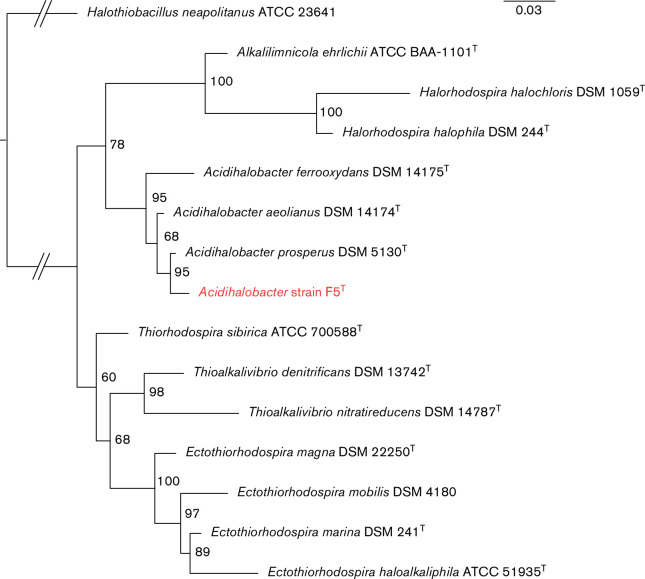
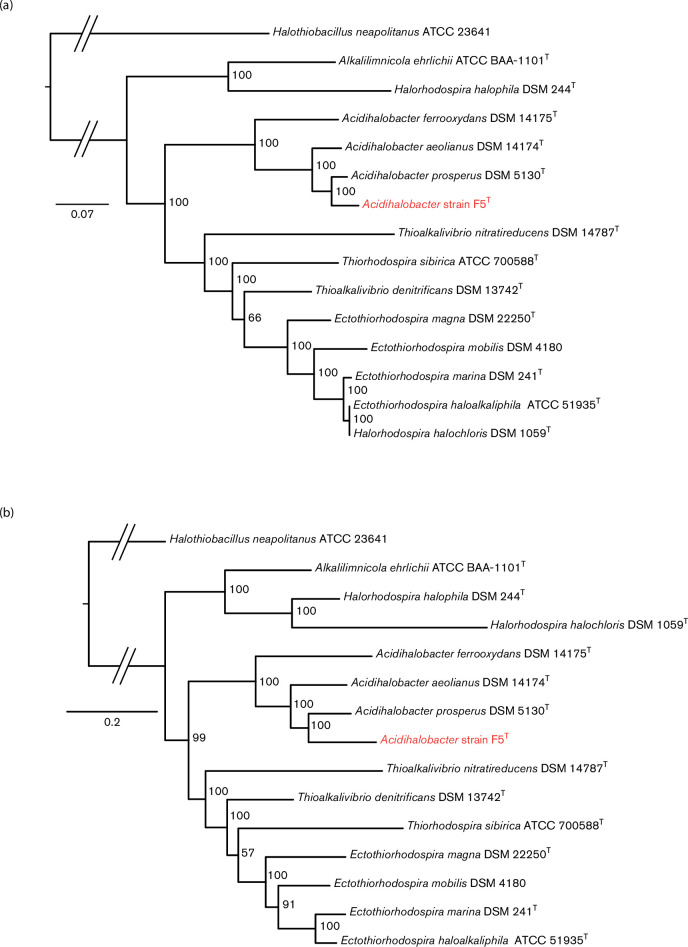
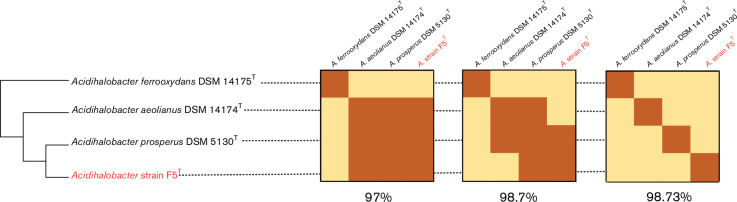
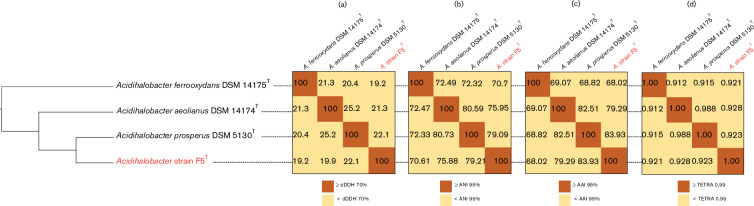
The genus Acidihalobacter has three validated species, Acidihalobacter ferrooxydans, Acidihalobacter prosperus and Acidihalobacter aeolinanus, all of which were isolated from Vulcano island, Italy. They are obligately chemolithotrophic, aerobic, acidophilic and halophilic in nature and use either ferrous iron or reduced sulphur as electron donors. Recently, a novel strain was isolated from an acidic, saline drain in the Yilgarn region of Western Australia. Strain F5T has an absolute requirement for sodium chloride (>5 mM) and is osmophilic, growing in elevated concentrations (>1 M) of magnesium sulphate. A defining feature of its physiology is its ability to catalyse the oxidative dissolution of the most abundant copper mineral, chalcopyrite, suggesting a potential role in biomining. Originally categorized as a strain of A. prosperus, 16S rRNA gene phylogeny and multiprotein phylogenies derived from clusters of orthologous proteins (COGS) of ribosomal protein families and universal protein families unambiguously demonstrate that strain F5T forms a well-supported separate branch as a sister clade to A. prosperus and is clearly distinguishable from A. ferrooxydans DSM 14175T and A. aeolinanus DSM14174T. Results of comparisons between strain F5T and the other Acidihalobacter species, using genome-based average nucleotide identity, average amino acid identity, correlation indices of tetra-nucleotide signatures (Tetra) and genome-to-genome distance (digital DNA-DNA hybridization), support the contention that strain F5T represents a novel species of the genus Acidihalobacter. It is proposed that strain F5T should be formally reclassified as Acidihalobacter yilgarnenesis F5T (=DSM 105917T=JCM 32255T).
Keywords: Acidihalobacter; Yilgarn Craton; acidophile; average amino acid identity (AAI); chalcopyrite bioleaching; genome-based average nucleotide identity (ANI); genome-to-genome distance (digital DNA-DNA hybridization (dDDH); halotolerant; iron and sulfur oxidising.
Conflict of interest statement
The authors declare that there are no conflicts of interest.
Figures
References
-
- Watling H. Microbiological advances in Biohydrometallurgy. Minerals. 2016;6:49. doi: 10.3390/min6020049. - DOI
-
- Shiers DW, Blight KR, Ralph DE. Sodium sulphate and sodium chloride effects on batch culture of iron oxidising bacteria. Hydrometallurgy. 2005;80:75–82. doi: 10.1016/j.hydromet.2005.07.001. - DOI
-
- Zammit CM, Mutch LA, Watling HR, Watkin ELJ. The characterization of salt tolerance in biomining microorganisms and the search for novel salt tolerant strains. Adv Mat Res. 2009;71-73:283–286. doi: 10.4028/www.scientific.net/AMR.71-73.283. - DOI
MeSH terms
Substances
Supplementary concepts
LinkOut - more resources
Full Text Sources
Molecular Biology Databases
Research Materials
Miscellaneous