


Physical Activity Dimensions and Its Association with Risk of Diabetes in Middle and Older Aged Chinese People
- PMID: 33113802
- PMCID: PMC7663282
- DOI: 10.3390/ijerph17217803
Physical Activity Dimensions and Its Association with Risk of Diabetes in Middle and Older Aged Chinese People
Abstract
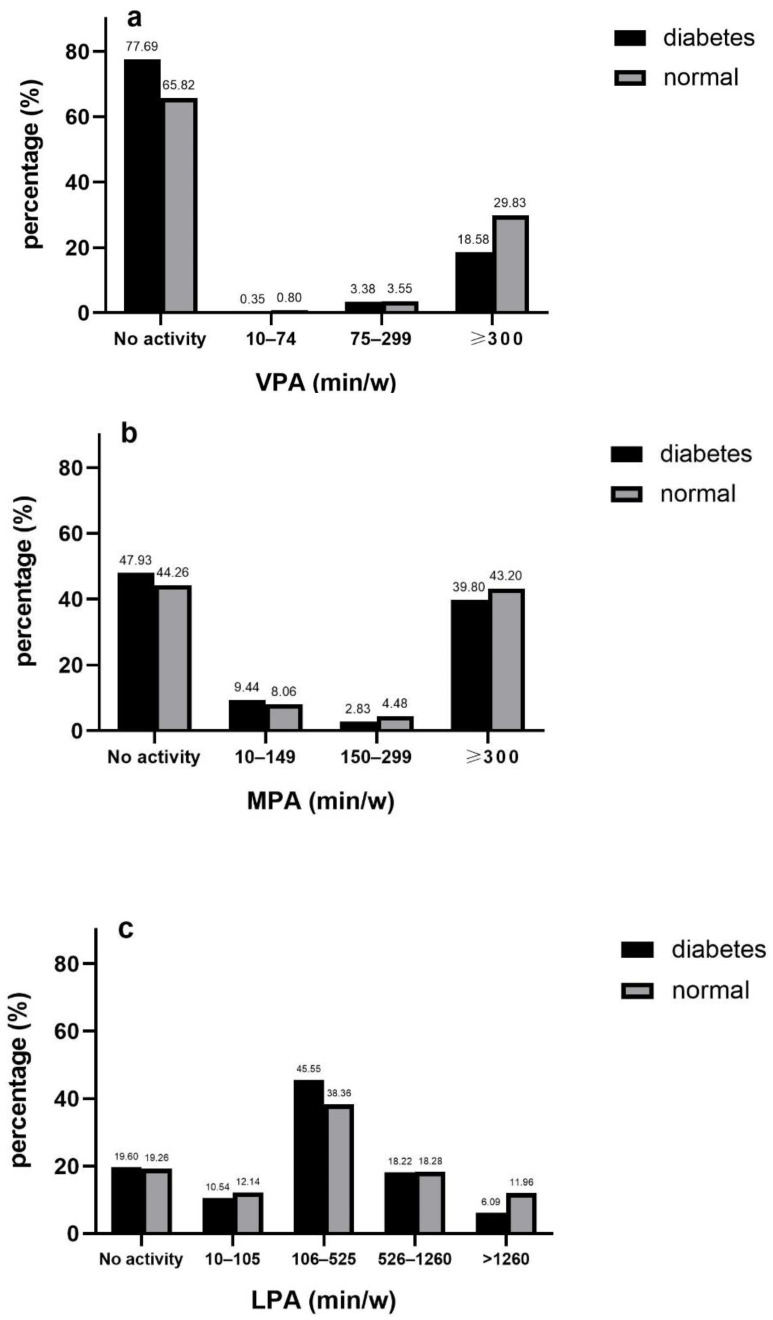
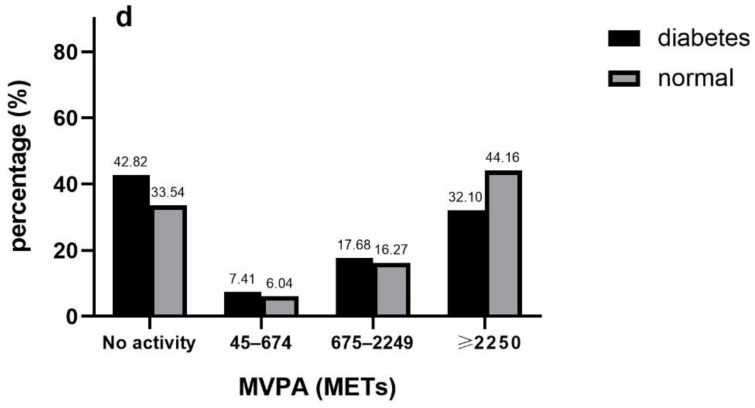
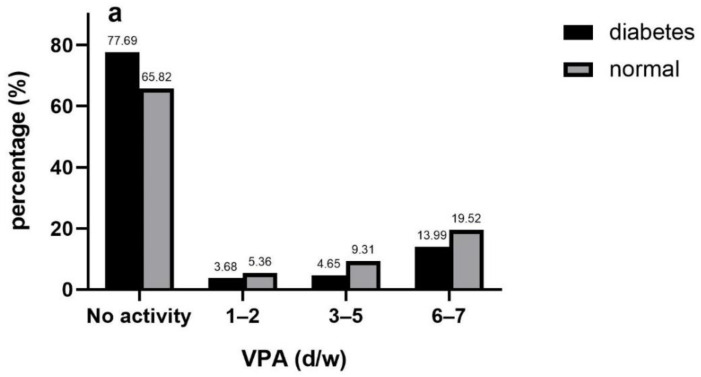
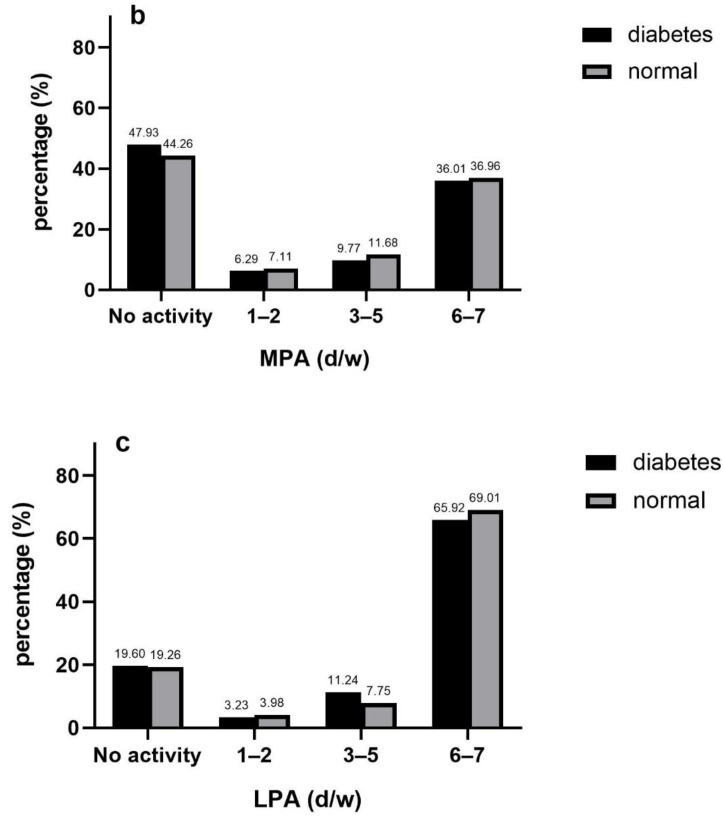
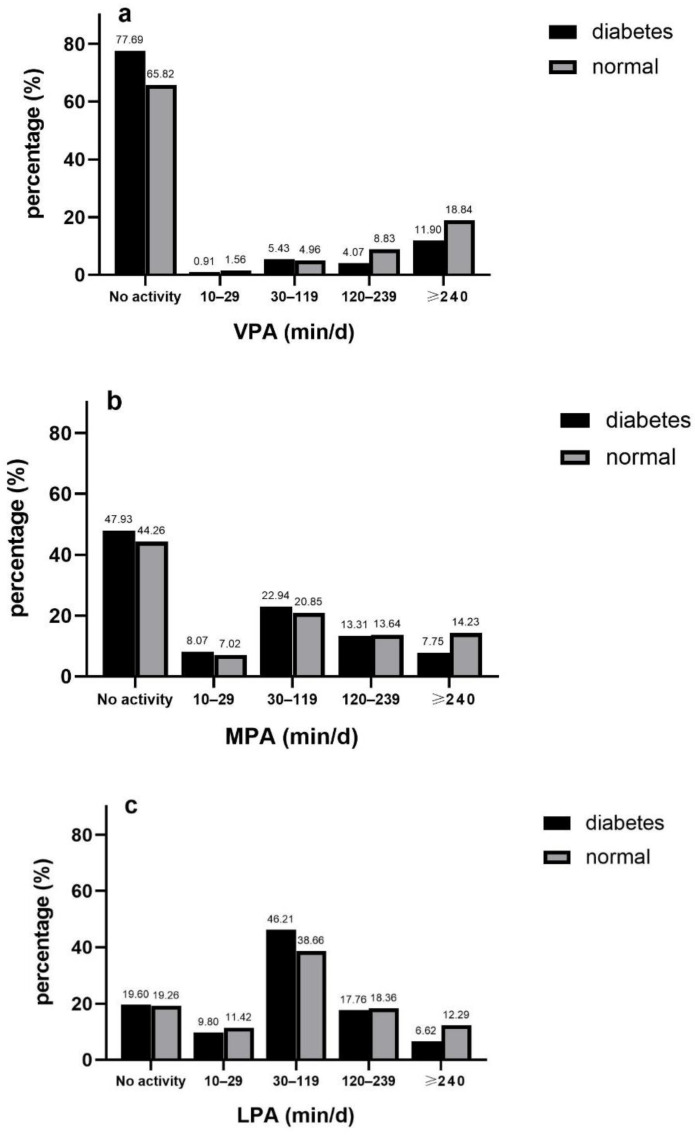
Background: Diabetes and physical inactivity are prevalent worldwide. Risk of diabetes is known to be related with insufficient physical activity (PA), but associations with the respective dimensions of PA is unclear. Objective: To describe the patterns of physical activity among Chinese middle- and older-aged individuals and figure out their associations with diabetes risk in different dimensions. Methods: Extracting self-reported data from China Health and Retirement Longitudinal Study (CHARLS, 2015), this study included 6196 participants. Multivariate logistic regression was conducted to determine the association between diabetes risk and PA dimensions such as intensity, frequency, duration, and volume. Results: Concerning frequency, lower diabetes risk was associated with performing vigorous PA at any frequency overall. For duration, smaller odds of diabetes were observed in performing vigorous PA 2-4 h/day (OR 0.46, 95%CI 0.30 to 0.71), moderate PA ≥4 h/day (OR 0.59, 95%CI 0.42 to 0.82) and light PA ≥4 h/day (OR 0.59, 95%CI 0.41 to 0.85) overall. For volume, lower diabetes risk was associated with performing moderate-to-vigorous PA (MVPA) ≥2250 METs/week (OR 0.58, 95%CI 0.42 to 0.81) in middle-aged group (45-64 years), whereas no significant associations between MVPA and diabetes risk were found in older aged group (≥65 years). Conclusions: Our results revealed that physical inactivity is prevalent in China, with a greater proportion in the diabetes group. Lower risk of diabetes was associated with higher frequency, longer duration and longer volume of PA at higher intensity in middle-aged respondents and similar associations at lower intensity for the older adults. Additionally, further well-designed prospective studies are needed to confirm our findings.
Keywords: diabetes risk; middle- and older-aged individuals; physical activity.
Conflict of interest statement
The authors report no conflicts of interest in this work.
Figures
References
-
- Saeedi P., Salpea P., Karuranga S., Petersohn I., Malanda B., Gregg E.W., Unwin N., Wild S.H., Williams R. Mortality attributable to diabetes in 20–79 years old adults, 2019 estimates: Results from the International Diabetes Federation Diabetes Atlas, 9(th) edition. Diabetes Res. Clin. Pract. 2020;162:108086. doi: 10.1016/j.diabres.2020.108086. - DOI - PubMed
-
- Saeedi P., Petersohn I., Salpea P., Malanda B., Karuranga S., Unwin N., Colagiuri S., Guariguata L., Motala A.A., Ogurtsova K., et al. Global and regional diabetes prevalence estimates for 2019 and projections for 2030 and 2045: Results from the International Diabetes Federation Diabetes Atlas, 9(th) edition. Diabetes Res. Clin. Pract. 2019;157:107843. doi: 10.1016/j.diabres.2019.107843. - DOI - PubMed
-
- Sinclair A., Saeedi P., Kaundal A., Karuranga S., Malanda B., Williams R. Diabetes and global ageing among 65–99-year-old adults: Findings from the International Diabetes Federation Diabetes Atlas, 9(th) edition. Diabetes Res. Clin. Pract. 2020;162:108078. doi: 10.1016/j.diabres.2020.108078. - DOI - PubMed
Publication types
MeSH terms
LinkOut - more resources
Full Text Sources
Medical
