Review
. 2020 Oct 23;10(11):770.
doi: 10.3390/brainsci10110770.

Semantic Processing in Healthy Aging and Alzheimer's Disease: A Systematic Review of the N400 Differences

Affiliations
Review

Semantic Processing in Healthy Aging and Alzheimer's Disease: A Systematic Review of the N400 Differences

Marilyne Joyal et al. Brain Sci. .

Abstract

Semantic deficits are common in individuals with Alzheimer's disease (AD). These deficits notably impact the ability to understand words. In healthy aging, semantic knowledge increases but semantic processing (i.e., the ability to use this knowledge) may be impaired. This systematic review aimed to investigate semantic processing in healthy aging and AD through behavioral responses and the N400 brain event-related potential. The results of the quantitative and qualitative analyses suggested an overall decrease in accuracy and increase in response times in healthy elderly as compared to young adults, as well as in individuals with AD as compared to age-matched controls. The influence of semantic association, as measured by N400 effect amplitudes, appears smaller in healthy aging and even more so in AD patients. Thus, semantic processing differences may occur in both healthy and pathological aging. The establishment of norms of healthy aging for these outcomes that vary between normal and pathological aging could eventually help early detection of AD.

Keywords: Alzheimer’s disease; N400; healthy aging; semantic processing; systematic review.


Conflict of interest statement

The authors declare that they have no conflict of interest.

Figures
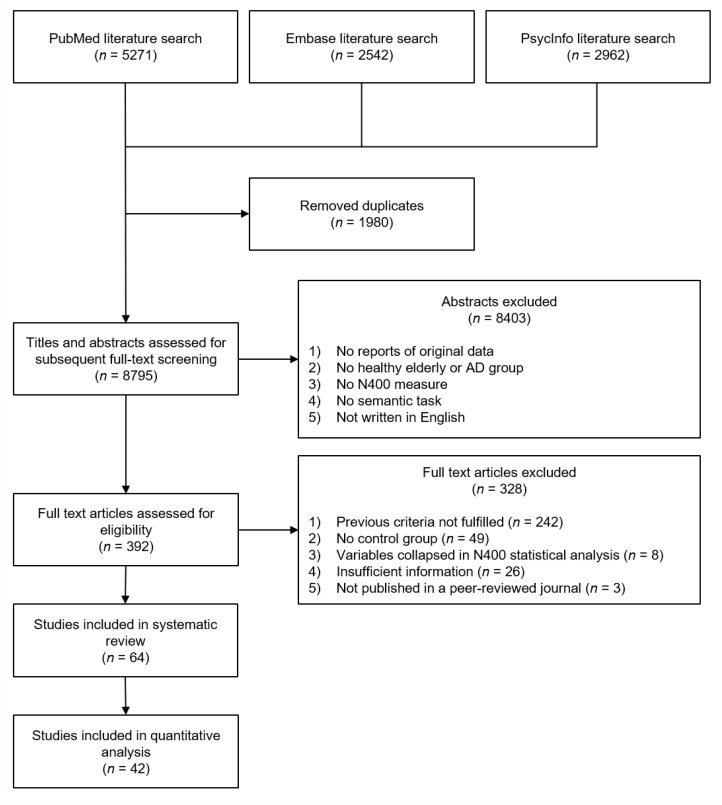
Figure 1
Figure 1
Schematic overview of the study selection procedure in this systematic review.
Figure 2
Figure 2
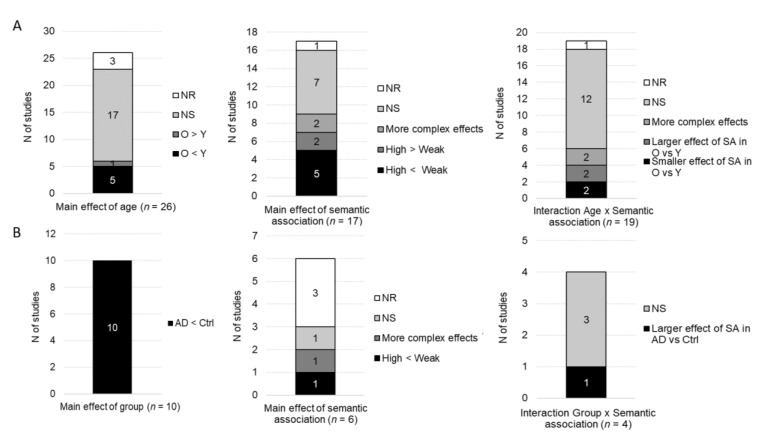
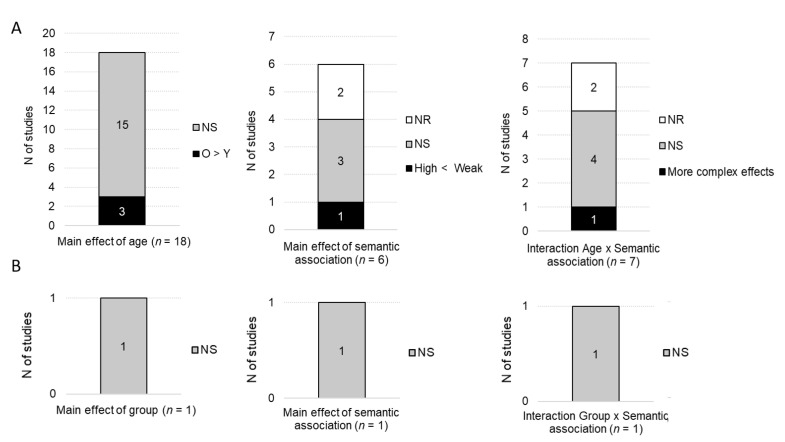
Qualitative results for behavioral accuracy: main effects of age/group, semantic association and the interaction group x semantic association. (A) Studies including older and younger groups of participants. (B) Studies including Alzheimer’s disease (AD) participants and control groups. N of studies: Number of studies; O: Older; Y: Younger; AD: Alzheimer’s disease; Ctrl: Control group(s); NS: No significant effect; NR: Statistical significance not reported; SA: Semantic association.
Figure 3
Figure 3
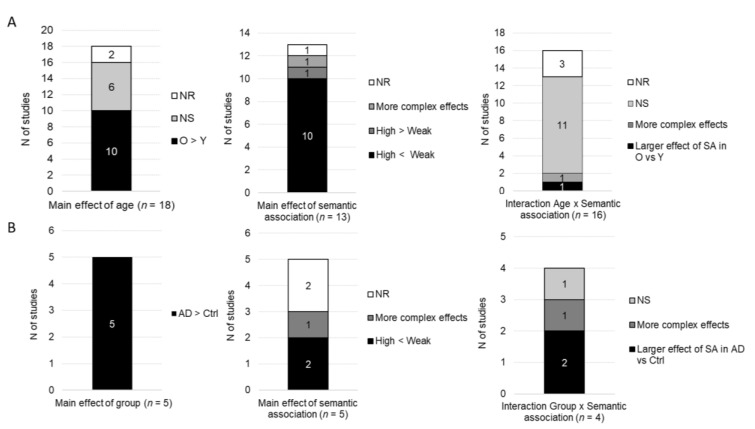
Qualitative results for behavioral response times: main effects of age/group, semantic association and the interaction group x semantic association. (A) Studies including older and younger groups of participants. (B) Studies including AD participants and control groups. N of studies: Number of studies; O: Older; Y: Younger; AD: Alzheimer’s disease; Ctrl: Control group(s); NS: No significant effect; NR: Statistical significance not reported; SA: Semantic association.
Figure 4
Figure 4
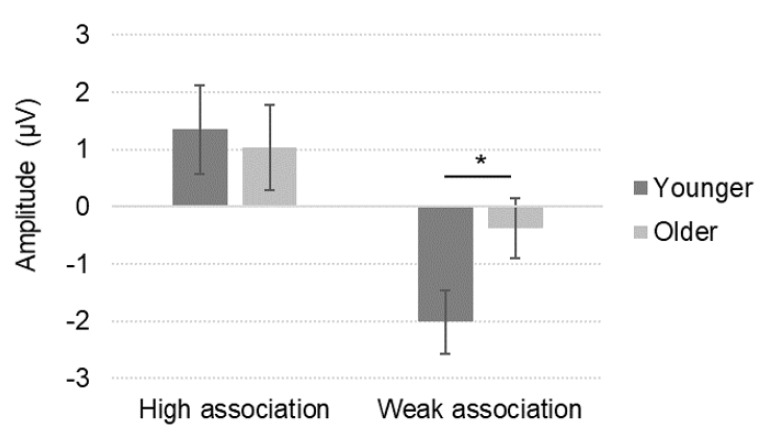
Mean N400 amplitude (± SEM) as a function of age group and semantic association in the reviewed studies (n = 21). * p < 0.05.
Figure 5
Figure 5
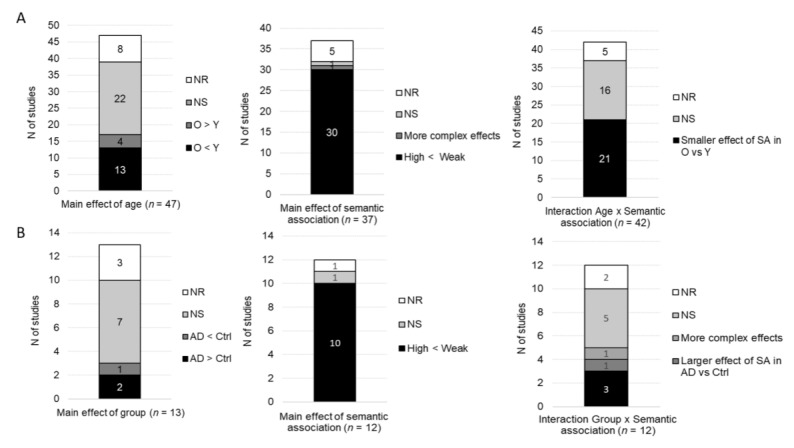
Qualitative results for the N400 amplitude: main effects of age/group, semantic association and the interaction group x semantic association. (A) Studies including older and younger groups of participants. (B) Studies including AD participants and control groups. N of studies: Number of studies; O: Older; Y: Younger; AD: Alzheimer’s disease; Ctrl: Control group(s); NS: No significant effect; NR: Statistical significance not reported; SA: Semantic association.
Figure 6
Figure 6
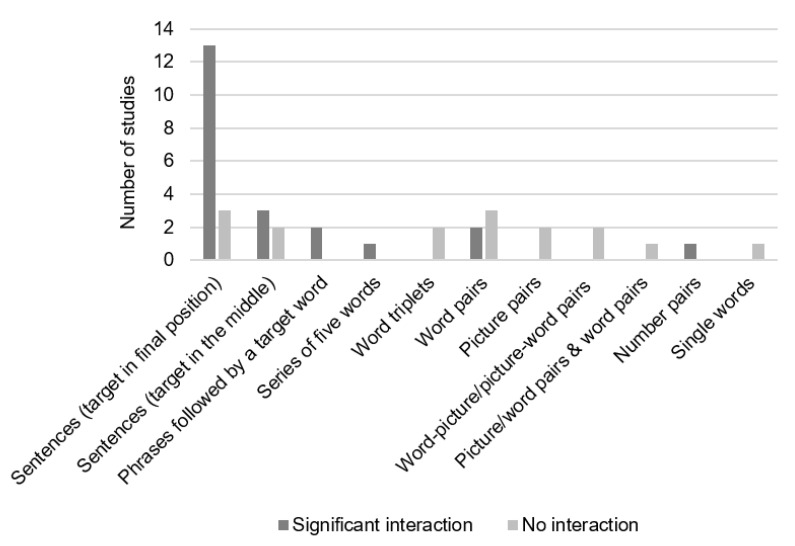
Number of studies that found a significant interaction between age and semantic association for the N400 amplitude as a function of stimulus type.
Figure 7
Figure 7
Qualitative results for the N400 peak latency: main effects of age/group, semantic association and the interaction group x semantic association. (A) Studies including older and younger groups of participants. (B) Studies including AD participants and control groups. N of studies: Number of studies; O: Older; Y: Younger; NS: No significant effect; NR: Statistical significance not reported.

References

    1. Hoffman P. An individual differences approach to semantic cognition: Divergent effects of age on representation, retrieval and selection. Sci. Rep. 2018;8:8145. doi: 10.1038/s41598-018-26569-0. - DOI - PMC - PubMed
    1. Lambon Ralph M.A., Pobric G., Jefferies E. Conceptual knowledge is underpinned by the temporal pole bilaterally: Convergent evidence from rTMS. Cereb. Cortex. 2009;19:832–838. doi: 10.1093/cercor/bhn131. - DOI - PubMed
    1. Ralph M.A., Jefferies E., Patterson K., Rogers T.T. The neural and computational bases of semantic cognition. Nat. Rev. Neurosci. 2017;18:42–55. doi: 10.1038/nrn.2016.150. - DOI - PubMed
    1. Altmann L.J., McClung J.S. Effects of semantic impairment on language use in Alzheimer’s disease. Semin. Speech Lang. 2008;29:18–31. doi: 10.1055/s-2008-1061622. - DOI - PubMed
    1. Verma M., Howard R.J. Semantic memory and language dysfunction in early Alzheimer’s disease: A review. Int. J. Geriatr. Psychiatry. 2012;27:1209–1217. doi: 10.1002/gps.3766. - DOI - PubMed

LinkOut - more resources