Review
. 2020 Oct 26;12(11):2480.
doi: 10.3390/polym12112480.

Recent Progress in Conducting Polymers for Hydrogen Storage and Fuel Cell Applications

Affiliations
Review

Recent Progress in Conducting Polymers for Hydrogen Storage and Fuel Cell Applications

Neelima Mahato et al. Polymers (Basel). .

Abstract

Hydrogen is a clean fuel and an abundant renewable energy resource. In recent years, huge scientific attention has been invested to invent suitable materials for its safe storage. Conducting polymers has been extensively investigated as a potential hydrogen storage and fuel cell membrane due to the low cost, ease of synthesis and processability to achieve the desired morphological and microstructural architecture, ease of doping and composite formation, chemical stability and functional properties. The review presents the recent progress in the direction of material selection, modification to achieve appropriate morphology and adsorbent properties, chemical and thermal stabilities. Polyaniline is the most explored material for hydrogen storage. Polypyrrole and polythiophene has also been explored to some extent. Activated carbons derived from conducting polymers have shown the highest specific surface area and significant storage. This review also covers recent advances in the field of proton conducting solid polymer electrolyte membranes in fuel cells application. This review focuses on the basic structure, synthesis and working mechanisms of the polymer materials and critically discusses their relative merits.

Keywords: conducting polymers; fuel cell; hydrogen storage; polyaniline; polypyrrole; polythiophene; proton conducting solid polymer electrolytes.


Conflict of interest statement

The authors declare no conflict of interest.

Figures

Figure 1
Figure 1
A typical hydrogen fuel cell consists of an anode, a cathode and a polymer electrolyte membrane (PEM) in the middle.
Figure 2
Figure 2
Hydrogen storage materials. (IRMOFS- Isoreticular metal–organic frameworks; MILs- M atériaux de l’ I nstitut L avoisier; MWNT-Multi-walled carbon nanotubes; SWNT- Single-walled carbon nanotubes; PIM-Polymers of Intrinsic Microporosity; CTC–PIM-Cyclotricatechylene; Porph–PIM- Porphyrin-PIM; Trip–PIM- Triptycene-PIM; and HATN–PIM- Hexaazatrinaphthylene-PIM).
Figure 3
Figure 3
Molecular structures of conducting polymers.
Figure 4
Figure 4
Different methods of the synthesis of polyaniline from aniline monomer.
Figure 5
Figure 5
Synthesis of (a) polyaniline and polyaniline nanofibers in the presence/absence of surfactant, and (b) polyaniline composites with nanostructured particles (RT-Room temperature; DI-Deionized Water).
Figure 6
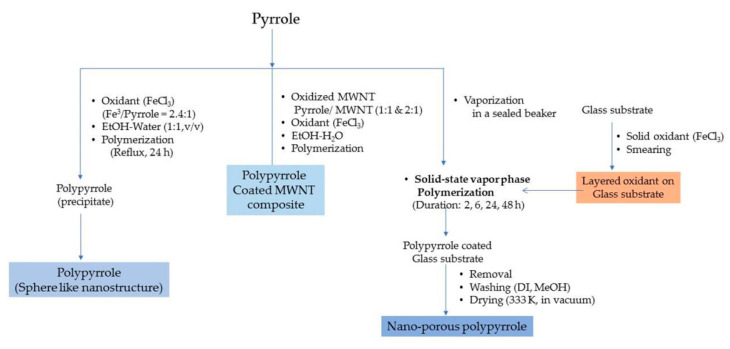
Figure 6
Synthesis of polypyrrole using wet chemical and solid state vapor phase polymerization methods.
Figure 7
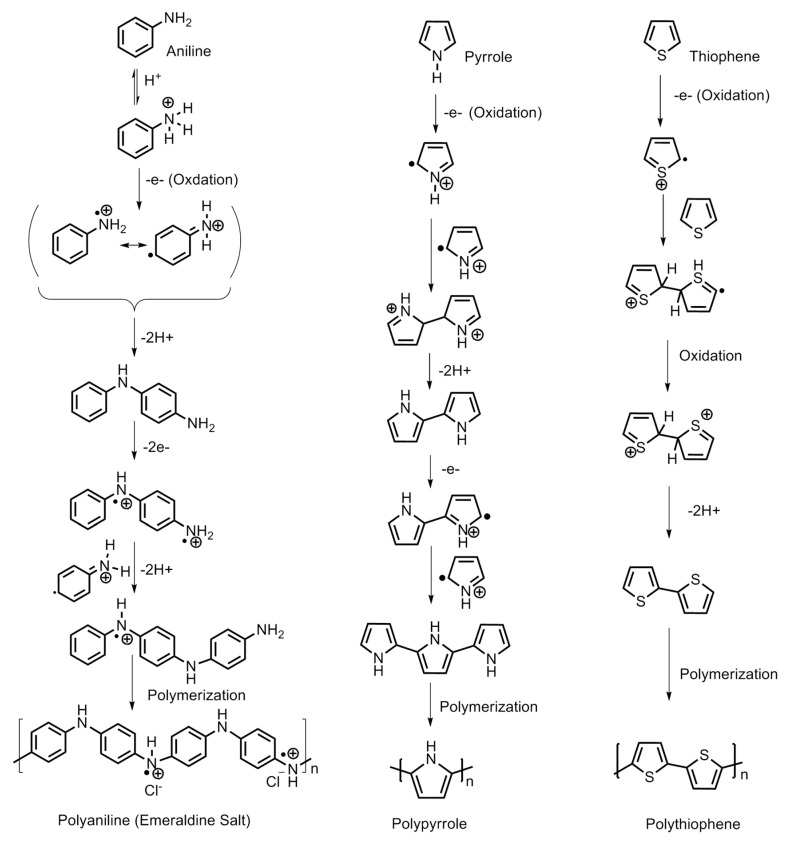
Figure 7
Steps involved in the synthesis of polyaniline, polypyrrole and polythiophene.
Figure 8
Figure 8
Molecular structures of the different redox forms of polyaniline.
Figure 9
Figure 9
Steps involved in the process of hydrogen adsorption and storage.
Figure 10
Figure 10
Schematic representing the effect of surfactant employed during the synthesis of polyaniline. The surfactant molecules become incorporated into the polymer structure and decide its morphology significantly.
Figure 11
Figure 11
Mechanism of doping–de-doping in polyaniline, polypyrrole and polythiophene.
Figure 12
Figure 12
Steps involved in the synthesis of different polyaniline composite. (PVA-Polyvinyl Alcohol).
Figure 13
Figure 13
(a) Hyper-crosslinking, (b) recovery and purification of polyaniline. Artwork developed from descriptions in the Ref. [26].
Figure 14
Figure 14
Steps involved in the hyper-crosslinking of polyaniline; (A) diiodoalkanes (single-step crosslinking), (B) paraformaldehyde (three-step crosslinking) and (C) dimethylsulfoxide (two-step crosslinking). Adapted from Ref. [26].
Figure 15
Figure 15
A comparison of results among hyper-crosslinked polyaniline materials obtained from different crosslinking agents and methods of preparation. Leucoemeraldine (LeucoEm)-a,b,c: hyper-crosslinked with diiodomethane in DMF using microwave-assisted process (concentration of polyaniline in a: 0.038 g mL−1); b: 0.058 g mL−1; and c: 0.078 g mL−1)): Leucoemeraldine-d: hyper-crosslinked with DMSO assisted diiodomethane using conventional process; Leucoemeraldine-e,f: hyper-crosslinked with paraformaldehyde (equivalents of paraformaldehyde relative to the amine content of polyaniline in e: 3.7 and f: 2.4) using microwave assisted process; Emeraldine-g: hyper-crosslinked with diiodomethane using conventional process; Emeraldine-h: hyper-crosslinked with paraformaldehyde (equivalents of paraformaldehyde relative to the amine content of polyaniline: 2.4) using the microwave-assisted process. Artwork developed from description given in the Ref. [26].
Figure 16
Figure 16
Methods of preparing activated carbons from conducting polymers.
Figure 17
Figure 17
Polyperfluorosulfonic acid (PFSA) (Nafion)-type membrane.
Figure 18
Figure 18
Basic molecular structure of the sulfonated poly (α,β,β-trifluorostyrene) BAM3G (Basic Advanced Materials 3rd Generation) membrane.
Figure 19
Figure 19
Basic structure of a polysulfonated polystyrene (PSSA) membrane and a general PSSA-based solid polymer electrolyte membrane with a probability of modification by the incorporation of monomeric, oligomeric or polymeric segments in order to achieve improved material properties.
Figure 20
Figure 20
Basic molecular structures of linear polyimide, aromatic heterocyclic polyimide, Phthalic-and Naphthalenic-type sulfonated polyimides.
Figure 21
Figure 21
Sulfonated polyimide (SPI)-based membranes.
Figure 22
Figure 22
Molecular structures of some polybenzimidazole (PBI)-based membranes.
Figure 23
Figure 23
Molecular structures of polyphozphazane-based membranes.
Figure 24
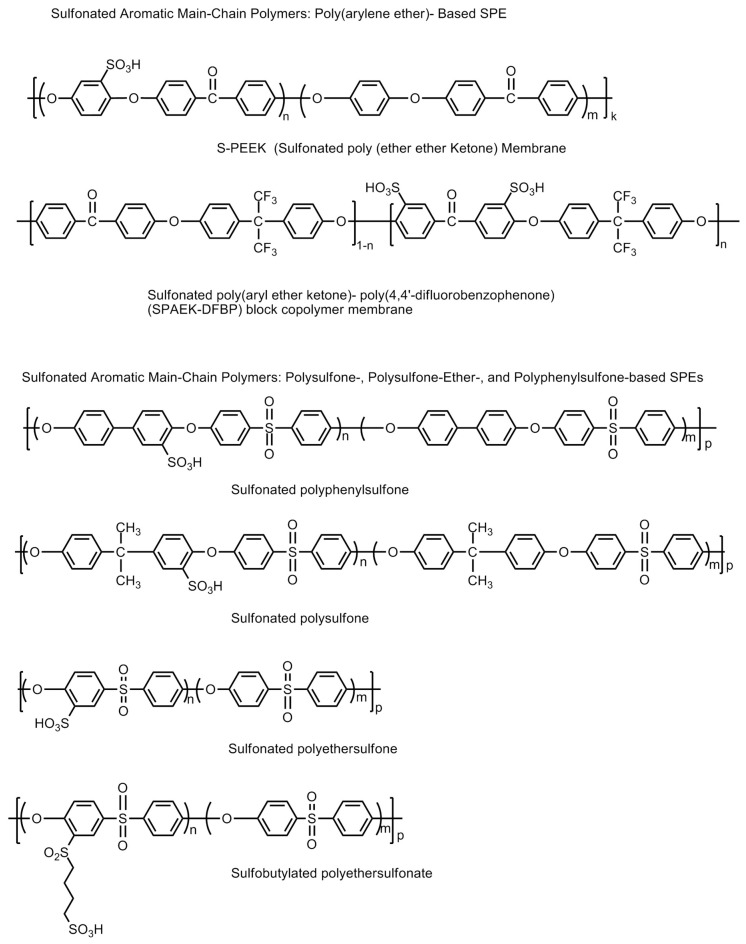
Figure 24
Molecular structures of sulfonated main chain polymers, viz., poly (arylene ether)-, polysulfone-, polysulfone (ether)-, and polyphenylsulfone-based solid polymer electrolytes.
Figure 25
Figure 25
Strategy for developing novel sulfonic acid-containing polymers. Artwork adapted from the descriptions given in the Ref. [4].
Figure 26
Figure 26
Molecular structure of chitosan.
Figure 27
Figure 27
Molecular structures of anion exchange moieties and anion exchange polymers.
Figure 28
Figure 28
Vehicle mechanism of (a) proton, and (b) hydroxyl ion transport through water channels.
Figure 28
Figure 28
Vehicle mechanism of (a) proton, and (b) hydroxyl ion transport through water channels.
Figure 29
Figure 29
Proton-hopping or Grotthuss-type mechanism in proton conducting solid electrolyte polymers; (a) Proton conduction in non-ionic imidazole-based polymers, (b) hydrated sulphonated- polymers, (c) phosphoric acid doped polybenzimidazoles, and (d) chitosan-mix polymer, where the transport takes place via diffusion of hydronium ions.

References

    1. Attia N.F., Lee S.M., Kim H.J., Geckeler K.E. Nanoporous polypyrrole: Preparation and hydrogen storage properties. Int. J. Energy Res. 2014;38:466–476. doi: 10.1002/er.3095. - DOI
    1. Attia N.F., Geckeler K.E. Polyaniline as a Material for Hydrogen Storage Applications. Macromol. Rapid Commun. 2013;34:1043–1055. doi: 10.1002/marc.201300255. - DOI - PubMed
    1. Hardy B., Tamburello D., Corgnale C. Hydrogen storage adsorbent systems acceptability envelope. Int. J. Hydrogen Energy. 2018;43:19528–19539. doi: 10.1016/j.ijhydene.2018.08.140. - DOI
    1. Bae C. Development of Novel Proton-Conductive Polymers for Proton Exchange Membrane Fuel Cell (PEMFC) Technology 2007. 7,615,300. U.S. Patent. 2009 Nov 10;
    1. Prater K. The renaissance of the solid polymer fuel cell. J. Power Sources. 1990;29:239–250. doi: 10.1016/0378-7753(90)80023-7. - DOI

LinkOut - more resources