


A Conceptual Model Map on Health and Nutrition Behavior (CMMHB/NB)
- PMID: 33114729
- PMCID: PMC7663323
- DOI: 10.3390/ijerph17217829
A Conceptual Model Map on Health and Nutrition Behavior (CMMHB/NB)
Abstract
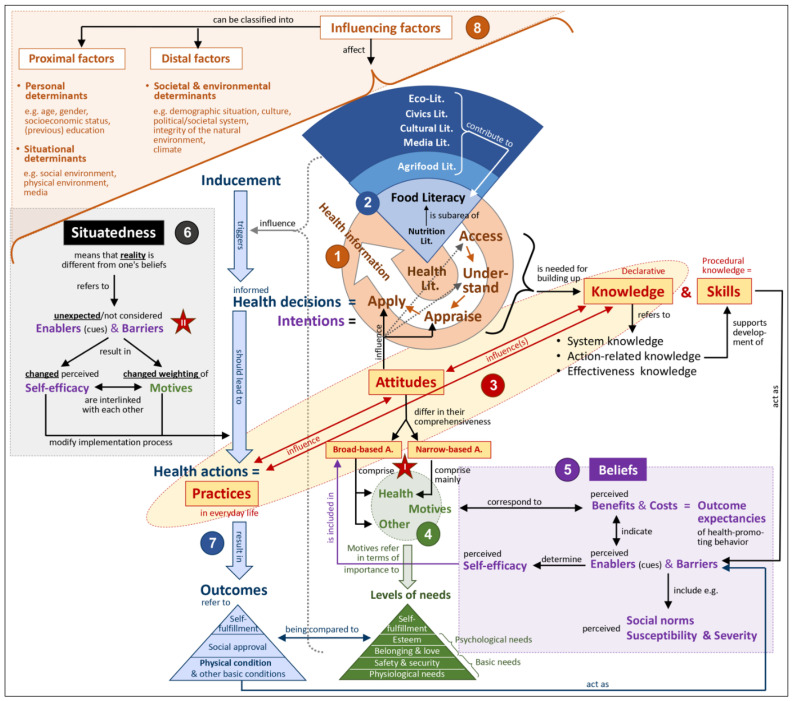
The Conceptual Model Map (CMM) presented here is intended to show the connections between different theories and constructs in the field of health and nutrition behavior (including literacy models, the knowledge-attitude(s)-practice(s) survey structure (KAP), behavior change theories, and Maslow's pyramid of needs). The CMM can be used as a map to locate existing and future studies, to show their range of effect as well as their limitations. In this context, the CMM also reveals reasons for the attitude/intention-behavior gap.
Keywords: KAP; Maslow’s pyramid of needs; attitude–behavior gap; behavior change theories; concept map; food literacy; health literacy; intention–behavior gap; knowledge–attitude–practice.
Conflict of interest statement
The authors declare no conflict of interest.
Figures
References
-
- Glanz K., Rimer B.K., Viswanath K., editors. Health Behavior and Health Education: Theory, Research, and Practice. 4th ed. Jossey-Bass; San Francisco, CA, USA: 2008.
-
- Nutbeam D., Harris E., Wise M. Theory in a Nutshell: A Practical Guide to Health Promotion Theories. 3rd ed. McGraw-Hill; North Ryde NSW, Australia: 2010.
-
- Gellman M.D., Turner J.R., editors. Encyclopedia of Behavioral Medicine. Springer; New York, NY, USA: 2013.
MeSH terms
LinkOut - more resources
Full Text Sources
Miscellaneous
