


The impact of growth differentiation factor 15 on the risk of cardiovascular diseases: two-sample Mendelian randomization study
- PMID: 33115406
- PMCID: PMC7594331
- DOI: 10.1186/s12872-020-01744-2
The impact of growth differentiation factor 15 on the risk of cardiovascular diseases: two-sample Mendelian randomization study
Abstract
Background: Growth differentiation factor 15 (GDF-15), a stress responsive cytokine, belongs to transforming growth factor β cytokine superfamily. Some evidence support that it's involved in inflammation, coagulation, oxidative stress, endothelial dysfunction, and hemostasis. However, it's still controversial whether GDF-15 directly contributes to the morbidity and mortality of patients suffered with cardiovascular disease (CVD). Besides prospective cohort study and randomized controlled trial, Mendelian randomization (MR) is a genetic epidemiological method that exploits genetic variants as unbiased proxies for modifiable to determine the causal relationships between exposures and health outcomes. Herein, we introduced a two-sample MR approach to evaluate the causal relationships of circulating GDF-15 levels with major CVDs incidence.
Methods: Genetic instruments and summary statistics for two-sample MR analysis were obtained from 5 independent large genome-wide association studies (GWAS) to investigate the causal correlation between circulating GDF-15 levels and 9 CVDs, respectively. Conventional inverse variance weighted method was adopted to evaluate the causality of GDF-15 with different outcomes; weighted median and MR egger were used for sensitivity analyses.
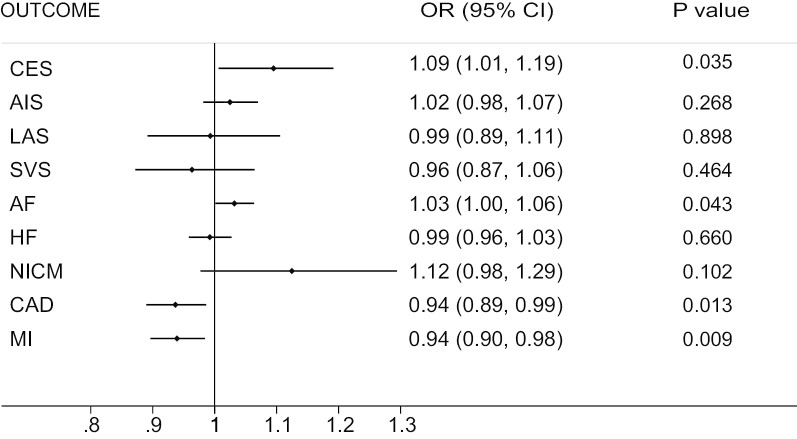
Results: Among 9 SNPs identified from 5 GWASs in 2.6 million individuals, 5 SNPs (rs1227731, rs3195944, rs17725099, rs888663, rs749451) coming from chromosome 19 and containing the PGPEP1 and GDF-15 genes were employed. Based on the instruments, circulating GDF-15 levels significantly linked to the increased risk of cardioembolic stroke, atrial fibrillation, coronary artery disease and myocardial infarction. However, no significant causal association was observed for circulating GDF-15 levels with the incidence of any ischemic stroke, large-artery atherosclerotic stroke, small vessel stroke, heart failure and nonischemic cardiomyopathy.
Conclusions: The MR study provides with genetic evidence for the causal relationship of circulating GDF-15 levels with the increased risk of cardioembolic stroke, atrial fibrillation, coronary artery disease and myocardial infarction, but not any ischemic stroke, large-artery atherosclerotic stroke, small vessel stroke, heart failure and nonischemic cardiomyopathy. It indicates that GDF-15 might be a promising biomarker or potential therapeutic target for some CVDs.
Keywords: Atrial fibrillation; Cardioembolic stroke; Cardiovascular diseases; Coronary artery disease; Growth differentiation factor 15; Mendelian randomization; Myocardial infarction.
Conflict of interest statement
The authors declare that they have no competing interests.
Figures
References
-
- Yang H, Filipovic Z, Brown D, Breit SN, Vassilev LT. Macrophage inhibitory cytokine-1: a novel biomarker for p53 pathway activation. Mol Cancer Ther. 2003;2(10):1023–1029. - PubMed
-
- Bouabdallaoui N, Claggett B, Zile MR, McMurray JJV, O'Meara E, Packer M, et al. Growth differentiation factor-15 is not modified by sacubitril/valsartan and is an independent marker of risk in patients with heart failure and reduced ejection fraction: the PARADIGM-HF trial. Eur J Heart Fail. 2018;20(12):1701–1709. doi: 10.1002/ejhf.1301. - DOI - PubMed
Publication types
MeSH terms
Substances
Grants and funding
LinkOut - more resources
Full Text Sources
