SARS-CoV-2 and Health Care Worker Protection in Low-Risk Settings: a Review of Modes of Transmission and a Novel Airborne Model Involving Inhalable Particles
- PMID: 33115724
- PMCID: PMC7605309
- DOI: 10.1128/CMR.00184-20
SARS-CoV-2 and Health Care Worker Protection in Low-Risk Settings: a Review of Modes of Transmission and a Novel Airborne Model Involving Inhalable Particles
Erratum in
-
Erratum for Zhang and Duchaine, "SARS-CoV-2 and Health Care Worker Protection in Low-Risk Settings: a Review of Modes of Transmission and a Novel Airborne Model Involving Inhalable Particles".Clin Microbiol Rev. 2021 Jan 27;34(2):e00009-21. doi: 10.1128/CMR.00009-21. Print 2021 Mar 17. Clin Microbiol Rev. 2021. PMID: 33504505 Free PMC article. No abstract available.
Abstract
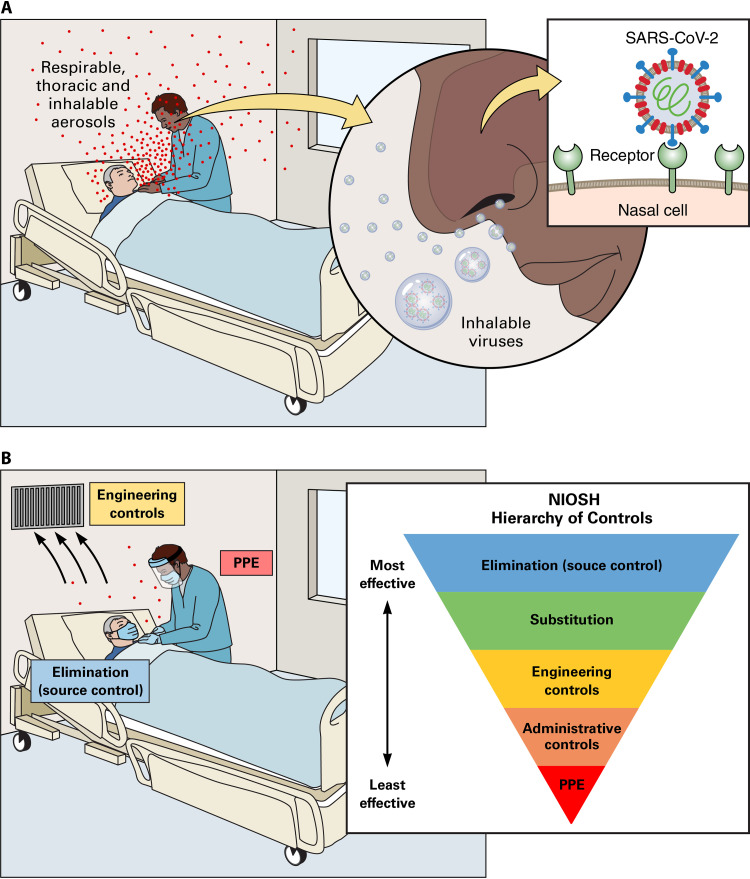
Since the beginning of the COVID-19 pandemic, there has been intense debate over SARS-CoV-2's mode of transmission and appropriate personal protective equipment for health care workers in low-risk settings. The objective of this review is to identify and appraise the available evidence (clinical trials and laboratory studies on masks and respirators, epidemiological studies, and air sampling studies), clarify key concepts and necessary conditions for airborne transmission, and shed light on knowledge gaps in the field. We find that, except for aerosol-generating procedures, the overall data in support of airborne transmission-taken in its traditional definition (long-distance and respirable aerosols)-are weak, based predominantly on indirect and experimental rather than clinical or epidemiological evidence. Consequently, we propose a revised and broader definition of "airborne," going beyond the current droplet and aerosol dichotomy and involving short-range inhalable particles, supported by data targeting the nose as the main viral receptor site. This new model better explains clinical observations, especially in the context of close and prolonged contacts between health care workers and patients, and reconciles seemingly contradictory data in the SARS-CoV-2 literature. The model also carries important implications for personal protective equipment and environmental controls, such as ventilation, in health care settings. However, further studies, especially clinical trials, are needed to complete the picture.
Keywords: COVID-19; SARS-CoV-2; bioaerosols; infection prevention; inhalable aerosols; low-risk settings; personal protective equipment; respiratory protection; ventilation.
Copyright © 2020 American Society for Microbiology.
Figures
References
-
- World Health Organization. 2020. Transmission of SARS-CoV-2: implications for infection prevention precautions. World Health Organization, Geneva, Switzerland. https://www.who.int/news-room/commentaries/detail/transmission-of-sars-c.... Accessed 11 July 2020.
Publication types
MeSH terms
Substances
LinkOut - more resources
Full Text Sources
Medical
Miscellaneous