. 2020 Oct 28;12(567):eaax4905.
doi: 10.1126/scitranslmed.aax4905.

A probiotic yeast-based immunotherapy against Clostridioides difficile infection

Affiliations

A probiotic yeast-based immunotherapy against Clostridioides difficile infection

Kevin Chen et al. Sci Transl Med. .

Abstract

Antibiotic-resistant Clostridioides difficile is an anaerobic Gram-positive bacterium that colonizes the colon and is responsible for more than 29,000 deaths in the United States each year. Hence, C. difficile infection (CDI) poses an urgent threat to public health. Antibody-mediated neutralization of TcdA and TcdB toxins, the major virulence factors of CDI, represents an effective strategy to combat the disease without invoking antibiotic resistance. However, current antitoxin approaches are mostly based on parenteral infusion of monoclonal antibodies that are costly, narrow spectrum, and not optimized against the intestinal disease. Here, we engineered probiotic Saccharomyces boulardii to constitutively secrete a single tetra-specific antibody that potently and broadly neutralized both toxins and demonstrated protection against primary and recurrent CDI in both prophylactic and therapeutic mouse models of disease. This yeast immunotherapy is orally administered, can be used concurrently with antibiotics, and may have potential as a prophylactic against CDI risk and as a therapeutic for patients with CDI.


Figures

Fig. 1.
Fig. 1.. Design and optimization of ABAB secretion in yeast.
(A) Schematic of ABAB. VHHs AH3 and AA6 (blue boxes) target neutralizing epitopes in TcdA; VHHs 5D and E3 (red boxes) target neutralizing epitopes in TcdB. Individual VHHs were joined by glycine-serine linkers. (B and C) In vitro neutralizing activities of Fc-ABAB. TcdA [10 ng/ml (B)] or TcdB [10 pg/ml (C)] was mixed with the indicated concentrations of Merck anti-TcdA (B) or Merck anti-TcdB (C) or Fc-ABAB for 30 min before addition to Vero cell monolayers. Percentage of cell rounding was determined by phase-contrast microscopy. (D) In vivo neutralization by Fc-ABAB and Merck antibodies in a prophylactic murine systemic toxin challenge model. Mice were injected intraperitoneally with PBS, Merck anti-TcdA and anti-TcdB mixture (10 mg/kg each), or Fc-ABAB (10 or 100 μg/kg) and followed by intraperitoneal injection of mixed TcdA and TcdB (1 μg/kg each) 4 hours later. Mouse survival was monitored. P = 0.0041, PBS versus Merck antibodies; P = 0.0015, PBS versus Fc-ABAB at 10 μg/kg; P = 0.0015, PBS versus Fc-ABAB at 100 μg/kg; P = 0.1176, Merck antibodies versus Fc-ABAB at 10 μg/kg; P = 0.0026, Merck antibodies versus Fc-ABAB at 100 μg/kg; P = 0.0025, Fc-ABAB at 10 μg/kg versus Fc-ABAB at 100 μg/kg. (E and F) Relative ABAB secretion in yeast culture supernatant with different secretion signals. E/O value is defined as ELISA optical density (OD)/Optical cell density. (G) Codon optimization for enhanced secretion (y: yeast codon optimized). All in vivo experimental data represent one of at least three separate experiments with n = 5 mice per group and are presented as means ± SEM. Statistical analysis was performed by comparing the indicated groups using Wilcoxon signed-rank tests (B and C), one-way ANOVA (E), or a two-tailed Mann-Whitney test (F and G). Mouse survival (D) was analyzed by Kaplan-Meier survival curves. *P < 0.05, **P < 0.01, ***P < 0.001, and ****P < 0.0001.
Fig. 2.
Fig. 2.. Construction of clinically relevant lead strain Sb-ABAB.
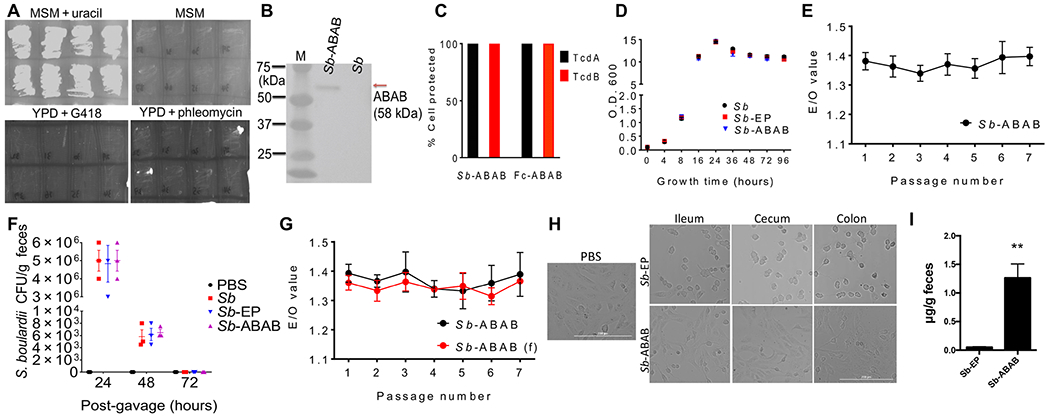
(A) Phenotype of the S. boulardii uracil auxotroph on MSM containing uracil and YPD media containing G418. (B) ABAB antibody in Sb-ABAB culture supernatant detected by Western blotting. (C) Toxin-neutralizing activity of Sb-ABAB culture supernatant compared with purified Fc-ABAB. (D) In vitro growth of Sb, Sb-EP, and Sb-ABAB. (E) ABAB expression in Sb-ABAB culture supernatants over multiple passages. (F) Persistence of Sb, Sb-EP, and Sb-ABAB in antibiotic cocktail–treated mice. (G) ABAB expression in Sb-ABAB culture supernatants over multiple passages in vitro for yeast recovered from fecal (f) samples in (F) versus nonpassaged strains from frozen master stocks. (H) Neutralizing activity of intestinal lavages from mice treated with Sb-EP and Sb-ABAB. (I) ABAB expression in feces from mice treated with Sb-EP and Sb-ABAB. **P < 0.01. Experimental data from in vivo studies represent one of at least three separate experiments with n = 3 mice per group and are presented as means ± SEM.
Fig. 3.
Fig. 3.. Prophylactic efficacy of Sb-ABAB against CDI in mice.
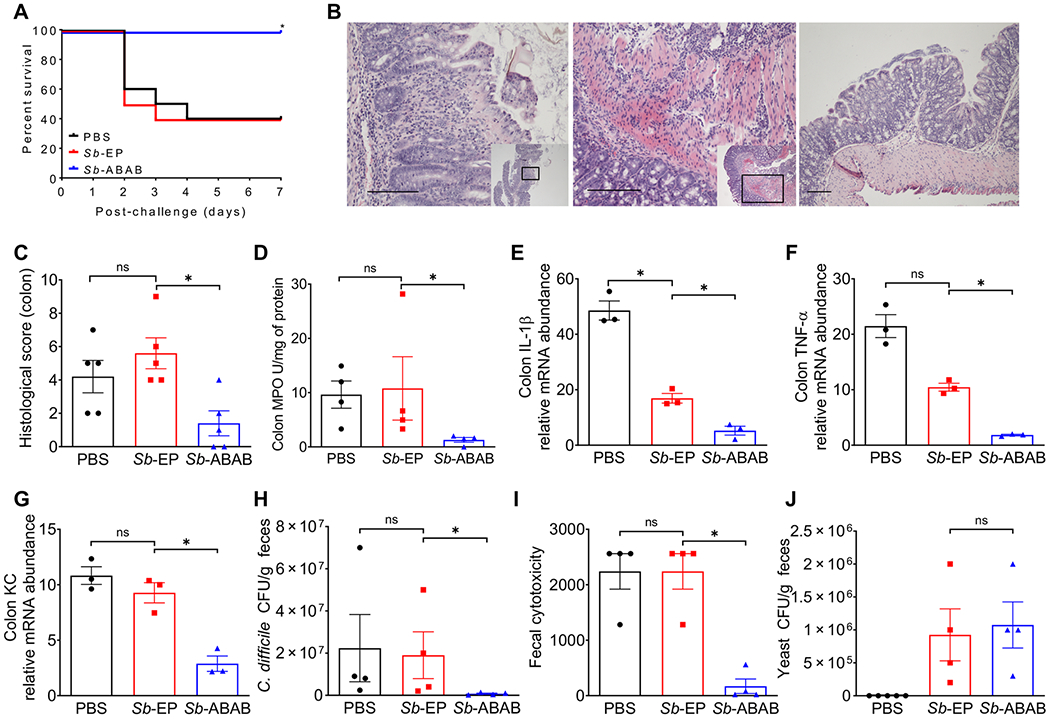
Antibiotic cocktail–treated mice were given Sb-ABAB 3 days before C. difficile spore challenge. (A) Kaplan-Meier survival curves of mice treated with Sb-ABAB compared with controls treated with Sb-EP or PBS. (B) Hematoxylin and eosin (H&E)–stained colonic tissue sections. The insets show where in the tissue the magnified section is located. Left to right: Crypt loss in a representative section from the PBS-treated group (200×), neutrophil infiltration into serosa in a representative section from the Sb-EP–treated group (200×), and a representative tissue sectioning from the Sb-ABAB–treated group (100×). Scale bars, 100 μm. (C) Histological scores for H&E-stained colonic tissue sections. (D) Myeloperoxidase (MPO) assay as a measure of neutrophil infiltration. (E to G) mRNA expression of proinflammatory cytokines interleukin-1β (IL-1β), tumor necrosis factor–α (TNF-α), and cytokine-induced neutrophil-attracting chemokine (KC) in colonic tissues. (H) Fecal C. difficile count from challenged mice. (I) Fecal toxin titers from challenged mice. (J) Fecal S. boulardii CFU counts from prophylactically treated mice. All experimental data in this figure represent one of at least three separate experiments with 10 mice per group (A) or 4 mice per group (C to J) and are presented as means ± SEM. Statistical analysis was performed by comparing the indicated groups using a log-rank (Mantel-Cox) test (A) or a two-tailed Mann-Whitney test (C to J). *P < 0.05; ns, not significant.
Fig. 4.
Fig. 4.. Therapeutic efficacy of Sb-ABAB against primary and recurrent CDI in mice.
(A to C) Primary CDI model: After C. difficile spore challenge, mice were orally dosed daily with yeast for 4 days. (D to F) Recurrent CDI model; mice were concurrently given vancomycin and yeast 1 day after C. difficile spore challenge. (A and D) Kaplan-Meier survival curves of mice treated with Sb-ABAB compared with controls treated with Sb-EP or PBS. (B and E) Relative weight change and (C and F) percentage of mice that experienced diarrhea after spore challenge. The experiment was repeated twice with n = 10 mice per group. Data are presented as means ± SEM. Statistical analysis was performed by comparing the indicated groups using Fisher’s exact test (A and D) or two-way ANOVA (B, C, E, and F). *P < 0.05, ***P < 0.001, and ****P < 0.0001.

References

    1. Kelly CP, LaMont JT, Clostridium difficile—More difficult than ever. N. Engl. J. Med 359, 1932–1940 (2008). - PubMed
    1. McDonald LC, Owings M, Jernigan DB, Clostridium difficile infection in patients discharged from US short-stay hospitals, 1996-2003. Emerg. Infect. Dis 12, 409–415 (2006). - PMC - PubMed
    1. Lessa FC, Mu Y, Bamberg WM, Beldavs ZG, Dumyati GK, Dunn JR, Farley MM, Holzbauer SM, Meek JI, Phipps EC, Wilson LE, Winston LG, Cohen JA, Limbago BM, Fridkin SK, Gerding DN, McDonald LC, Burden of Clostridium difficile infection in the United States. N. Engl. J. Med 372, 825–834 (2015). - PMC - PubMed
    1. Lessa FC, Winston LG, McDonald LC; Emerging Infections Program C difficile Surveillance Team, Burden of Clostridium difficile infection in the United States. N. Engl. J. Med 372, 2369–2370 (2015). - PMC - PubMed
    1. Kelly CP, Can we identify patients at high risk of recurrent Clostridium difficile infection? Clin. Microbiol. Infect 18 (suppl. 6), 21–27 (2012). - PubMed

Publication types

LinkOut - more resources